OWN THE FUTURE · SEASON 1 · TECHNOLOGICAL BREAKTHROUGH
What is a quantum computer? Counted in quantum bits and errors
Quantum computers calculate with quantum bits, which follow the rules of quantum physics. We explain what they do today, what they do not do and what has actually been measured and published.
Published 9 Sep 2026 · About 9 minutes to read
That far, everyone agrees on what a quantum computer is. Then the texts part ways, and most of them are about the future, about what the machines will solve and when.
This article does the opposite. It explains what a quantum bit is and why it differs from an ordinary bit, and then counts only what has been measured and published. That goes further than you might think.
Bit and quantum bit
A bit is a switch with two positions, zero or one. An ordinary computer is billions of such switches being turned off and on in a set order.6 Each switch is in one position at a time, and you can always check which.
A quantum bit follows other rules. Until it is measured, it can be in a superposition of the two positions, a weighted combination of zero and one.6 Only when it is measured does it fall to zero or one. The popular phrase that a quantum bit "is zero and one at the same time" is a simplification of this.6 The quantum bit can be in a superposition until it is read, and the superposition can be calculated with.
The second property is entanglement. Two quantum bits can be linked so that they behave as a single unit even when they are apart: what happens to one decides what happens to the other.5 This is the experiment that won the 2022 Nobel Prize in Physics, described further down, so it is not a metaphor.5
Together, the two properties mean that a quantum computer can keep many possibilities open at once and let them affect each other before the answer is read.6 For some kinds of problem, that is a completely different route to the answer than trying one possibility at a time.
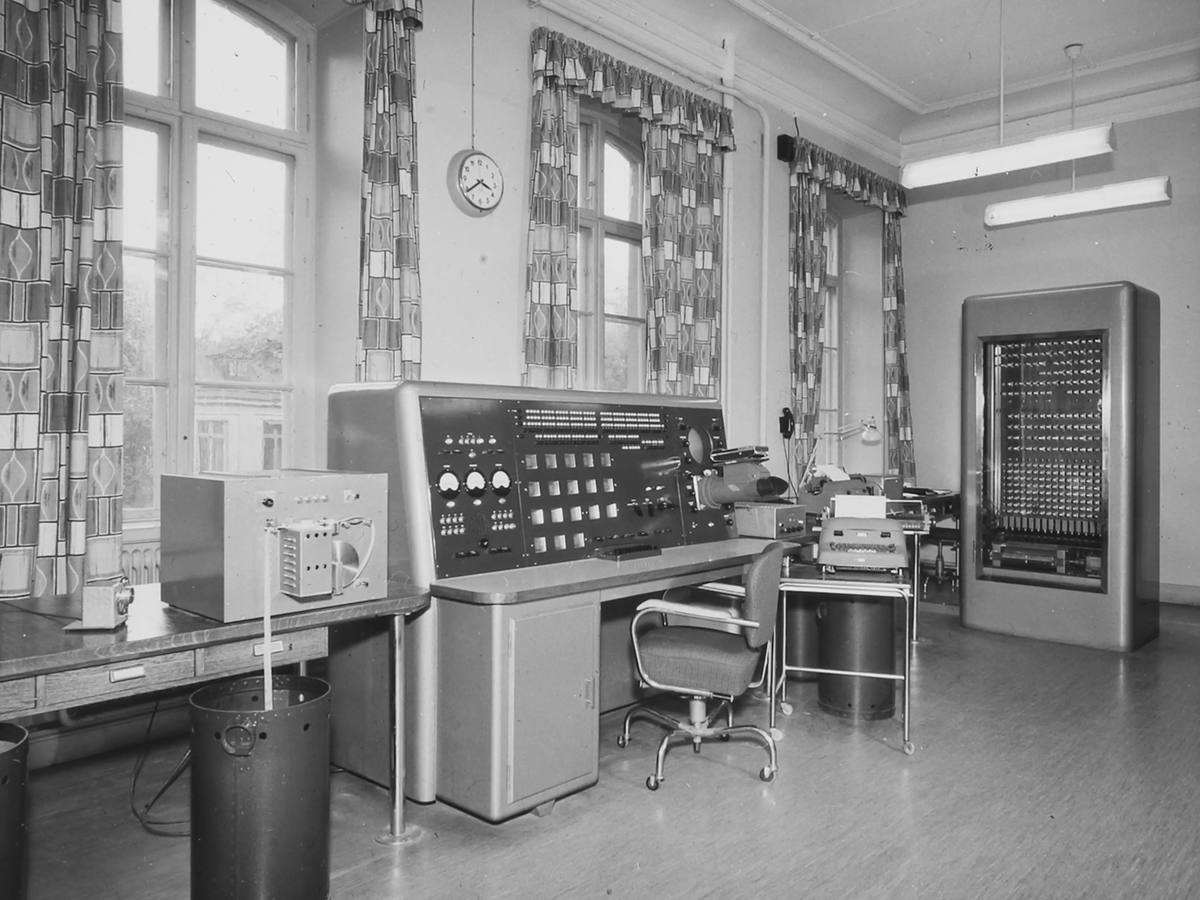
Why it is not a faster ordinary computer
The most common misunderstanding is that a quantum computer is an ordinary computer that calculates faster. It is not. It calculates in a different way, and that way suits some problems and is useless for others. Writing an email, showing a film or adding up a column are tasks a quantum computer does not do better, and in practice does not do at all.
That also explains why the comparisons in the headlines look the way they do. When it says a calculation "would take a supercomputer X years", that is a result from one particular problem, chosen because the quantum machine is good at exactly that. Such figures say something about that problem and nothing about general performance. The rule for anyone reading them is simple: ask who measured, which problem was measured, and whether the problem was chosen for the purpose.6 If any of the three answers is missing, the figure is worth no more than a headline. This article uses no such figures.
Sweden's quantum computer, counted
Sweden is building its own quantum computer. The project has been running at Chalmers University of Technology since 2018, within the Wallenberg Centre for Quantum Technology, WACQT, a twelve-year programme funded mostly by the Knut and Alice Wallenberg Foundation, with four main areas: quantum computers, quantum simulators, quantum communication and quantum sensors.1
According to the university's own account in January 2023, when the testbed was presented, the machine had reached 25 quantum bits.1, 7 The project's goal for 2029 is 100 quantum bits.1, 7 That is a goal the project has set for itself, and it is given here as a goal, not as a statement about what will happen. The number of quantum bits is also the figure in this article that ages fastest; it is checked against the university's own account shortly before publication.
quantum bits was what the Swedish quantum computer at Chalmers had, according to the university's own account in January 2023, when the testbed was presented. The project's goal for 2029 is 100.
Source: Chalmers University of Technology, news item 23 Jan 2023 on the WACQT testbedQuantum computers that can be reached over the internet already exist in several places. What the university itself points to as the difference is that the testbed will be cheaper for Swedish users and that it shows openly what is inside the machine, so that the algorithm can be adapted to the hardware.1 The reason a copy is being built is that the original machine is very rarely free, because the researchers keep rebuilding it.1 The Knut and Alice Wallenberg Foundation has, in a first stage, granted the testbed 102 million kronor.1 Besides the computer, the testbed includes a support unit and test equipment for developing components.1, 8 The plan in January 2023 was for the test equipment to be in place during 2024 and for the quantum computer for running algorithms to open in 2025 with 25 quantum bits, with an upgrade to 40 after a couple of years.1, 8
One more thing from the university's description deserves a mention, because it says something about what a quantum computer is physically. The machine is cooled by a unit in several stages, and the university shows two of its researchers opening the unit's final stage.1
The error is the whole problem
Why quantum bits make errors
The Swedish machine's quantum bits are counted in tens.1, 7 The reason is that they make errors. A quantum bit loses its superposition after a short while, and every operation on it risks disturbing it.6 That is not a teething problem waiting for better components; it is a property of what quantum bits are.
The solution, proposed as early as 1995, is called quantum error correction: many physical quantum bits are combined into a single logical quantum bit, and the errors of the logical one fall as more physical ones are added.2, 9 But it only works if the physical quantum bits already make few enough errors, below a critical threshold.2 For almost thirty years nobody had shown a machine that was below the threshold.2, 3
What the study in Nature showed
On 9 December 2024 a research team published a result in the journal Nature that did so.2 On a superconducting processor with 105 quantum bits, they built one logical quantum bit from 101 physical ones.2 Each time they increased the size of the code by two steps, the logical error rate fell by a factor of 2.14, with an uncertainty of 0.02.2 The largest code gave 0.143% errors per error correction cycle, with an uncertainty of 0.003.2
The most important figure is perhaps the simplest. The logical quantum bit held its state for 291 microseconds, with an uncertainty of 6.2 The best physical quantum bit on the same processor held for 119, and the median was 85.2 So the combined quantum bit was better than its best component, by a factor of 2.4 with an uncertainty of 0.3.2 It is the first time this has been shown for a code of this kind.2, 3 What people have been waiting for for almost thirty years is the second thing the same study shows: that a machine is below the threshold.2, 3
How far there is still to go
The rest of the study is about how far there is still to go, and the researchers say so themselves. The decoder that works out which errors have occurred ran in real time with an average delay of 63 microseconds in the smaller of the study's two codes, against a cycle time of 1.1 microseconds.2 In the study's repetition codes, run on a smaller processor, rare errors that hit many quantum bits at once occurred about once an hour, that is, once every three billion cycles.2 According to the authors, their cause is not yet understood. The study states that the performance, if scaled up, could meet the requirements for large-scale error-corrected algorithms.2 The condition "if scaled up" is the authors' own. The research group's own commentary on the study also says that at current error levels more than a thousand physical quantum bits per code grid may be needed to reach a logical error rate of one in a million, and that the engineering challenge ahead is enormous.3
physical quantum bits were needed to build a single logical quantum bit in the code that gave 0.143% errors per cycle. The researchers themselves write that more than a thousand per logical quantum bit may be needed to reach one in a million.
Source: Nature 638, 2025, and the research group's own commentary on the studyPut the two figures side by side. Chalmers reported 25 quantum bits in January 2023, and a single error-corrected quantum bit of that kind required 101 physical ones in the study from December 2024.1, 2 That is the distance between what exists and what is written about.
What the 2022 Nobel Prize rewarded
Everything above rests on entanglement being real and not a mathematical convenience. That was settled in experiments that won the 2022 Nobel Prize in Physics, awarded to Alain Aspect, John F. Clauser and Anton Zeilinger "for experiments with entangled photons, establishing the violation of Bell inequalities and pioneering quantum information science".5 The prize was announced by the Royal Swedish Academy of Sciences on 4 October 2022 and was shared equally between the three.5
The background is a question the founders of quantum mechanics argued about: can the strange connections be explained by the particles carrying hidden information from the start, so-called hidden variables?13 In the 1960s John Stewart Bell showed that the question can be settled by measurement.5, 13 If there are local hidden variables, the correlation between a large number of measurement results can never exceed a certain value.12, 13 Clauser turned the idea into an experiment, and the measurements clearly broke Bell's limit.5, 12 Aspect developed the set-up and closed an important loophole, by switching the measurement settings after the pair had left its source.5, 12 Zeilinger's group demonstrated quantum teleportation, which moves a quantum state from one particle to another at a distance.5
The conclusion is that quantum mechanics cannot be replaced by a theory with local hidden variables.12, 13 Entanglement is real. The Academy stresses that there is now a large field of research covering quantum computers, quantum networks and secure quantum-encrypted communication, among other things.5 That is the foundation of the field, established in experiments, and that is as far as this article follows it.
What a quantum computer does not do today
It does not break today's encryption.6 What has happened is more concrete. The standards body NIST has published new encryption standards that it describes as designed to withstand attacks from quantum computers.4, 10 That a standard has been developed with that starting point is a fact that has happened. When or whether a quantum computer breaks today's methods is not, and it is not stated here.
Nor does it solve any practical problem for you today. What has been measured and published is a logical quantum bit that lasts longer than its parts, and a Swedish machine with 25 quantum bits that companies will be able to try.1, 2 The result on the logical quantum bit was published on 9 December 2024. The figure of 25 quantum bits for the Swedish machine comes from Chalmers' account of 23 January 2023.1 The two describe different machines.
What to take away
A quantum computer calculates in a different way from an ordinary computer, not faster at everything.6 Chalmers' machine had 25 quantum bits in January 2023, and in the study from December 2024 it took 101 physical quantum bits to make a single logical one, which held for 291 microseconds against 119 for the best physical one.1, 2 What makes this work that spans decades is that error correction is the problem itself. The researchers write that more than a thousand physical quantum bits per logical one may be needed to reach an error level they themselves call modest.2, 3 Follow Chalmers' own account of the number of quantum bits against the goal of 100 by 2029, the opening of the testbed to companies, and the NIST standards, where a fifth algorithm was chosen in March 2025.1, 7, 11
Education, not advice.
The fund
Behind the library stands a fund.
Own The Future is published by AIX. The library is the knowledge; AIX Dynamic is the tool, a systematic securities fund (UCITS) that follows the trend and steps aside when risk rises.
This is marketing. Fund units can both rise and fall in value. Read the key information document (KID) and the prospectus before you invest; you will find them on the fund's page at Avanza.
34 UNITHOLDERS · AS OF 15 SEP 2026The future in your inbox.
The most important things from each area, without the noise and without the hype.
Sources
- Chalmers University of Technology (Chalmers tekniska högskola), Ny svensk kvantdator blir tillgänglig för industrin (New Swedish quantum computer becomes available to industry), news item 23 Jan 2023, and the project entry for the WACQT testbed. The project's start in 2018, the number of quantum bits, the 2029 goal, the testbed, the funding, the timetable, the cooling unit, and WACQT's four main areas.
- Google Quantum AI and Collaborators, Quantum error correction below the surface code threshold, Nature 638, pages 920 to 926, 2025, published online 9 Dec 2024. Logical quantum bit from 101 physical ones, error rate, lifetimes, decoder, correlated errors, the condition about scaling.
- The same research group's own commentary on the study, Making quantum error correction work, published on the research blog research.google/blog. The goal since the 1990s and the estimate of more than a thousand physical quantum bits per code grid.
- NIST, NIST Releases First 3 Finalized Post-Quantum Encryption Standards, 13 Aug 2024. The standards are described as designed to withstand attacks from quantum computers.
- Royal Swedish Academy of Sciences (Kungliga Vetenskapsakademien), press release on the Nobel Prize in Physics 2022, 4 Oct 2022. The laureates, the citation, Bell's inequality, the experiments, that the prize was shared equally, and the Academy's description of the field of research.
- Chalmers University of Technology (Chalmers tekniska högskola), Wallenberg Centre for Quantum Technology, Kvantdatorer (Quantum computers), published 17 Mar 2023, updated 4 Dec 2023. That a quantum bit can carry two values at once through superposition, that the number of possible simultaneous states doubles with each added quantum bit, that superpositions collapse when disturbed, that the number of quantum bits on its own says very little about a quantum computer's performance, and that thousands of well-functioning quantum bits are needed to break today's encryption codes.
- Chalmers University of Technology (Chalmers tekniska högskola), Majmöte 2025 (May meeting 2025), news item 16 May 2025. The core project's goal of a quantum computer with 100 quantum bits, that in May 2025 the 25-quantum-bit chip was still on its way into the testbed, and that the testbed is run by Chalmers Next Labs.
- Chalmers University of Technology (Chalmers tekniska högskola), WACQT Quantum Technology Testbed, published 24 Oct 2024, updated 12 Nov 2025. What the testbed contains, that is, hardware labs, its own quantum processor, the support unit and cloud access, and that its own quantum computer is said to be about to open during 2025.
- Shor, Scheme for reducing decoherence in quantum computer memory, Physical Review A 52, pages R2493 to R2496, 1 Oct 1995. The year 1995 and the proposal to encode one logical quantum bit in several physical ones.
- NIST, FIPS 203, Module-Lattice-Based Key-Encapsulation Mechanism Standard, 13 Aug 2024. That the standard is approved as an alternative that is currently judged secure even against an adversary with a large-scale fault-tolerant quantum computer, and that the standardisation process started in 2016 with 82 submitted algorithms.
- NIST, NIST Selects HQC as Fifth Algorithm for Post-Quantum Encryption, 11 Mar 2025. That a fifth algorithm was chosen in March 2025, so the number three in the headline of the earlier press release no longer describes the whole set.
- Royal Swedish Academy of Sciences (Kungl. Vetenskapsakademien), Så blev sammanflätning ett kraftfullt verktyg (How entanglement became a powerful tool), popular science information on the Nobel Prize in Physics 2022 (PDF). The term local hidden variables, the EPR argument from 1935, Bell's inequality, Clauser's experiment with Freedman in 1972, Aspect's switching of the filter setting after the pair had left the source, and the conclusion that there are no hidden variables.
- Royal Swedish Academy of Sciences (Kungl. Vetenskapsakademien), Nobel Committee for Physics, Scientific Background on the Nobel Prize in Physics 2022, 4 Oct 2022 (PDF). That Bell showed in 1964 that no theory built on local hidden variables can reproduce the results of quantum mechanics, and that the founders of quantum mechanics held strongly opposing views on the question.
- Swedish National Museum of Science and Technology (Tekniska museet), Datorhistoria (Computer history). That BESK was completed in 1953 and that vacuum tubes were the step after relay technology in the first computers.
Sources read on 6 and 7 Sep 2026, links checked on 8 Sep 2026. The number of quantum bits in the Swedish machine is checked against the university's own account shortly before publication.
Extended on 14 Sep 2026 with the university's own description of quantum computers and of the testbed, the latest account of the quantum bit figure from May 2025, the original 1995 article behind quantum error correction, the encryption standard itself behind the press release, the news of a fifth algorithm from March 2025, the Academy's popular science and scientific background to the 2022 physics prize, and the museum's computer history. The year 1995 is in the original article and not in the research group's commentary, which says the 1990s and almost thirty years. The term local hidden variables is in the Academy's background texts and not in the press release, which says hidden variables. The quantum bit figure of 25 is unchanged in the university's account from May 2025.