OWN THE FUTURE · 01 OF 05
Technological Breakthrough
Computing power, automation and security: the technologies that push the limit of what economies can do.
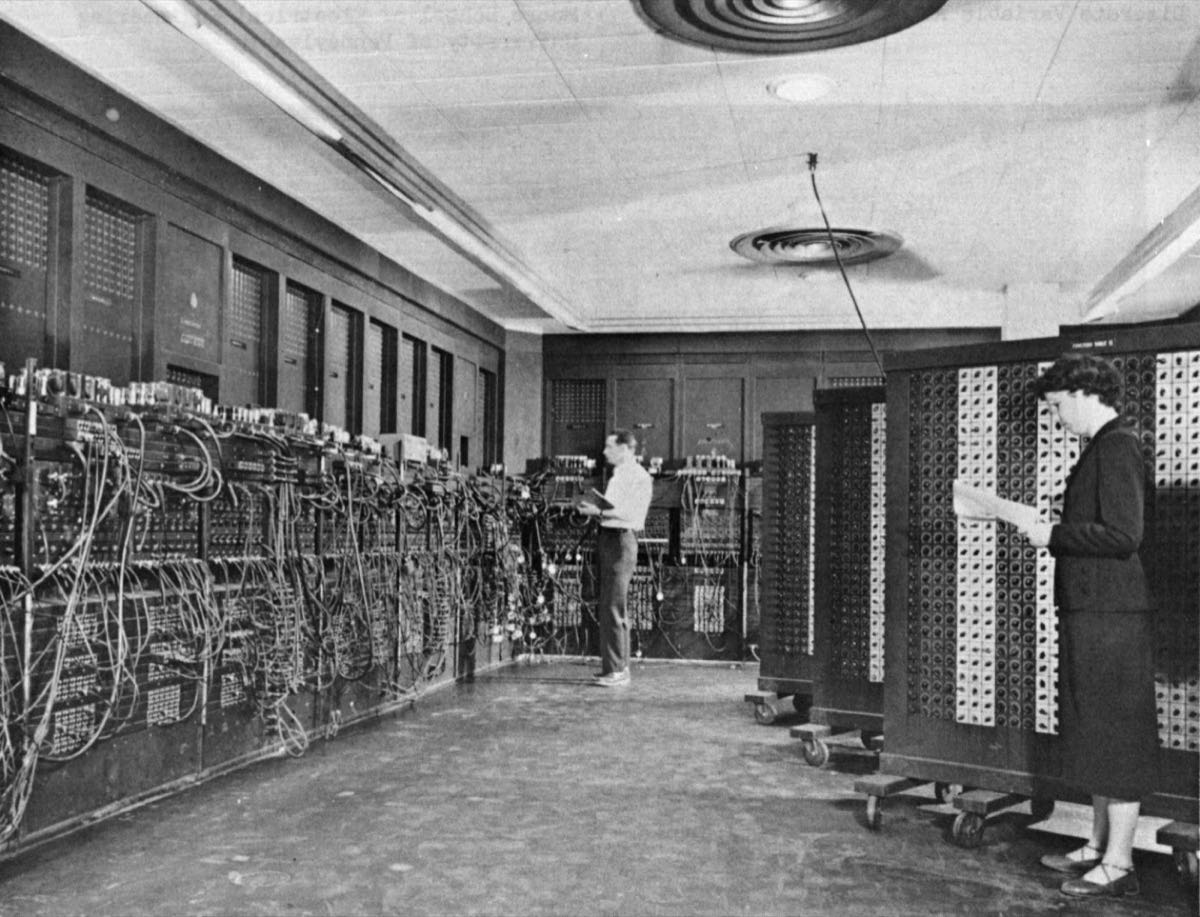
The shift
ENIAC, 1946: thirty tonnes, and slower than your wristwatch.
Eighty years later, more computing power fits in a thimble, at a fraction of the price. That is the pattern of technology: exponential, not linear.
Photograph: ENIAC, U.S. Army, 1946. Public domain.
Season 1 · Introduction
What are technological breakthroughs?
In 2005, 15.6 in every 100 people in the world counted as internet users. In 2025 the figure is 73.6 in 100, almost three in four people on Earth. The figures come from the World Bank's statistics database, whose original source is the International Telecommunication Union (ITU), the UN agency for telecommunications. It is the same measure, measured the same way, just twenty years later.
The rise did not come in a single step. It came year by year, twenty years in a row, and the curve still points upwards. A large part of the explanation fits in your pocket: the mobile phone. A phone is in practice a small computer, and it has become both cheaper and more common.
The area of technological breakthroughs is about exactly that pattern, not only about the internet. Technology that grows much faster than most people expect, until one day it is an ordinary part of everyday life for billions of people. The five themes here, AI, Robotics, Cybersecurity, Semiconductors (the chips found in almost all electronics) and Quantum, solve different problems but share a common engine underneath.
The engine can be explained in everyday language. A chip that becomes cheaper to make makes computers cheaper. Cheaper computers make it possible to build more, from mobile networks to cloud services (computing power that sits somewhere else and is rented over the internet, instead of standing in each person's home). More people then get access to the tools, which makes it profitable to build the next generation of chips, which become cheaper still. That loop is a large part of the reason the share of internet users went from 15.6% to 73.6% in twenty years.
A technology that feels marginal one year can be taken for granted ten years later.
This area gathers facts about the technologies that have already changed how economies work. Each article is built on figures from organisations that measure the trend year by year, not on guesses about what comes next. Here you get the basics explained with no prior knowledge needed, before you move on to each of the five themes.
Education, not advice.
The library
Five episodes.
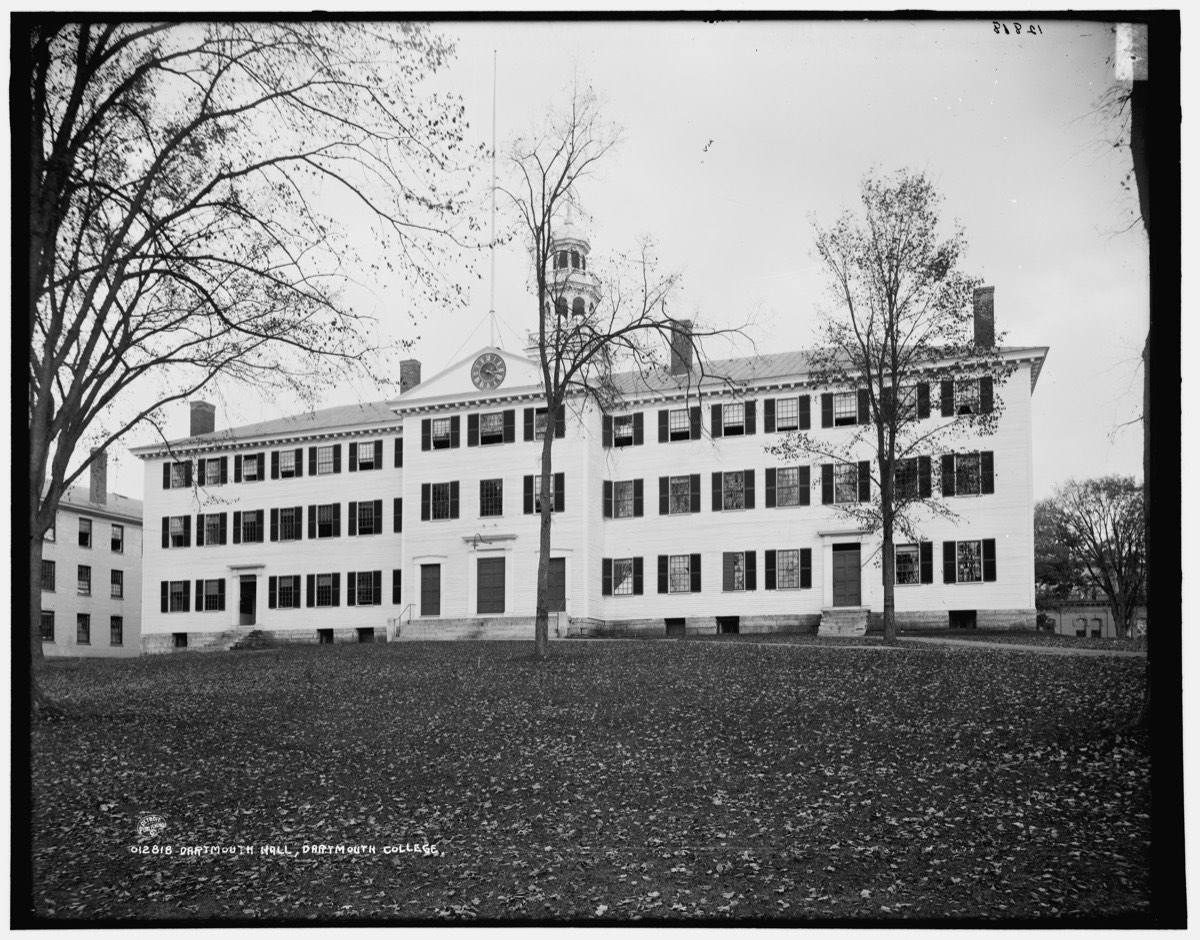
Caption and source
Dartmouth College, Hanover, New Hampshire, around 1900. In the summer of 1956 this was where the study took place that is usually seen as the starting point of AI as a field of research. Photograph: Detroit Publishing Co., Library of Congress. Public domain.
AI
Artificial intelligence is computer programs that work out their own answers, usually by learning patterns from examples. Here we explain what the technology does today, where it is used and what the words mean.
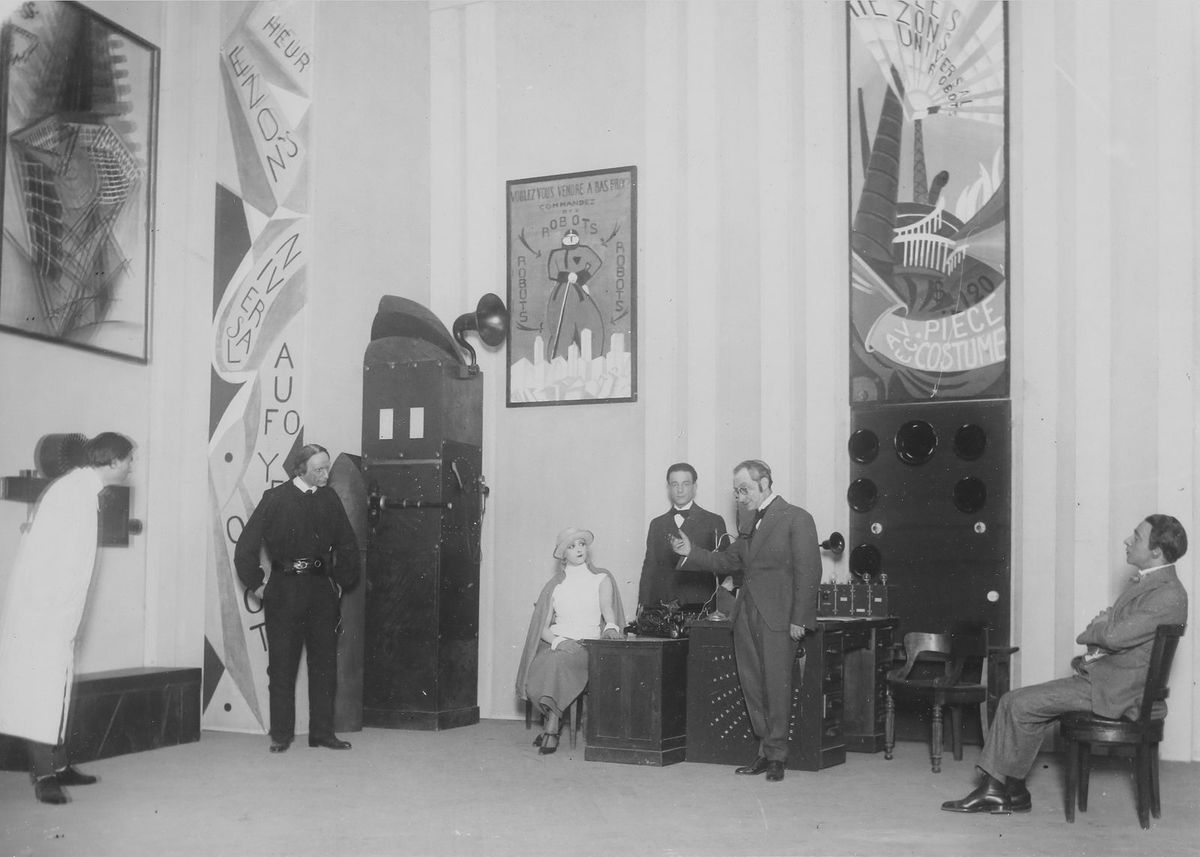
Caption and source
The production of R.U.R. at the Comédie des Champs-Élysées in Paris in 1924. The poster on the wall reads "Voulez-vous vendre à bas prix? Commandez des robots", roughly: want to sell cheaply? Order robots. Photograph: Henri Manuel, 1924. Public domain.
Robotics
A robot is a machine that senses its surroundings and carries out tasks without anyone controlling every movement. We look at where robots work today and what sets them apart from ordinary machines.
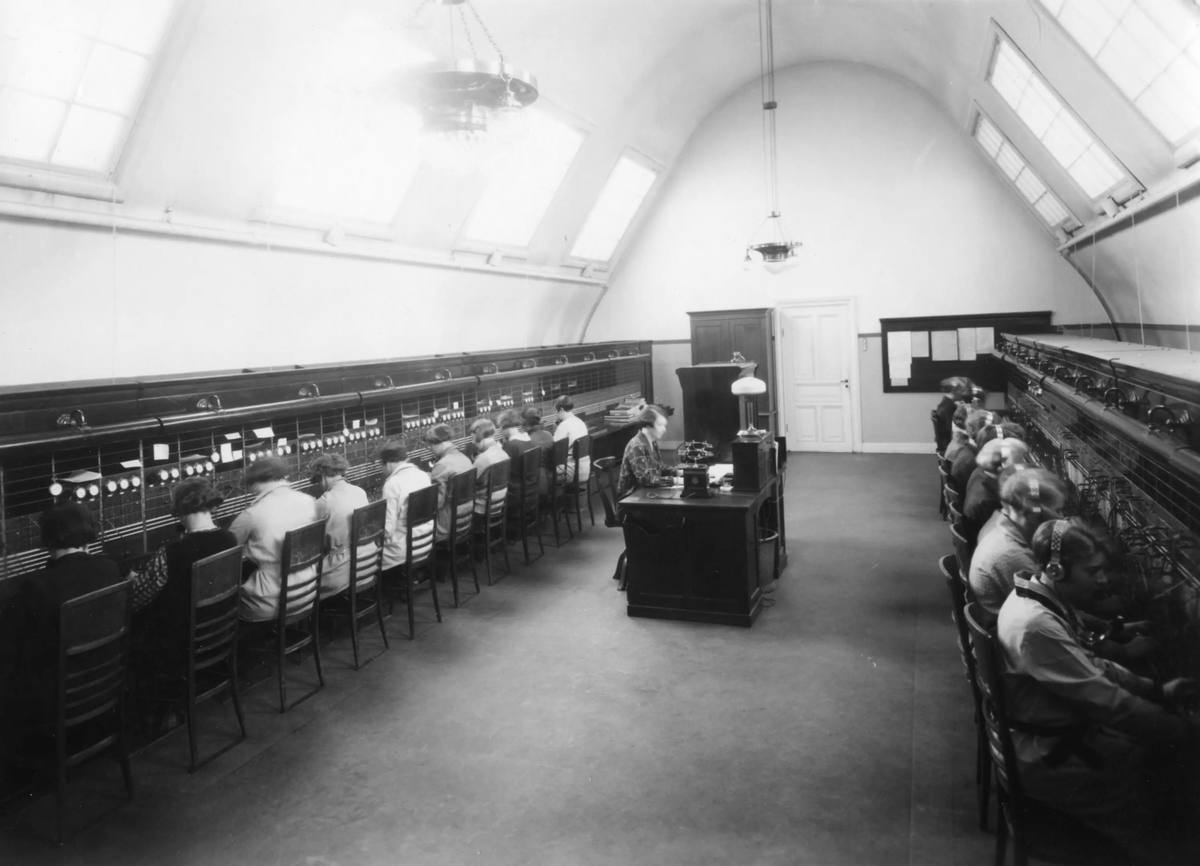
Caption and source
Telephone operators at the telephone exchange in Kalmar in the early 1930s. Every call was connected by hand, through people and cords. Photograph: Walter Olson. Kalmar County Museum, KLMF.E00658. Public domain.
Cybersecurity
Cybersecurity means that only the right people can read, that nobody changes anything without permission, and that systems work when they are needed. We explain what counts as an incident and how incidents are counted in Sweden.
Caption and source
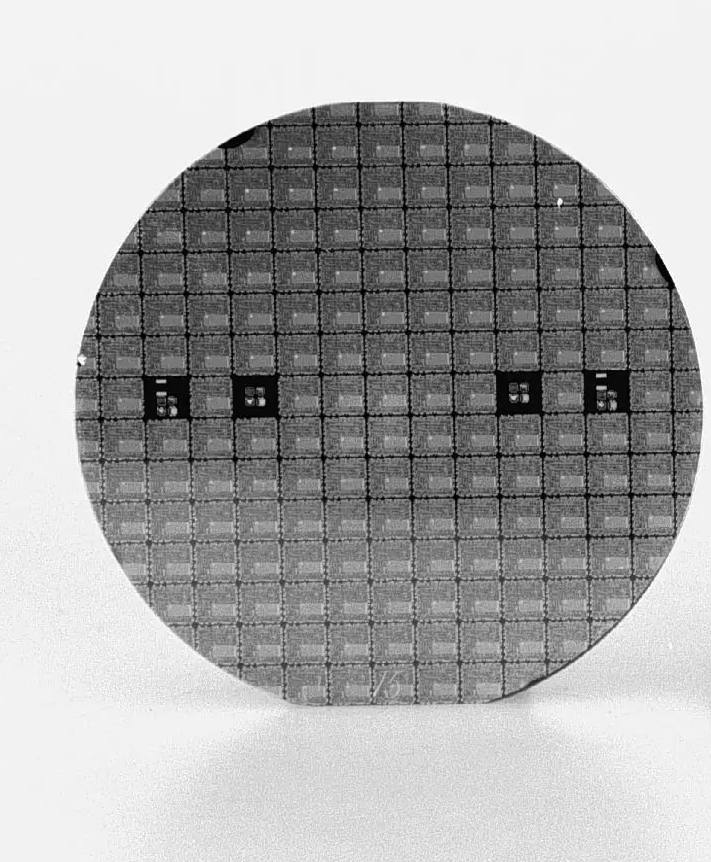
Silicon wafer for semiconductor manufacturing, three-inch process, 76 millimetres in diameter and 0.4 millimetres thick, with circuit patterns and four test squares. The object is undated in the museum's record and the photographer is given as unknown. Photograph: Swedish National Museum of Science and Technology (Tekniska museet), TEKS0043126, via DigitaltMuseum. Licence: CC BY 4.0. Greyscale. Cropped, with the museum's number tag and scale bar outside the frame.
Semiconductors
Semiconductors are the material, usually silicon, that the chips in phones, cars and washing machines are made from. We explain how a chip is made, why it is so hard and what Moore's law really says.
Caption and source
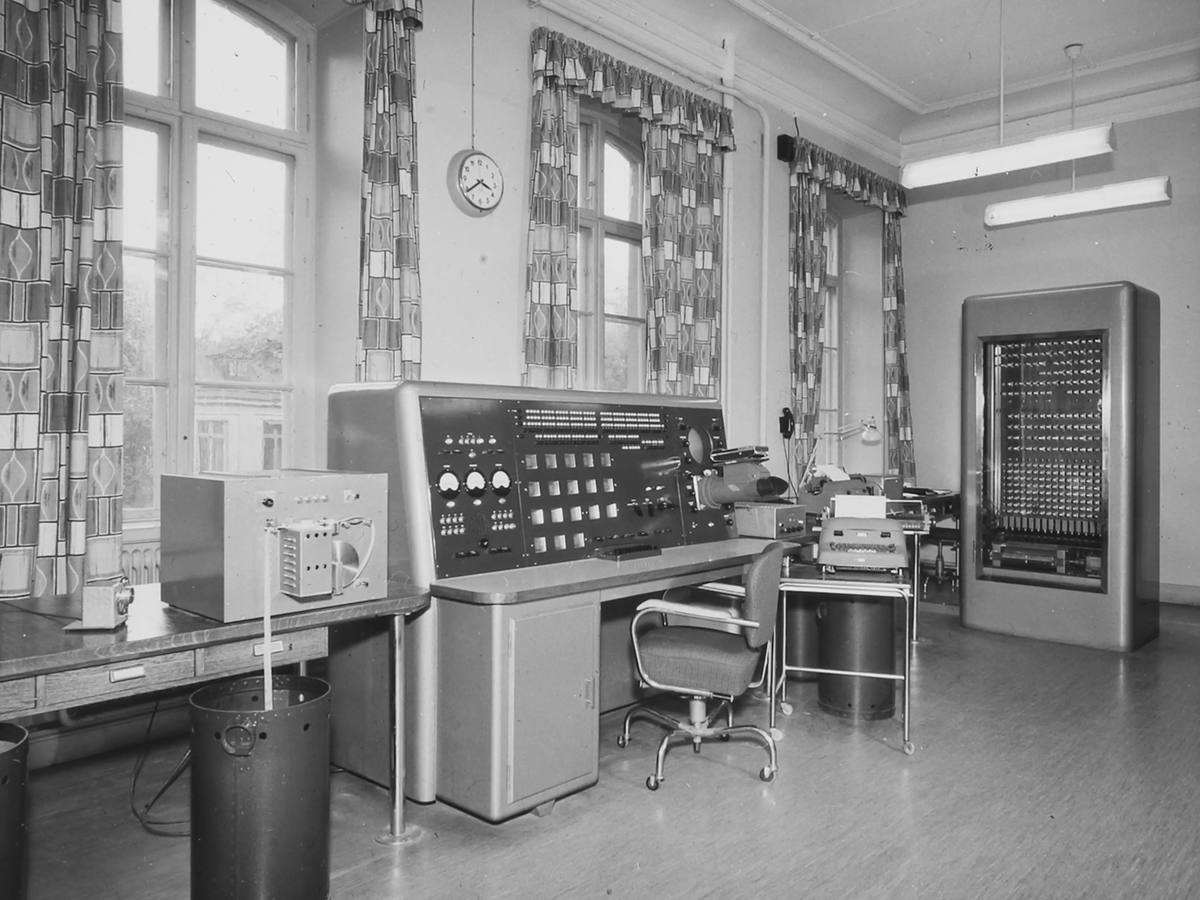
The control desk of BESK, the second Swedish computer and the first Swedish-built one to calculate with vacuum tubes, completed in 1953 at the Swedish Board for Computing Machinery (Matematikmaskinnämnden) together with KTH in Stockholm. The working memory sat in 40 cathode-ray tubes with 512 bits in each, and the machine filled a room. Photograph: unknown photographer, Swedish National Museum of Science and Technology (Tekniska museet), TEKA0104968. Public domain. Cropped.
Quantum
Quantum computers calculate with quantum bits, which follow the rules of quantum physics. We explain what they do today, what they do not do and why so many researchers work on them.
What is a quantum computer? Counted in quantum bits and errors
One article per episode. Subscribe and you will get each new article straight away.
The future in your inbox.
The most important things from each area, without the noise and without the hype.