OWN THE FUTURE · SEASON 1 · TECHNOLOGICAL BREAKTHROUGH
What is a robot? Explained from the ground up
A robot is a machine that senses its surroundings and carries out tasks without anyone controlling every movement. We look at where robots work today and what sets them apart from ordinary machines.
Published 4 Sep 2026 · About 10 minutes to read
Most people have seen a robot. Perhaps a robot vacuum cleaner moving around the floor. Perhaps a robot lawnmower at a neighbour's. Perhaps a robot arm in a film about a car factory.
And yet the question of what a robot is is hard to answer. Is the vacuum cleaner a robot? Is a remote-controlled toy car a robot? Is the washing machine a robot?
The answer has been written down. There is even an international standard for it, and it is surprisingly easy to read once it has been translated. We start there.
The word is a hundred years old and comes from a play
The word robot comes from a play, not from the technology.
In 1920 the Czech writer Karel Čapek published the play R.U.R., "Rossum's Universal Robots".31 It opened on 2 January 1921.31 In the play, artificial workers are made in a factory, and they are called robots. As far as is known, it is the first time the word is used in anything like today's meaning.30
Čapek himself said he did not invent the word.30 He explained in a letter, and later in a newspaper article, that it was his brother Josef who suggested it.30 Karel had planned to call the figures "laboři", after the Latin word for work.30 He did not like the word and asked his brother.
The word robota means work in Slavic languages.2 More exactly, it means heavy, monotonous and forced labour.2 In the past it referred to the days of the week when peasants had to leave their own farm and work unpaid on the landowner's land.
One detail in the play is worth noting. The robots in it were not robots by today's definition. They were not machines. They were artificial living beings of some kind of flesh and blood.30 Today we would call them androids. So the word robot meant something different on the day it was invented from what it means now.
The play was a hit, and the word spread. It pushed out older words such as "automaton" and "android" in languages all over the world.
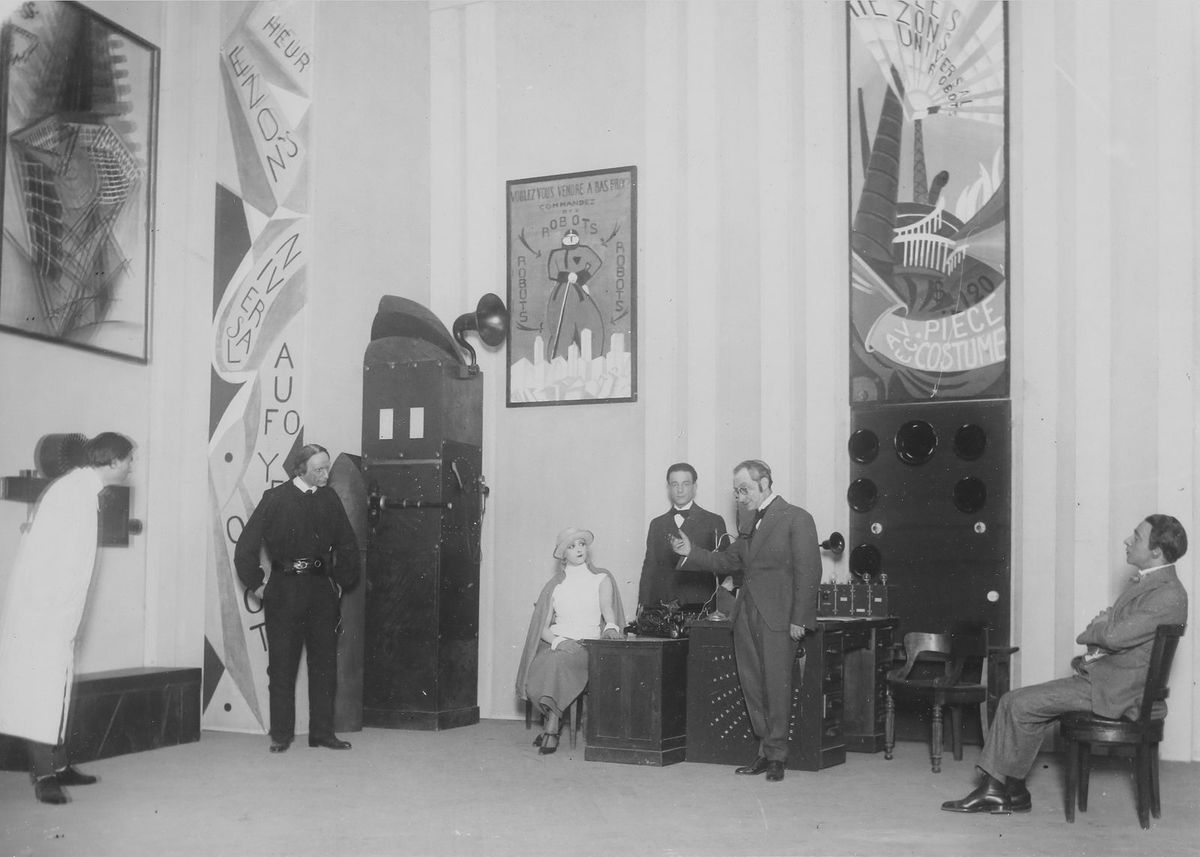
What counts as a robot: the formal definition, in plain words
There is an international standard that sets out what the words in robotics mean. It is called ISO 8373. A standard is a document that experts from many countries have agreed on, so that everyone means the same thing when they say the same word. The first version came in 1994 and the one in force now came in 2021.20, 21
Four words that decide
The standard says that a robot is a programmed, actuated mechanism with a degree of autonomy, which performs locomotion, manipulation or positioning.5, 20
It sounds dry. We will take it word by word.
Programmed means that someone has told it what to do.
Actuated means that it has motors or something else that makes it move under its own power.
Autonomy is the word that makes all the difference. The standard defines autonomy as the ability to perform its task based on the current state and what it senses, without a human stepping in.20 So the robot reads something and decides its next movement itself.
Locomotion, manipulation or positioning means that it moves itself, moves things, or puts something in the right place.
Schematic sketch of autonomy, the word that decides what counts as a robot. After ISO 8373:2021. Source: ISO, ISO 8373:2021, Robotics, Vocabulary, 2021.
The answers to the questions at the start
Now we can answer the questions from the start.
The robot vacuum cleaner is a robot. It senses where the walls are and decides for itself how to drive.
The remote-controlled toy car is not a robot. It only does what you tell it at the moment you tell it. The car is controlled directly by the user.
The washing machine is not a robot either. It runs a programme you chose. It does not sense your clothes and change its mind.
The standard even has its own term for machines like these that are almost robots: robotic device. These are mechanisms built with robotic technology that do not meet all the properties of a robot. In the older 2012 edition the criterion was stated outright: the mechanism lacked either enough axes of movement or the degree of autonomy.21 A remote-controlled machine ends up there.
autonomy.
The robot reads something and decides its next movement itself. That is the whole difference from a washing machine or a remote-controlled car.
The same machine can be two different things
Here is something that confuses most people, and it is worth understanding properly.
The standard divides robots into industrial robots, service robots and medical robots. But the division is made by what the robot is used for, not by how it is built.20
An industrial robot is defined as an automatically controlled, reprogrammable, multipurpose manipulator, programmable in three or more axes.5, 20 "Manipulator" is the technical term for the part that does the actual work, usually an arm.
The point is that a robot arm welding in a car factory is an industrial robot. An almost identical robot arm putting food on a plate in a restaurant is a service robot.20, 21 Same machine, different answer, because the use is different.
So it is the job that decides what a robot is, not the shape.
The first real industrial robot started work in 1961
The first industrial robot actually put into service on a production line started work in 1961, at a car maker in New Jersey in the United States.6, 7 It was called Unimate.
The inventor George Devol filed the patent application on 10 December 1954.27 The patent was not granted until 13 June 1961, and it was called "Programmed Article Transfer".27
The robot weighed about 1,360 kilograms and could lift up to 45 kilograms.6, 7 Its job was to take newly cast metal parts out of a die-casting machine.6, 7 The parts were red-hot metal.
There is a detail in the story that is easy to miss. The workers did not protest. Standing and picking red-hot metal out of a machine is described in the sources as a job nobody wanted.6, 7 The protests came later, almost ten years afterwards, when a much larger robot installation was put in place at another factory.6
That says something about the whole subject. The question of robots is rarely just yes or no. It is about which job, at what pace and in whose factory.
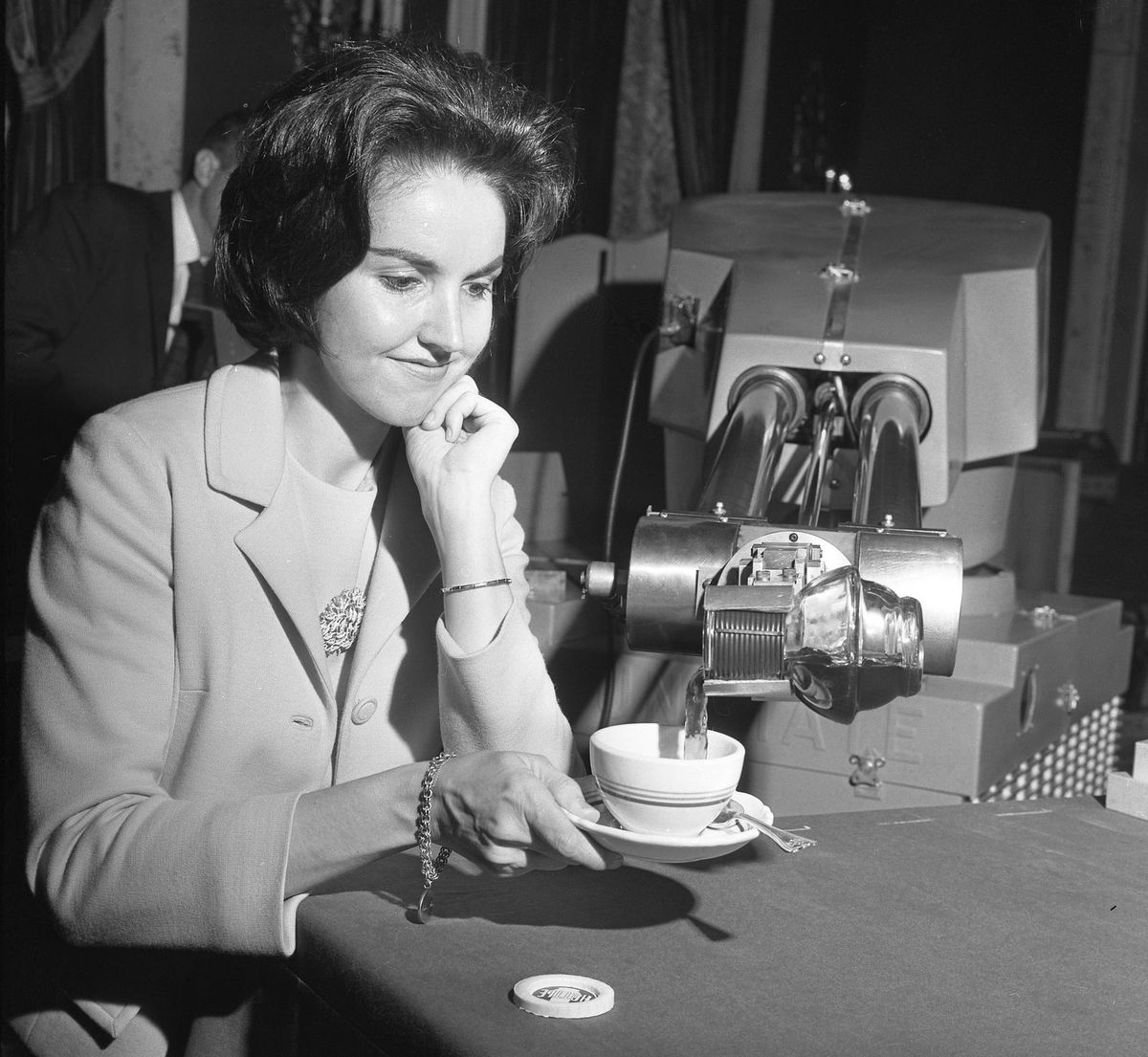
Where robots are sold, and in what volumes
Now to the figures. They refer to 2024 unless otherwise stated, and they come from the International Federation of Robotics, the organisation that collects the world's robot statistics together with the industry associations in different countries.9, 24
In 2024, 542,076 new industrial robots were installed in the world.24 That is the second highest number ever. The record is 552,946 from 2022.24
In total there were about 4.66 million industrial robots in operation in the world in 2024, a rise of 9% in one year.9, 24
74% of all new industrial robots in 2024 were installed in Asia. Europe got 16% and the Americas as a whole 9%.9, 24
The car industry was not the largest in 2024. The electronics industry was the largest with 24% of installations, the car industry came second with 23%, and metal and machinery third with 16%.24 The picture of the robot as a car factory machine was true for a long time, but it is no longer true globally.24
And now the figure that changes the whole perspective. Alongside the industrial robots, nearly 20.1 million service robots for consumer use were sold in 2024.11, 12 Robots for household tasks, in practice floor cleaning and lawn mowing, made up 97% of them.11, 12 Just over 199,000 professional service robots and just under 16,700 medical robots were sold.11, 12
service robots for consumer use were sold in 2024, against 542,076 new industrial robots. The whole stock of industrial robots in operation was 4.66 million.
Source: IFR, World Robotics 2025, Industrial Robots and World Robotics 2025, Service RobotsDo the sums. In one year about 20 million robots were sold to ordinary homes and just over half a million industrial robots to factories. A single year's sales to homes is several times larger than the world's entire stock of industrial robots in operation.12, 24 The figures for home robots come from the 294 suppliers that reported to the IFR and are therefore a minimum.11 The organisation also advises against setting figures from different World Robotics reports against each other, so the comparison above shows orders of magnitude and not exact proportions. The robots sold in the largest numbers do not look the way we have learned robots look.
Sweden is one of the most robot-automated countries in the world
The measure used to compare countries is called robot density. It is the number of industrial robots in operation divided by the number of employees in manufacturing, counted per 10,000 employees.10
Sweden's place in the table
Sweden had 377 robots per 10,000 employees in 2024, which is fifth place in the world.10
Ahead of Sweden are South Korea with 1,220, Singapore with 818, Germany with 449 and Japan with 446.10 After Sweden come Denmark with 329, Slovenia with 315, the United States with 307, Taiwan with 302 and Switzerland with 294.10 China, where more than half of the world's new industrial robots were installed in 2024, is still in 22nd place in the table, after the country's statistics bureau revised its labour market figures.10
The world average was 132 robots per 10,000 employees and the average for the EU's 27 countries was 231.10, 24 The figure 132 comes from the statistics producer's latest table, published in April 2026.10 The same producer's report from September 2025 instead gives 177 for the same year, before China's employment data was revised, and 162 for the year before.24, 25 Sweden is well above both the world average and the EU average.
industrial robots per 10,000 employees in Swedish manufacturing in 2024. Fifth place in the world, well above both the world average of 132 and the EU average of 231.
Source: IFR, robot density 2024 and World Robotics 2025, Industrial RobotsWhy the ratio should be read with care
But read the measure with care, because it is a ratio. Robot density is robots divided by employees. So the figure can go up if industry shrinks, and down if industry grows and hires, without a single robot being moved. You can see it in China's placing. The statistics producer states that the country ends up in 22nd place after the Chinese statistics bureau provided updated labour market data, that is, after a change in the denominator and not in the number of robots.10
Sweden saw this in practice. For the statistics year 2023 the Swedish robotics association reported 1,849 new robot installations, a rise of 13% on the year before, and a stock of 17,436 robots in Swedish industry.13, 14 The same year China moved into third place in the robot density table and pushed down the countries below it, Sweden included.26 More robots, a lower placing. Both facts were true.
Why a robot can weld a car but not fold a towel
Now the most interesting question in the whole subject.
A robot can weld a car with a precision of a tenth of a millimetre, around the clock, for years. The same robot cannot fold a towel. It cannot pick a dishcloth out of a full dish rack. It cannot find the keys in a messy hallway.
This pattern has a name. In 1988 the researcher Hans Moravec wrote that it is comparatively easy to make computers perform at adult level on intelligence tests or at games, and difficult or impossible to give them the skills of a one-year-old in perception and movement.29, 32 Several researchers put forward similar ideas in the 1980s, among them Rodney Brooks and Marvin Minsky.15
Moravec's own explanation is that sight and movement have developed over an immensely long time in animals and humans, and are therefore deeply practised and feel easy to us, while abstract thinking is a recent ability that we are not actually very good at.29, 32
The observation is not undisputed, and that should be said. Allen Newell called the idea a myth as early as 1983.28 The researcher Arvind Narayanan has described it as a statement about what AI research thinks is worth working on, rather than a prediction of what will turn out easy or hard.29
But it still explains something important. That a robot is impressive in a factory says almost nothing about how it copes in a kitchen.
A factory is built to be predictable. The parts arrive in the same place every time, the light is the same, the floor is flat. A home is the opposite. That is why robots came to factories first, and it is why the robots sold to homes do one simple thing: vacuum the floor or cut the grass.
Humanoid robots: what is promise and what is outcome
Robots that look like people get a lot of attention right now, and very large volumes are being talked about for the years ahead.
This is the current situation according to a review in the technical trade press from September 2025: most of the market is still hypothetical.16 The most successful companies have deployed a small number of robots in carefully controlled trials.16 The obstacles pointed out are demand, battery life, reliability and safety.16
A few figures from the same review make the problem concrete. Industrial customers often expect 99.99% reliability, because a stop on a production line can cost tens of thousands of dollars a minute.16 At 99%, according to the review's own worked example, that means about five hours of downtime a month.16 The difference between 99 and 99.99 is the difference between a demonstration and a job.
The same review also points out something simpler. In the short and medium term, robots with arms and wheels instead of legs are more reliable, more energy efficient and cheaper for exactly the settings shown in the demonstration videos.16
One market analysis gives about 16,000 humanoid robots installed in the world in 2025, more than 80% of them in China.17 Set the 16,000 for 2025 against 542,076 industrial robots for 2024, and the proportions become clear.17, 24
This is familiar from the history of AI, which we went through in the AI timeline: the field has promised more than it could deliver before. That does not mean the promise is false this time. It means that the difference between pilot and operation is the only difference worth measuring.
One last thing: the word cobot does not mean what most people think
You will come across the word cobot, or collaborative robot. It is usually described as a robot you can work next to without a safety cage.
The safety rules for industrial robots are in the standard ISO 10218, in two parts.22, 23 A new edition of part 1 came in February 2025 and replaced the one from 2011.22 The requirements for robots that work close to people were in a separate document, ISO/TS 15066 from 2016. Most of them are now included in ISO 10218, above all in part 2 on applications and robot cells.22, 23
And the new edition does something interesting with language. It avoids the terms "collaborative robot" and "collaborative operation."22, 23 Instead it talks about a collaborative application: it is the robot, the task, the tool and the environment together that can be assessed as safe to work with, not the robot on its own.22
So you cannot buy a safe robot, only build an installation that has been assessed as safe. If you change the gripper or the task, the assessment must be done again, whatever the robot's product sheet says.22
What to take away
A robot is an actuated machine that senses something and decides its next movement itself. In 2024, 542,076 industrial robots were installed in the world and the stock was about 4.66 million, while nearly 20.1 million service robots for consumer use were sold.11, 12, 24 Sweden had 377 robots per 10,000 employees, fifth place in the world.10 The structural point is where the volume lies and how the measure behaves. Homes take in robots on a different scale from factories, and robot density is a ratio that can move when the denominator changes, as China's 22nd place after revised employment data shows.10, 12, 24 Follow the International Federation of Robotics' World Robotics for industry and service, and the number of installed humanoid robots, 16,000 in 2025 according to a market analysis.11, 17, 24
The next episode is S1:E3 Cybersecurity, about what counts as an incident and how incidents are counted in Sweden.
Education, not advice.
The fund
Behind the library stands a fund.
Own The Future is published by AIX. The library is the knowledge; AIX Dynamic is the tool, a systematic securities fund (UCITS) that follows the trend and steps aside when risk rises.
This is marketing. Fund units can both rise and fall in value. Read the key information document (KID) and the prospectus before you invest; you will find them on the fund's page at Avanza.
34 UNITHOLDERS · AS OF 15 SEP 2026The future in your inbox.
The most important things from each area, without the noise and without the hype.
Sources
- Wikipedia (sv), "Robot", the section on the origin of the word, cross-read against SAOB.
- Dictionary of the Swedish Academy (Svenska Akademiens ordbok), the entry ROBOT, with dated Swedish citations.
- Wikipedia (en), "R.U.R.", the opening date and Čapek's statement about his brother's suggestion.
- ISO 8373:2021, Robotics: Vocabulary, the definitions of robot, autonomy, industrial robot, service robot and robotic device.
- International Federation of Robotics, on standardisation, which reproduces the ISO 8373 definitions.
- IEEE Spectrum, "In 1961, the First Robot Arm Punched In".
- The Henry Ford, Robot, First Unimate Robot Ever Installed on an Assembly Line, 1961.
- Wikipedia (en), "Unimate", patent filing date 10 Dec 1954 and grant 13 Jun 1961.
- International Federation of Robotics, World Robotics 2025 Industrial Robots, press release with Executive Summary.
- International Federation of Robotics, press release on robot density, with the country table for 2024.
- International Federation of Robotics, World Robotics 2025 report, Service Robots, press release 7 Oct 2025.
- World Robotics 2025 Service Robots, Executive Summary.
- SWIRA, the Swedish robotics association, robot statistics for 2023. The association publishes the statistics in the password-protected members' area at swira.se, which the address swira.se/statistik also leads to, so there is no open primary document to link and the entry therefore has no link. The association's press release from September 2023 covers the statistics year 2022 and is not used as a substitute. The figures 1,849 and 17,436 rest on the report below, checked on 11 Sep 2026.
- PLM & ERP News, Kraftig ökning av antalet robotar i svensk industri: En historisk milstolpe, skriver SWIRA (Sharp rise in the number of robots in Swedish industry: a historic milestone, writes SWIRA), 9 Oct 2024. A report on the 2023 statistics. The report links the 13% both to the stock and to the new installations; the association quoted links it to the new installations, and that is the reading the article follows. The report does not replace a primary check.
- Wikipedia (en), "Moravec's paradox", with the quotation from Hans Moravec, Mind Children, Harvard University Press 1988, and the objections from Allen Newell and Arvind Narayanan.
- IEEE Spectrum, Reality Is Ruining the Humanoid Robot Hype, published 11 Sep 2025. The article is part of the special issue Humanoid Robots: The Scale Issue and carries the headline "Why Humanoid Robots Aren't Scaling" in the print edition for October 2025.
- Counterpoint Research, Global Humanoid Robot Installations Reach 16,000 Units in 2025 as Mass Production Picks Up Pace.
- ISO, the standard page for ISO 10218-1:2025, edition 3, published February 2025.
- ISO, the standard page for ISO/TS 15066:2016.
- ISO, ISO 8373:2021, Robotics, Vocabulary, third edition November 2021, official preview in PDF (pages 1 to 5, produced by the Slovenian Institute for Standardization). Supports 3.1 robot, 3.2 autonomy, 3.3 robotic technology, 3.5 robotic device, 3.6 industrial robot, 3.7 service robot and 3.8 medical robot word for word, and that the third edition replaces the second edition of 2012. Replaces the address in k4.
- ISO, ISO 8373:2012, Robots and robotic devices, Vocabulary, second edition, official preview in PDF. Supports that the second edition replaces the first edition ISO 8373:1994, which is the article's year 1994, and that it is the 2012 edition and not the 2021 edition that defines robotic device with the words "either the number of programmable axes or the degree of autonomy".
- ISO, ISO 10218-1:2025, Robotics, Safety requirements, Part 1: Industrial robots, third edition 2025-02, official preview in PDF. Supports publication in February 2025, that the third edition replaces the second edition from 2011, that the terms collaborative operation and collaborative robot are not used, and definition 3.1.1.6 collaborative application. Replaces the address in k18.
- ISO, ISO 10218-2:2025, Robotics, Safety requirements, Part 2: Robot applications and robot cells, second edition 2025, official preview in PDF. Supports that most of the requirements in ISO/TS 15066:2016 have been moved into part 2 and not part 1, and the same wording that the term collaborative robot is not used.
- International Federation of Robotics, World Robotics 2025, Industrial Robots, Executive Summary, September 2025, PDF. Supports 542,076 installations in 2024, the record of 552,946 from 2022, the stock of 4,663,698 (up 9%), Asia 401,665 units and 74%, Europe 85,006, the Americas 50,077, electronics 128,899 units and 24%, the car industry 126,088 units and 23%, metal and machinery 88,777 units and 16%, and the world average of 177 robots per 10,000 employees in 2024. Replaces the part of k9 that the entry text promises but does not carry.
- International Federation of Robotics, World Robotics 2024, Industrial Robots, Executive Summary, PDF. Supports that the same publisher gave the world average as 162 robots per 10,000 employees for 2023, that is, the series that 132 breaks.
- International Federation of Robotics, press release Global Robot Density in Factories Doubled in Seven Years, 20 Nov 2024. Supports the world average of 162 for 2023, China in third place with 470 robots per 10,000 employees, and that Sweden was in the global top ten as early as the statistics year 2023.
- United States Patent and Trademark Office, US 2,988,237, Programmed Article Transfer, inventor George C. Devol Jr, facsimile in PDF. Supports word for word on the front page "June 13, 1961", "PROGRAMMED ARTICLE TRANSFER" and "Filed Dec. 10, 1954". Replaces the address in k8.
- Allen Newell, Intellectual issues in the history of artificial intelligence, in The Study of Information: Interdisciplinary Messages, John Wiley and Sons 1983, pages 199 to 200, PDF at the University of South Carolina. Supports that Newell called the idea a myth in 1983, in his own words.
- Arvind Narayanan, Fact checking Moravec's paradox, 29 Jan 2026. Supports his own wording that the claim is a statement about what AI research thinks is worth working on, and reproduces Moravec's two paragraphs word for word.
- Karel Čapek, About the Word Robot, originally in Lidové noviny on 24 December 1933, translated by Norma Comrada, in University of Oregon Scholars' Bank. Supports that the writer did not invent the word, that he had planned to call the figures laboři and that his brother Josef suggested roboti. The identifier responds with 200 and resolves to the library's record page. The record page meets automated retrieval with a robot check, so the text was also read in an archived copy.
- University of Hradec Králové (Univerzita Hradec Králové), Faculty of Education, Světová premiéra R.U.R. byla před 100 lety v Hradci Králové (The world premiere of R.U.R. was 100 years ago in Hradec Králové), 3 Feb 2021. Supports that the play was published in 1920, that the world premiere took place on 2 January 1921 in Hradec Králové and that it was performed by the amateur company Klicpera.
- Hans Moravec, Mind Children: The Future of Robot and Human Intelligence, Harvard University Press 1988, pages 15 to 16. Supports the sentence about intelligence tests and the one-year-old, and the evolutionary explanation. The book is not freely available online, so the entry has no link, in the same way as k13. The two paragraphs have been checked word for word against the versions reproduced in k29 and k15.
Links checked on 8 Sep 2026. The ISO standard pages do not respond to automated requests and are therefore given with publisher and website.
Extended on 14 Sep 2026 with ISO's official previews of ISO 8373 in the 2021 and 2012 editions and of ISO 10218 parts 1 and 2, with the World Robotics 2025 and 2024 summaries, with the patent office's facsimile of the 1961 patent, with Newell's 1983 text, with Narayanan's essay, with Čapek's own account from 1933 and with the university's account of the world premiere. Robotic device is defined in the 2012 edition with the words about the number of programmable axes, while the 2021 edition says that the mechanism does not meet all the properties of a robot. World Robotics 2025 gives the world average robot density in 2024 as 177 robots per 10,000 employees, while the publisher's press release of 8 April 2026 gives 132 after China's employment data was revised; the article follows the press release.