OWN THE FUTURE · SEASON 1 · TECHNOLOGICAL BREAKTHROUGH
The AI timeline: from 1950 to today, including the times it did not work
The word AI is older than most of the people who use it, and the field has promised too much before. Here we go through the timeline from 1950 to today, in order, with the times things went the other way written out.
Published 26 Aug 2026 · About 9 minutes to read
If you only read headlines, AI sounds like something that appeared recently. It did not. The word is older than most of the people who use it today, the technology has come close to being written off more than once, and between the big breakthroughs lie decades in which almost nothing of what was promised happened.
This article goes through the timeline in order. It does not try to impress with the number of dates. It tries to answer a single question: how did we get here, and what can we learn from the times things went the other way. If you want to start with what artificial intelligence actually is, from the ground up, that article comes first in the area.
Key points on the timeline, 1950 to 2026. The blue dot is the turning point: the 2012 image recognition competition. Source: ILSVRC 2012, official results.
1950: the question before the word
Five years before the term artificial intelligence existed, a British mathematician set out the problem.2, 15 In October 1950 Alan Turing published an article in the journal Mind that opened with the question of whether machines can think.2, 15
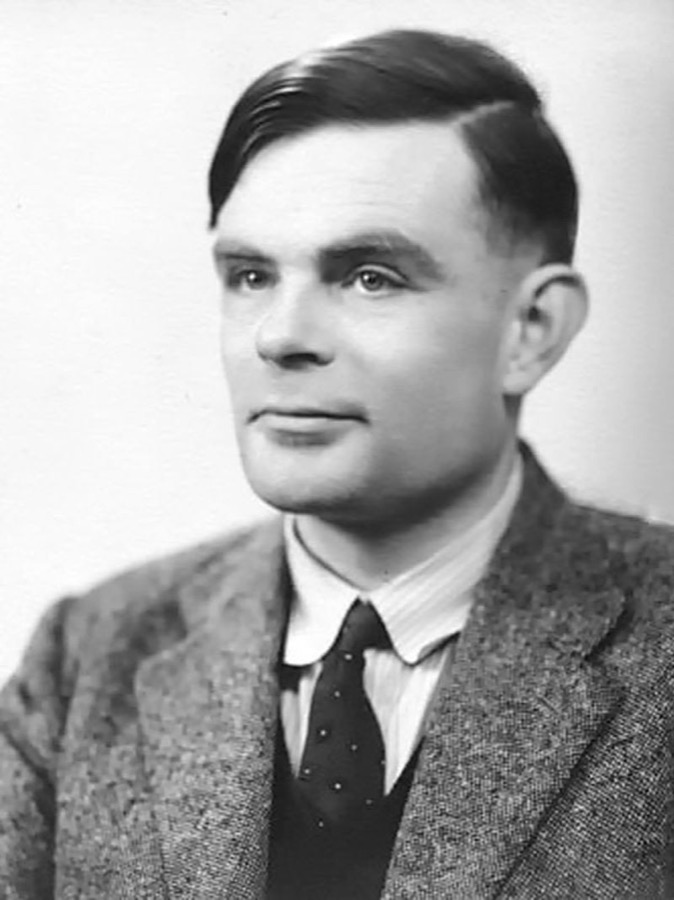
Turing then did something clever. He noted that the question is too vague to be answered, and replaced it with a game.2 In his imitation game, a judge has to decide which of two hidden conversation partners is the woman and which is the man.2 The question Turing asks is what happens when a machine takes the place of one of them. If the machine makes the judge guess wrong just as often, the question of whether the machine "thinks" is less interesting than what it actually achieves. Today the set-up is called the Turing test.
The point to take away is about method. Turing replaced a question that could not be measured with one that could be tested. That is still what separates work from hope in AI.
1955 and 1956: the word gets a date
As far as is known, the term artificial intelligence was first used in a research proposal dated 31 August 1955.1, 5 Behind it were John McCarthy, Marvin Minsky, Nathaniel Rochester and Claude Shannon.1 They applied for funding for a two-month study with ten participants, in the summer of 1956 at Dartmouth College.1
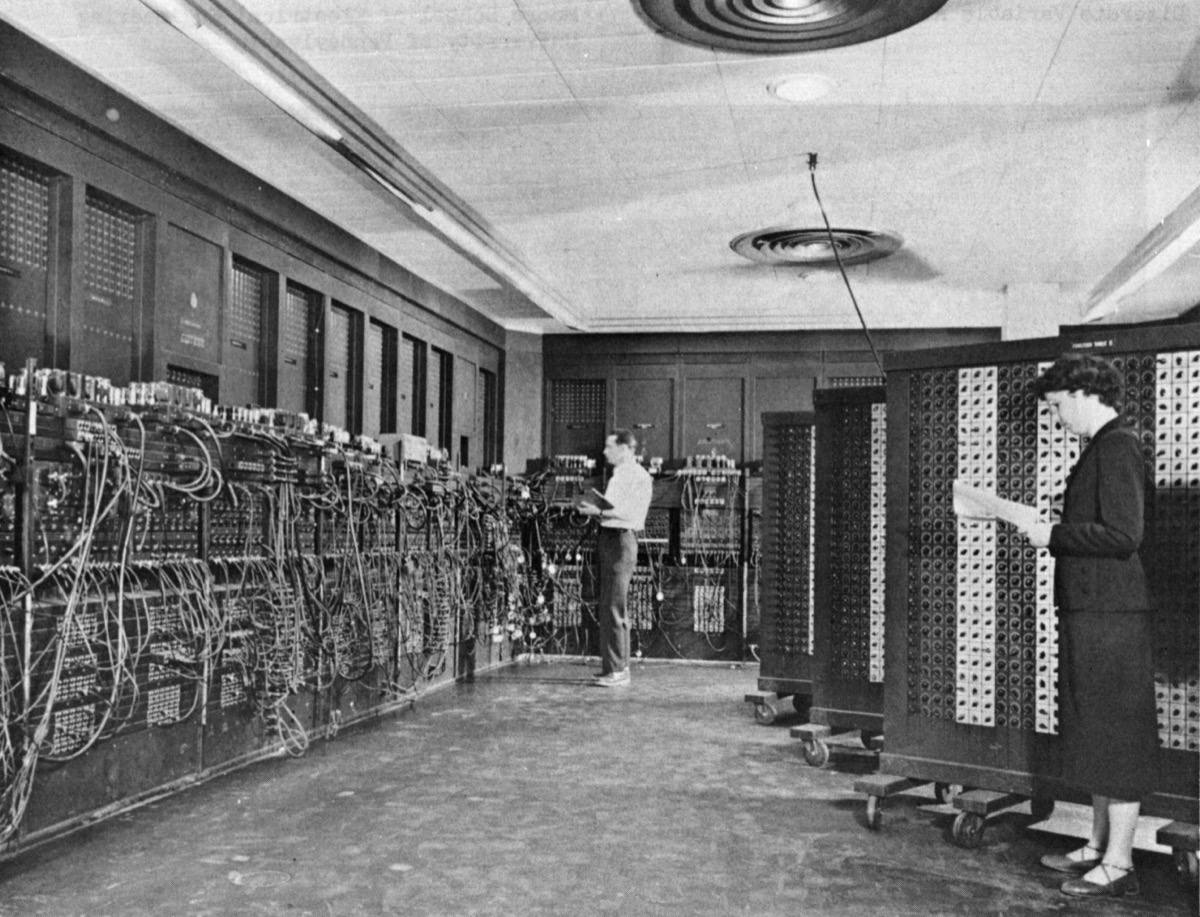
What makes the proposal worth reading seventy years later is how open it is about its own uncertainty. The starting point is called a conjecture, plainly: that every aspect of learning, or any other feature of intelligence, can in principle be described so precisely that a machine can be made to simulate it.1
A conjecture. Two months. Ten people. That is how the field began.
1966: the first setback came quickly
Ten years later the bill came for the first big promise. It was about machine translation, which during the Cold War had an obvious and well-funded use.
In 1964 an advisory committee was set up at the US National Academy of Sciences to assess the situation.3 The report came in 1966 under the title "Language and Machines".3 The conclusion was brief and uncomfortable: there was no machine translation of general scientific text, and none was in sight for the foreseeable future.3
The committee also put a price on the hope. Over about ten years the government had spent around 20 million dollars on machine translation and related subjects, more than a whole year of translation work cost the government to buy.3
It is an early version of a pattern that comes back: a concrete task turns out to be harder than it looked, and the funder does the sums.
1969 to 1976: the money comes with conditions
In the 1960s American AI research had been funded generously and with few demands. That changed.
Conditions tighten in the US and Britain
In 1969 the Mansfield Amendment was passed, which banned any of the defence budget from being used for research without a direct and apparent relationship to a specific military function.17 For the research funder ARPA it meant mission-driven research instead of free basic research. Researchers now had to show that the work would lead to something useful, and fairly soon.
In 1973 the mathematician James Lighthill delivered a review of British AI research.7, 18 His verdict was that in no part of the field had the discoveries produced the major impact that was once promised.7 The report is usually given as the reason British support was withdrawn. The historian who recalculated the figures writes that it is unclear both how and whether the review triggered any wider funding freeze.4, 18 In practice the work continued at a few places. The two big groups were in Sussex and Edinburgh.18
The programme that met its goals
A year earlier, in 1971, DARPA had started a five-year programme for speech understanding worth 15 million dollars in total.19, 20 The best system met the goals when the programme was demonstrated in September 1976: it understood whole sentences from a vocabulary of a thousand words.19, 21 But the goals had been set so that the sentences had to follow a constructed grammar, and when the programme ended it was not renewed.19
The difference between meeting a goal and getting a product is the whole problem of AI history in a nutshell.
On the winter: the story is disputed
Here we need to be careful, because there is a standard story and it is not undisputed.
The standard story and the objection
The standard story says that the years 1974 to 1980 were AI's first winter, a period of collapsed interest and withdrawn money.4 That version is in most of the summaries you find online.
The historian Thomas Haigh has argued in Communications of the ACM that the first winter did not happen.4 His objection can be measured. When the Lighthill report was published in 1973, the ACM's AI group SIGART had 1,241 members, about twice as many as in 1969.4 During what is usually described as the darkest part of the winter, the group almost tripled: by mid-1978 it had 3,500 members.4 It grew faster than the ACM as a whole.4
members of the ACM's AI group SIGART in mid-1978, almost a tripling during the period usually called AI's first winter.
Source: Thomas Haigh, Communications of the ACMWhat the figures say and do not say
So it was not the field that shrank. It was the largest laboratories and the most ambitious projects that were turned down. The number of people working on AI kept rising.
We do not take a position on what the period should be called. We note that the picture is disputed, and that anyone who copies the usual version without checking risks repeating something that is not true. That in itself is a lesson about how the history of technology is written.
1984: someone says it out loud
There is, however, a period that almost everyone agrees on, and the interesting thing is that it was predicted in public.
In August 1984 a panel debate was held at the AAAI annual conference in Austin, Texas.6, 22 The title was "The Dark Ages of AI". According to accounts at the time, the conference itself felt more like a trade fair: expert system companies were springing up everywhere, large companies were rushing to set up AI departments, and the money was flowing.5, 6
Drew McDermott opened the panel by talking about a deep unease that overly high expectations would end in disaster.22 He sketched what he himself called an unlikely worst case: all the start-ups fail, the companies lose interest, it becomes impossible to get money for anything to do with AI, and everyone hastily renames their research projects as something else.22
Roger Schank turned it around on the same occasion. He said he was worried not that expectations were too high but that they were too low: the AI community had forgotten that it was there to do science, and it was nowhere near any solution.6, 22
It was 1984. The field warned itself, on stage, in the middle of the boom.
1987: the warning comes true
The commercial AI of the 1980s was called expert systems: programs that captured an expert's knowledge in sets of rules. The best known, XCON, was built at Carnegie Mellon for a computer maker, which said that together with a related system it saved more than 40 million dollars a year.5 It was a strong sales story, and it pulled a whole industry along with it.
From 1987 the market for the specialised hardware that AI programs ran on gave way, and over the following years most of the makers disappeared or lost their lead.23 The reason was not that AI had failed in any deep sense. Ordinary workstations had become just as powerful and much cheaper, driven by a new generation of processors.23
The expert systems themselves turned out to have a more basic problem. Systems meant to automate expert knowledge required companies to hire new experts to maintain them.5 In 1989 the computer maker mentioned had 59 technicians assigned to look after the infrastructure and rule base of its internal expert systems.5 Few companies could afford that investment.
technicians were assigned by the computer maker in 1989 to maintain the infrastructure and rule base of its internal expert systems.
Source: Thomas Haigh, Communications of the ACMThe downturn that followed lasted into the 2000s.5 The sources do not agree on the year it ended, and we do not claim a year.
1997, 2012, 2016: three dates that changed the picture
May 1997. The reigning world chess champion lost a match to a computer. The deciding sixth game was played in New York on 11 May; the champion resigned after 19 moves and the match ended 3.5 to 2.5.24, 25 It was the first time a reigning world champion was beaten by a machine in a match played under standard tournament time controls.25
2012. A neural network won the ILSVRC image recognition competition with a top-5 error of 15.3%.9 The second-best entry was at 26.2%.9 The model had 60 million parameters, was trained on 1.2 million images and was built on an efficient implementation for graphics processors.9
top-5 error for the winning neural network in ILSVRC 2012. The runner-up was at 26.2%. The margin could not be dismissed.
Source: ILSVRC 2012, official resultsThat margin is the turning point of the whole timeline. The gap to the runner-up was too large to be dismissed, and the method behind it was not a new theory but more computing power and more data applied to an old idea.
March 2016. In Seoul a five-game match of the board game Go was played between one of the world's top players and a computer program.26 The program won 4 to 1.26 The human took the fourth game.
The breakthroughs usually came when computing power and amounts of data caught up with an old idea. That is why the timeline speeds up where it does.
2017 onwards: the architecture behind what you use today
In June 2017 an article titled "Attention Is All You Need" was published.10 It proposed an architecture built entirely on attention mechanisms, without the recurrence that had been standard until then.10 The decisive property was practical: it could be parallelised much more and therefore needed much less training time.10
Almost all the text tools the public began using from 2022 onwards are built on that architecture.
That the technology also delivers results outside competitions and chat windows became clear in 2024, when half of the Nobel Prize in Chemistry went to David Baker and the other half jointly to Demis Hassabis and John Jumper, the latter for predicting the structure of proteins with AlphaFold2.11
2024 to 2026: the rules catch up
The latest part of the timeline is not about models but about laws.
The EU AI Act entered into force on 1 August 2024 and applies in stages.12, 27, 28 The bans on certain uses apply from 2 February 2025, the rules for general-purpose AI models from 2 August 2025, and the general date of application was 2 August 2026.27, 28 From that date the transparency rules apply: you must be told when you are interacting with an AI system, and AI-generated content must be labelled.13 The labelling requirement was, however, given a grace period until December 2026 for services already on the market.12, 13
The same summer something happened that says more about the maturity of the technology than any model release. On 8 July a simplification act was signed, published on 24 July and in force from 27 July 2026.12, 28 It pushed back the heaviest requirements, those for high-risk AI systems, to 2 December 2027 and 2 August 2028 respectively.12 The reason given in the act is that the technical standards and national supervision were not ready in time.12
In Sweden, on 4 June 2026, the government gave five agencies the task of acting as national competent authorities: the Swedish Post and Telecom Authority, the Swedish Authority for Privacy Protection, the Swedish Financial Supervisory Authority, the Swedish Medical Products Agency and Swedac.14, 29 The task runs until 31 December 2026, pending supplementary Swedish legislation.14, 29
What the timeline is good for
Seventy years of history give three things worth taking away.
The word is older than the technology. The term turned seventy in 2025.1 What is new is not the idea but that it works well enough to build on.
The field has promised too much before, and has known it. The 1984 warning came from inside, from the stage, while the money was still flowing.22 Anyone who wants to understand technology cycles has more to learn from 1984 than from any product launch.
The breakthroughs usually came when capacity caught up with an old idea. But capacity was not the whole answer. As early as 1955 the proposal wrote that the main obstacle was not the capacity of the machines but the inability to write programs that made use of it, and in 1966 the committee explained the failure of machine translation by a semantic barrier and not by computers being too slow.1, 3 That is why the timeline speeds up where it does.
The next article in this area moves on from when to how.
What to take away
The term artificial intelligence was first written down in a research proposal dated 31 August 1955.1 The turning point is 2012: a top-5 error of 15.3% against the runner-up's 26.2%.9 The strength lies in the pattern rather than in single years. The breakthroughs came when computation and data caught up with old ideas, and capacity was never the whole answer: in 1955 the proposal pointed to the programs, and in 1966 the committee pointed to a semantic barrier.1, 3 The field has also warned itself in the middle of the boom, on stage in 1984.22 Follow three dated things at the Commission and the government: the labelling requirement's grace period in December 2026, the new high-risk dates of 2 December 2027 and 2 August 2028, and whether the five Swedish agencies' task, which runs until 31 December 2026, is replaced by Swedish legislation.12, 14
Education, not advice.
The fund
Behind the library stands a fund.
Own The Future is published by AIX. The library is the knowledge; AIX Dynamic is the tool, a systematic securities fund (UCITS) that follows the trend and steps aside when risk rises.
This is marketing. Fund units can both rise and fall in value. Read the key information document (KID) and the prospectus before you invest; you will find them on the fund's page at Avanza.
34 UNITHOLDERS · AS OF 15 SEP 2026The future in your inbox.
The most important things from each area, without the noise and without the hype.
Sources
- The Dartmouth proposal, McCarthy, Minsky, Rochester and Shannon, 31 Aug 1955, Stanford (McCarthy's archive).
- A. M. Turing, Computing Machinery and Intelligence, Mind LIX(236), October 1950, pp. 433 to 460.
- ALPAC, "Language and Machines", National Academy of Sciences, 1966.
- Thomas Haigh, "There Was No 'First AI Winter'", Communications of the ACM.
- Thomas Haigh, "How the AI Boom Went Bust", Communications of the ACM.
- George Johnson, "Thinking About Thinking", report from AAAI 1984, Alicia Patterson Foundation.
- James Lighthill, Artificial Intelligence: A General Survey, Science Research Council, 1973.
- New York Times, "Swift and Slashing, Computer Topples Kasparov", 12 May 1997.
- Krizhevsky, Sutskever, Hinton, "ImageNet Classification with Deep Convolutional Neural Networks", NeurIPS 2012, and ILSVRC 2012 official results.
- Vaswani et al., "Attention Is All You Need", arXiv 1706.03762, June 2017.
- The Nobel Prize in Chemistry 2024, press release, nobelprize.org.
- Regulation (EU) 2026/1744 (Digital Omnibus on AI), OJ 24 Jul 2026.
- European Commission, transparency rules for AI systems, updated 29 Jul 2026.
- Government Offices of Sweden (Regeringen), Fi2026/01365, decision 4 Jun 2026, published 12 Jun 2026, and Swedish Post and Telecom Authority (PTS), 16 Jun 2026.
- The Turing Digital Archive, Archive Centre, King's College, Cambridge, AMT/B/19, off-print of Computing machinery and intelligence, 1950. Supports that the article was printed in MIND, Vol. LIX, N.S. No. 236, Oct. 1950, with the catalogue entry GBR/0272/AMT/B/19 in the archive's search service.
- Karl Kempf, Electronic Computers Within The Ordnance Corps, chapter 2 on ENIAC, U.S. Army Ordnance Corps 1961, published by the Army Research Laboratory. Supports that the machine was dismantled in the winter of 1946 to 1947, that the first units arrived at Aberdeen Proving Ground in January 1947, that it was back in service in August 1947 and that the power was switched off at 23.45 on 2 October 1955.
- United States Statutes at Large, Public Law 91-121, 83 Stat. 206, section 203, 19 Nov 1969, via govinfo. Supports the Mansfield Amendment word for word and that the condition applies to all funds that law authorises, not a single research body.
- Science Research Council (B. H. Flowers), the preface to Artificial Intelligence: a Paper Symposium, 1973, via Chilton Computing and the UKRI Science and Technology Facilities Council. Supports that the review was commissioned as a personal survey and that the council considered it in September 1972 and decided to publish it together with objections, while the overview page states that the two big research groups were in Sussex and Edinburgh and that the research continued.
- CMU Computer Science Speech Group, Speech Understanding Systems, Summary of Results of the Five-Year Research Effort at Carnegie-Mellon University, first version September 1976, this version August 1977, report ADA049288 via Internet Archive. Supports that the programme began in 1971 as a five-year programme, that the goals from November 1971 explicitly assumed a constructed syntax and 1,000 words, that the demonstration took place in September 1976 at the end of the programme and that the best system met and in part exceeded the original requirements.
- Wayne A. Lea, Contributions of Speech Science to the Technology of Man-Machine Voice Interactions, NASA Technical Reports Server 19930075167, 1977. Supports that the speech understanding project was funded from 1971 to 1976 and that it was a five-year programme of 15 million dollars, that is, about three million a year.
- Dennis H. Klatt, Review of the ARPA Speech Understanding Project, Journal of the Acoustical Society of America 62(6), December 1977, pp. 1345 to 1366. Supports that four systems were demonstrated in September 1976 and that this marked the end of the five-year programme.
- Drew McDermott, M. Mitchell Waldrop, B. Chandrasekaran, John McDermott and Roger Schank, The Dark Ages of AI: A Panel Discussion at AAAI-84, AI Magazine 6(3), 1985, p. 122. Supports the panel's opening word for word, the worst case, that the opening speaker did not himself believe in it and what the last speaker actually said about expectations, and is also available as a PDF.
- Guy L. Steele Jr. and Richard P. Gabriel, The Evolution of Lisp, ACM SIGPLAN History of Programming Languages II, 1993. Supports that general workstations with fast processors eventually pushed out the specialised machines and that this happened during the standardisation work up to 1992, that is, later than the year the article gives.
- Murray Campbell, A. Joseph Hoane Jr. and Feng-hsiung Hsu, Deep Blue, Artificial Intelligence 134(1 to 2), January 2002, pp. 57 to 83. Supports that the match was played in May 1997 over six games and ended 3.5 to 2.5.
- Computer History Museum, the collection entry Murray Campbell, Deep Blue Team Member, accession 102645296. Supports the six-game match in May 1997, the result 3.5 to 2.5 and the museum's own wording of the record, which is narrower than the article's.
- David Silver et al., Mastering the Game of Go without Human Knowledge, Nature 550, October 2017. Supports that the program won 4 to 1 in March 2016 and that the match was played in Seoul with two hours of thinking time per player, and is available in an open version at University College London.
- European Union, Europaparlamentets och rådets förordning (EU) 2024/1689 av den 13 juni 2024 om harmoniserade regler för artificiell intelligens (Regulation (EU) 2024/1689 laying down harmonised rules on artificial intelligence, Swedish language version), via EUR-Lex. Supports the regulation's full title and date of adoption and the stages in Article 113.
- European Commission, Regulatory framework for AI, policy page. Supports all four dates in the stages word for word, that is, entry into force on 1 August 2024, the bans on 2 February 2025, the rules for general-purpose models on 2 August 2025 and the general date of application on 2 August 2026, and that the simplification act entered into force on 27 July 2026.
- Government Offices of Sweden (Regeringen), Ministry of Finance, government decision III:50, Uppdrag att vara nationella behöriga myndigheter enligt AI-förordningen (Task to act as national competent authorities under the AI Act), Fi2026/01365, dated 4 Jun 2026. Supports the decision date of 4 June 2026, the five agencies, that the task applies until 31 December 2026, and the background with the ongoing Swedish inquiry.
Links checked on 14 Sep 2026. Turing's article in Mind is behind a paywall. The bibliographic record is in the archive.
Extended on 14 Sep 2026 with the archive record for Turing's article, the Mansfield Amendment in the US statute book, the Science Research Council's own preface to the Lighthill symposium, the three primary reports on the speech understanding programme 1971 to 1976, the transcribed 1984 panel debate, the research literature on the Lisp machine market, the scientific article and the museum record on the 1997 chess match, the Nature article on the 2016 Go match, the AI Act itself with the Commission's page of dates, and the government's decision document. The 1973 review is dated July 1972 and was considered by the research council in September 1972. The article follows the year of publication. The speech understanding programme ended in September 1976, not in 1974.