OWN THE FUTURE · SEASON 1 · TECHNOLOGICAL BREAKTHROUGH
What is a chip, and what did Moore's law really say?
Semiconductors are the material, usually silicon, that the chips in phones, cars and washing machines are made from. We explain how a chip is made, why it is so hard and what Moore's law really says.
Published 9 Sep 2026 · About 9 minutes to read
There is one in your phone, several in your car and at least one in the washing machine. The word chip is used for all of them, and almost nobody who says it means anything particular by it. Yet it is one of the most precise objects people make.
This article answers four questions in turn. What a chip is. Why the material is silicon. How it is made, in broad outline. And what Moore's law said when it was written down in 1965, which is something other than what is usually quoted. Last, the industry is counted in outcomes, from world sales to Swedish production statistics.
What a chip is
Start with the smallest part. A transistor is a switch with no moving parts, turned off and on by an electrical signal. The transistor effect was awarded the Nobel Prize in Physics in 1956, according to the Academy's summary of the prize, and the year of the discovery is given as 1948 in the presentation speech at the same ceremony.7 Before the transistor, the switches sat in glass radio valves that had to be heated.
A chip is the next step. Instead of making transistors one by one and soldering them together, you build them, and the wiring between them, at the same time in a single piece of semiconductor material. This is called an integrated circuit. In 2000 the Royal Swedish Academy of Sciences gave half of the Nobel Prize in Physics to the engineer Jack Kilby for his part in the invention of the integrated circuit, and the Academy's detailed background text to the prize dates his first demonstration to the summer of 1958 and the finished one-piece circuit to September the same year.6, 9 So a chip is a whole circuit, with all its switches and connections, made in one piece.
The word semiconductor describes the material. A conductor lets current through, an insulator does not, and a semiconductor sometimes does, depending on how it has been treated and what voltage it gets. That property is what lets a piece of the material work as billions of switches, each controlled on its own.
Why the material is silicon
The reasons are already in the 1965 article that the rest of this text is about. Gordon Moore, then head of research at a semiconductor maker, wrote that silicon is likely to remain the basic material, and that silicon will dominate at lower frequencies for two reasons: the technology that had already grown up around silicon and its oxide, and the fact that silicon is an abundant and relatively cheap starting material.1
The oxide is the part that is easily forgotten. When silicon meets oxygen, a thin layer of silicon dioxide forms, the same substance as in ordinary glass, and that layer insulates.8 A material that both conducts on demand and insulates itself at the surface is unusually practical to build circuits in. Moore also wrote that gallium arsenide would become important for integrated microwave functions, that is, for special uses, not as a general replacement.1
How a chip is made, in broad outline
The wafer and the layers
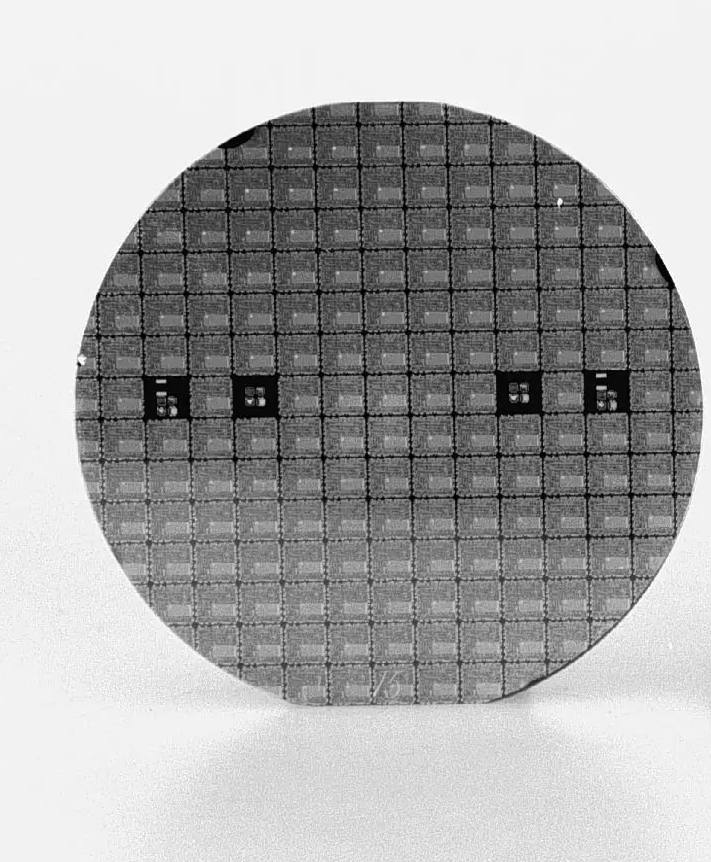
Chips are not made one at a time. They are built many at once on a round, thin disc of silicon called a wafer, in layers on top of each other: patterns are transferred to the wafer, material is added and removed, and finally the wafer is sawn into individual chips. In 1965 Moore described wafers that were an inch or more in diameter.1 The wafer in the photograph below is from a three-inch process, 76 millimetres in diameter and 0.4 millimetres thick, and besides the circuit pattern it carries four test squares used to check the process.10
The hard part is the precision, and that everything must come out right at once. In 1965 Moore reckoned that transistors could be placed two thousandths of an inch apart, centre to centre, with the tolerances already in use, which gives at least 500 components per inch and a quarter of a million per square inch.1 That was what made his calculation possible. Since then the distances have shrunk many times over, but the principle is the same: a circuit built in one piece cannot be repaired afterwards, so every layer must land correctly on top of the last one across the whole wafer.
The difficulties Moore pointed out
Moore wrote about two of the difficulties as early as 1965, and both remain questions for every new factory today. One is yield, that is, how large a share of the circuits on a wafer work. He argued that there was no fundamental obstacle to reaching 100% yields, only engineering work, and that the cost per component falls as more components fit in the circuit, up to the point where poorer yield eats up the gain.1 That was why his measure was components at minimum cost. The other is heat. He asked himself whether the heat from tens of thousands of components on a single silicon chip can be removed, and answered that a flat circuit has a cooling surface close to every heat source, unlike a computer built from separate parts, which would have glowed if shrunk to the same volume.1
One limitation he saw as fundamental. Capacitors and coils with high values store energy in a volume, and volume is exactly what an integrated circuit does not have.1 Such components, he wrote, will remain alongside the chip for a while yet. That is one reason a circuit board is still full of small black and brown components around the chip.
What Moore's law said in 1965
On 19 April 1965 the magazine Electronics published an article titled Cramming more components onto integrated circuits.1 It is four pages long and can be read in full. It is worth doing, because it says something other than what is usually quoted.
What the article actually calculated
Moore wrote about the number of components per circuit at minimum cost per component.1 So the quantity was neither the number of transistors nor performance, even though he writes about both elsewhere in the text. When he wrote, the cost-optimal level was 50 components per circuit, and he noted that the level had risen by roughly a factor of two per year.1 Then came the caveat, in his own words: in the short term the rate can be expected to continue, if not to increase; over the longer term the rate of increase is more uncertain, but there is no reason to believe it will not remain nearly constant for at least ten years.1
The calculation that followed is the article's most quoted figure. The curve in the article starts at one component in 1959 and rises by a doubling each year, which gives 65,000 components on a single silicon chip in 1975.1 Moore wrote that such a circuit would need only about a quarter of a square inch.1 The 50 components he gives as the cost optimum at the time of writing are the text's figure for 1965; the curve sits slightly higher in the same year.1 The article also guessed what the circuits would be used for: home computers, automatic controls for cars and personal portable communications equipment, and it noted that electronic wristwatches only needed a display to become possible.1
components on a single silicon chip in 1975 at minimum cost per component, if the yearly doubling continued from 1965. That was Moore's own calculation, with ten years as the stated horizon.
SOURCE: ELECTRONICS, 19 APRIL 1965Where the quoted version comes from
Two more things belong to the story. The word law did not come from Moore. The term Moore's law was coined by Carver Mead, according to the Computer History Museum's account of the article.2 And the version most often quoted, that the number doubles every two years, comes from 1975, when according to the same account Moore revised the rate to a doubling every two years instead of every year.2, 11
So when someone says that Moore's law says transistors double every two years, both the quantity and the rate come from somewhere other than the 1965 article.1, 2, 1 The original text talks about components at minimum cost, a factor of two per year, and ten years ahead. Whether the law has gone on holding since then is a judgement that different informed sources make differently, and it is not made here.
The industry counted in outcomes
The figure for the size of the industry that is usually quoted comes from the trade association SIA, which represents 99% of the US semiconductor industry by revenue and nearly two thirds of semiconductor companies outside the US.3 So it is the industry's own account, not an agency's, and that should be said in the same sentence as the figure.
According to SIA's account in February 2026, global semiconductor sales came to 791.7 billion dollars in 2025, up 25.6% from 630.5 billion dollars in 2024.3 The fourth quarter of 2025 accounted for 236.6 billion.3 The largest product category was logic chips at 301.9 billion, up 39.9%, and the second largest was memory at 223.1 billion.3
Note the figure for 2024. When the same organisation reported that year in February 2025, the total was 627.6 billion dollars, the first year ever above 600 billion, up 19.1% from 526.8 billion in 2023.4 On 3 March 2025, just over three weeks later, a note was added at the top of the same press release saying that the annual total for 2024 had been updated to 630.5 billion, and that is the total that still stands in the account a year later.4 The difference is due to a revision. Outcome statistics are updated as more data comes in, so anyone quoting a figure should also say when it was read. The monthly figures in the same series are reported as three-month moving averages and are therefore poorly suited to being quoted one at a time.3
The rise was unevenly spread. The same account states that sales in 2025 rose by 45.0% in Asia Pacific and other markets, by 30.5% in the Americas, by 17.3% in China and by 6.3% in Europe, while they fell by 4.7% in Japan.3 China and Japan are counted separately and are not part of the first group. The figures are regional outcomes for the year and say nothing about individual countries within the regions.
Sweden in the statistics
Sweden does not make chips on any large scale, but the electronics industry is in the official statistics.12 Statistics Sweden's (SCB) industrial production index measures each month how production is developing, with 2021 as the base equal to 100, and reports the industry for computers, electronics and optics as a branch of its own.5
Counted as the annual average of the monthly values, the branch stood at 131.7 for 2025, against 99.2 for 2021.5 Manufacturing as a whole stood at 109.3 over the same period, against 99.4 for 2021.5 Measured against the index base of 100, production in the electronics industry has risen by just under a third, while industry as a whole has risen by just under a tenth. The index is chain-linked and calendar-adjusted, and SCB no longer publishes news releases for it, so the figures are taken directly from the Statistical Database.5 The series was last updated on 10 September 2026 and then runs to July 2026, and the next publication is on 9 October 2026.5 SCB changed its method in April 2023, with new statistical units and wider use of VAT data, and recalculated the series back to April 2022; for branch 26 the recalculation moved the values by 1.5% on average during the transition year, according to SCB's document on changes in the statistics.5
What to take away
A chip is a whole circuit built in one piece of semiconductor material. Moore's law from 1965 was about components per circuit at minimum cost, a factor of two per year and ten years ahead.1, 2 The industry sold 791.7 billion dollars' worth in 2025 according to its own organisation, and the Swedish electronics industry stood at index 131.7 against the base value of 100.3, 5 What holds over decades is not the rate but the measure: cost per component. Moore wrote as early as 1965 that silicon remains the material, for two reasons, and that yield and heat removal are the limits every new factory faces.1 Follow SIA's annual account of sales, which is revised afterwards, and SCB's industrial production index, which was last updated on 10 September 2026 and will next be published on 9 October 2026.3, 5
The next episode is S1:E5 Quantum, counted in quantum bits and errors.
Education, not advice.
The fund
Behind the library stands a fund.
Own The Future is published by AIX. The library is the knowledge; AIX Dynamic is the tool, a systematic securities fund (UCITS) that follows the trend and steps aside when risk rises.
This is marketing. Fund units can both rise and fall in value. Read the key information document (KID) and the prospectus before you invest; you will find them on the fund's page at Avanza.
34 UNITHOLDERS · AS OF 15 SEP 2026The future in your inbox.
The most important things from each area, without the noise and without the hype.
Sources
- Gordon E. Moore, Cramming more components onto integrated circuits, Electronics, volume 38 number 8, 19 Apr 1965, pages 114 to 117, read in the museum's scan of the original issue. Components per circuit at minimum cost, 50 components in 1965, a factor of two per year, the ten-year caveat, 65,000 components in 1975, a quarter of a square inch, the tolerances, silicon and gallium arsenide, the applications.
- Computer History Museum, 1965: Moore's Law predicts the future of integrated circuits, The Silicon Engine. That the term was coined by Carver Mead and that in 1975 Moore revised the rate to a doubling every two years.
- Semiconductor Industry Association, Global annual semiconductor sales increase 25.6% to $791.7 billion in 2025, press release 6 Feb 2026. Sales in 2025 and 2024, the fourth quarter, the product categories, the organisation's coverage, the three-month averages.
- Semiconductor Industry Association, Global semiconductor sales increase 19.1% in 2024, press release 7 Feb 2025. Sales in 2024 as first reported, 2023, the first year above 600 billion.
- Statistics Sweden (SCB), Industriproduktionsindex (IPI), kedjeindex, 2021=100, efter näringsgren SNI 2007, månad (Industrial production index, chain-linked, 2021=100, by industry, monthly), Statistical Database, and the product page for the industrial production index. Branch 26 and manufacturing, calendar-adjusted monthly values 2021 to 2025, next publication 10 Sep 2026. Also SCB, Förändringar i statistiken, Industriproduktionsindex april 2023 (Changes in the statistics, industrial production index April 2023) (PDF). New statistical units, wider use of VAT data, recalculation back to April 2022 and the size of the revision for branch 26.
- Royal Swedish Academy of Sciences (Kungliga Vetenskapsakademien), press release on the Nobel Prize in Physics 2000 and the detailed background text to the same prize (PDF). Jack Kilby, the division and citation of the prize, the 1958 demonstration.
- Royal Swedish Academy of Sciences (Kungliga Vetenskapsakademien), the Nobel Prize in Physics 1956, summary, and the Nobel Foundation (Nobelstiftelsen), the 1956 presentation speech. The transistor effect, the citation and the discovery year 1948.
- Robert Noyce, patent 2,981,877, Semiconductor device-and-lead structure, filed 30 Jul 1959, issued 25 Apr 1961, in the patent office's facsimile and in machine-read text. Describes silicon dioxide as an electrically insulating material in an integrated circuit.
- Royal Swedish Academy of Sciences (Kungl. Vetenskapsakademien), Pressmeddelande: Nobelpriset i fysik 2000 (Press release: the Nobel Prize in Physics 2000), Swedish wording, 10 Oct 2000. Supports that the Academy awarded the prize, that one half went to Jack Kilby and that the citation in Swedish reads "för hans del i uppfinningen av den integrerade kretsen" (for his part in the invention of the integrated circuit), which is exactly the wording the article uses.
- Swedish National Museum of Science and Technology (Tekniska museet), Kiselskiva, för halvledartillverkning (Silicon wafer, for semiconductor manufacturing), object TEKS0043126, via DigitaltMuseum. Supports the three-inch process, the 76 millimetre diameter, the 0.4 millimetre thickness, the circuit pattern, the four test squares, that the record has no date and that the photographer is given as unknown.
- Gordon E. Moore, Progress in Digital Integrated Electronics, IEEE International Electron Devices Meeting, Technical Digest 1975, pages 11 to 13, reprinted in IEEE Solid-State Circuits Society Newsletter 2006, digital object identifier 10.1109/N-SSC.2006.4804410. The original publication behind the two-year rate.
- Statistics Sweden (SCB), Företagens ekonomi, basfakta och nyckeltal för verksamhetsenheter efter näringsgren SNI 2007, år 2024 (Business economics, basic facts and key figures for local units by industry, 2024), Statistical Database. Supports that branch 26 is in the official statistics with 1,204 local units, 20,688 full-time equivalents and a production value of 84,352 million kronor in 2024, and that the sub-branch 26.11, manufacture of electronic components, is marked confidential in the same table.
Links retrieved 7 Sep 2026. Extended on 14 Sep 2026 with the original 1965 issue of the magazine from a research museum's archive, the Academy's Swedish wording of the citation for the 2000 physics prize, the museum record for the silicon wafer in the photograph, Moore's own 1975 paper behind the two-year rate, the patent office's own facsimile of the 1961 patent and SCB's business statistics for branch 26. The index series in the Statistical Database was updated on 10 Sep 2026 and now runs to July 2026. When retrieved again on 14 Sep 2026 it gives the annual average 103.6 for branch 26 in 2022 and 109.25 for manufacturing as a whole in 2025, and the article's figures have been updated to those; the earlier figures 103.5 and 109.4 were read on 7 Sep 2026.