OWN THE FUTURE · SEASON 2 · DEMOGRAPHICS & SOCIAL CHANGE
What is the genome? Explained from the ground up
The genome is the genetic information found in almost every cell in the body. We explain what a gene is, how researchers read the genome and what gene scissors are used for.
Published 10 Sep 2026 · About 9 minutes to read
You have heard the words. Genes. DNA. Hereditary material. Genome. They are often used as if they meant the same thing, and they do not.
This article explains what they mean, how the human genome was read, and what the tool that won the Nobel Prize in Chemistry in 2020 actually does. No prior knowledge is needed.
Four letters, one set of instructions
Start with the picture of a set of instructions. Not a blueprint, which shows what something should look like, but instructions that say what should be done and in what order.
Those instructions are found in almost every cell in your body, written in a molecule called DNA. And they are written with only four characters, usually shortened to A, C, G and T. They are the names of four building blocks called bases.
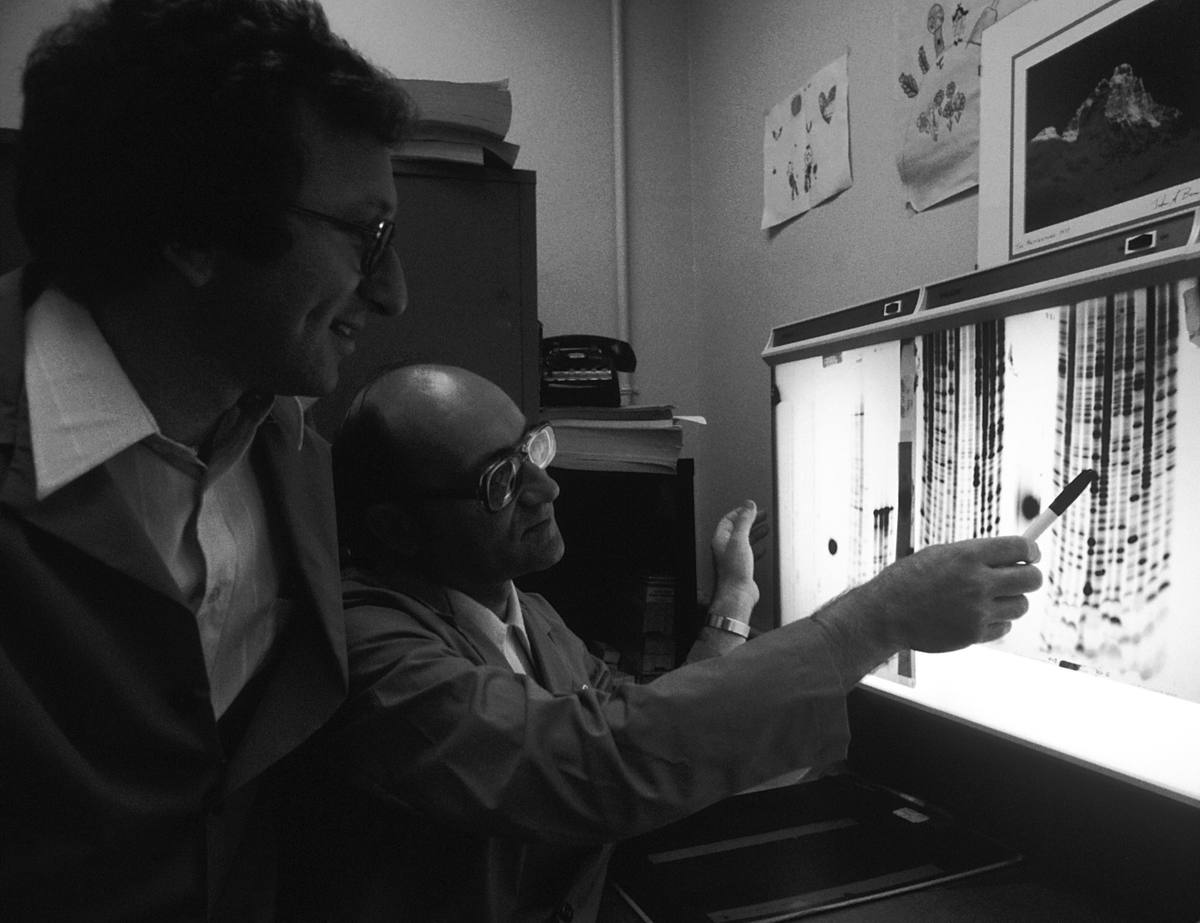
To sequence DNA means to work out the exact order of the four letters. It is reading the text, character by character.
A gene is a passage in that text that means something, a piece of instruction for one particular thing. The genome, our hereditary material, is the whole text together, both the parts we know the purpose of and the parts we do not.
So: DNA is the material, the gene is the passage, the genome is the whole book.
Reading the book took 32 years, and three times it was said to be finished
Here is what makes the story instructive rather than just impressive.
The work of reading the entire human genome had a name, the Human Genome Project, and it ran from 1990 to 2003. Its goals had been set out by a special committee of the US National Academy of Sciences as early as 1988. The estimated cost was 3 billion dollars and the estimated time 15 years.1, 9 The source is open about the fact that exact cost accounting was hard to do, because the money came from many international funders.
In June 2000 a draft was announced. It covered 90% of the genome, and contained more than 150,000 gaps where the sequence could not be determined with certainty.1, 10
In April 2003 an essentially complete sequence was announced. It covered 92% and had fewer than 400 gaps.1, 8 The project was finished two years before the date originally planned.
On 31 March 2022 T2T-CHM13 was published, a reference sequence with no gaps for the autosomes and the X chromosome. It was produced by a consortium that called its work telomere to telomere, meaning from one end to the other.5, 6 The Y chromosome was not included.5, 6
The point is not that anyone cheated. The point is that big technical breakthroughs are almost always declared finished before they are finished, because what remains is the hardest part. Anyone who read the headline in 2003 was told that the genome had been mapped. It was true enough to build on, and untrue enough to need another nineteen years.
Whose genome was it?
A question that is almost never asked, and that has a concrete answer.
The sequence did not belong to one person. It was a patchwork from several anonymised donors. 70% came from a single person and the remaining 30% from nineteen others.1 Most of the donors lived in Buffalo in the state of New York and were recruited through public adverts, with informed consent before the blood sample was taken.1, 7
The work involved researchers at twenty universities and research centres in the US, the UK, France, Germany, Japan and China, brought together in an international consortium.1 The method was a sequencing technique that existed before the project but was developed a great deal during it.
So the reference sequence was built on twenty donors, about 70% of it on one of them.1 It is a research reference with a limited base of donors.
Two legacies of the project that are about rules, not technology
According to the host agency itself, what lives on most strongly from the Human Genome Project is not a machine but an agreement.
At two meetings in Bermuda, starting in 1996, the researchers agreed that sequence data should be published openly and quickly instead of being held back until publication.1 Those rules are called the Bermuda Principles, and the agency describes them as one of the project's most important legacies.
The second legacy is that from the start, in 1990, the project had its own programme for ethical, legal and social issues. Congress later required the agency to set aside at least 5% of the research budget for such issues.1 So ethics was not a discussion after the fact. It was a line in the budget.
The scissors that won a Nobel Prize: what they do, and what they do not
The Nobel Prize in Chemistry 2020 was announced on 7 October 2020 by the Royal Swedish Academy of Sciences. It went to Emmanuelle Charpentier and Jennifer A. Doudna, for developing a method for genome editing.2 The prize money, 10 million kronor, was shared equally.
The scissors were borrowed from bacteria
The method is called CRISPR/Cas, and the most important thing to understand is that it was not invented. It was borrowed from bacteria.
Bacteria have their own ancient immune defence against viruses. It works by the bacterium cutting up the virus's DNA. Charpentier discovered a molecule in that system, called tracrRNA, while studying a bacterium that causes strep throat, and published the discovery in 2011.2, 13
The same year the two researchers began working together. They recreated the bacteria's scissors in test tubes and simplified their molecular parts. And in 2012 they showed something that changed the field: the scissors can be reprogrammed to cut any DNA molecule, at a chosen place.2
What the tool does not do, and what the law does not allow
That is why the picture of scissors is the right picture. The tool cuts. It does not rewrite the text for you, and it does not know what ought to be written there. It lets someone choose exactly where the cut should go.
In its press release the prize-awarding body says that clinical trials of new cancer treatments are under way and that the hope of curing inherited diseases is about to be realised.2 That is the source's wording about the current state, not a promise of results, and that difference is the whole difference when you read about medical research. In Sweden the Genetic Integrity Act bans both trials and treatments that cause genetic changes that can be inherited in humans. Gene editing of body cells, which is not inherited, is allowed.11, 12
Why this sits in an area about demographics
The question is reasonable. What does DNA have to do with population?
The answer is that the area is about how many of us there will be and how old we will live to be, and that both of those things have already changed measurably.
More older people and fewer children in the world
In 1974, 5.5% of the world's population was 65 or older. In 2024 the share was 10.3%.3 So the share has almost doubled in fifty years.
At the same time fewer children are being born. Global fertility was 4.7 children per woman in 1960 and 2.2 children per woman in 2023.4 More than 60% of the world's population lives in countries where fertility is below 2.1 children per woman, the level usually given as the one at which a population stays constant without immigration.
of the world's population was 65 or older in 2024, against 5.5% in 1974. The share has almost doubled in fifty years.
SOURCE: UNFPAWhat it means, and what we do not project
A population that lives longer gets different diseases from a population that dies young. That makes knowledge of the genome a question of how many people are affected by what, and not just laboratory work.
We deliberately give no figures about what the future will look like. Such figures exist in the sources, as population projections, and that is exactly what they are: projections. What has happened is fact. What will happen is a calculation. We keep the two apart throughout this library.
What to take away
The genome was declared finished three times: the draft in 2000 covered 90% and had more than 150,000 gaps, the sequence in 2003 covered 92% with fewer than 400 gaps, and only in 2022 did a sequence with no gaps arrive, except for the Y chromosome.1, 5 The reference sequence was built on twenty anonymised donors, about 70% of it on one of them.1 The strongest legacy is rules: open data and at least 5% of the research budget for ethical, legal and social issues, plus a tool borrowed from the immune defence of bacteria that can be programmed to cut at a chosen place.1, 2 Follow two figures that are updated regularly: the share of the world's population aged 65 or older, which UNFPA reports, and the World Bank's fertility rate per woman.3, 4
The next episode is S2:E2 Longevity, on why life expectancy has risen and what the figure actually measures.
Education, not advice.
The fund
Behind the library stands a fund.
Own The Future is published by AIX. The library is the knowledge; AIX Dynamic is the tool, a systematic securities fund (UCITS) that follows the trend and steps aside when risk rises.
This is marketing. Fund units can both rise and fall in value. Read the key information document (KID) and the prospectus before you invest; you will find them on the fund's page at Avanza.
34 UNITHOLDERS · AS OF 15 SEP 2026The future in your inbox.
The most important things from each area, without the noise and without the hype.
Sources
- National Human Genome Research Institute, Human Genome Project Fact Sheet, page last updated 13 Jun 2024.
- Royal Swedish Academy of Sciences (Kungliga Vetenskapsakademien), press release on the Nobel Prize in Chemistry 2020, dated 7 Oct 2020.
- UNFPA, the topic page Ageing, page last updated 19 Jun 2024.
- World Bank, World Development Indicators, the indicator SP.DYN.TFRT.IN, fertility rate for the world.
- Nurk et al., The complete sequence of a human genome, Science 376, 31 March 2022, via NIH PubMed Central. Supports the complete sequence of 31 Mar 2022, telomere to telomere, the CHM13 cell line.
- National Human Genome Research Institute, Researchers generate the first complete, gapless sequence of a human genome, press release 31 Mar 2022. Supports the same sentence, and that the 2003 sequence covered 92%.
- International Human Genome Sequencing Consortium (Lander et al.), Initial sequencing and analysis of the human genome, Nature 409, 2001. Supports anonymous donors and informed consent.
- International Human Genome Sequencing Consortium, Finishing the euchromatic sequence of the human genome, Nature 431, 2004. Supports 341 gaps in the finished sequence.
- National Human Genome Research Institute, Human Genome Project Timeline of Events, updated 2022. Supports 1990 to 2003, the draft of 26 Jun 2000 and the announcement of 14 Apr 2003.
- National Human Genome Research Institute, International Human Genome Sequencing Consortium Announces "Working Draft" of Human Genome, press release June 2000. Supports the announcement in June 2000.
- The Swedish Parliament (Sveriges riksdag), Lag (2006:351) om genetisk integritet m.m. (Genetic Integrity Act), Chapter 2, Sections 3 and 4. Supports the ban on inheritable genetic changes.
- Swedish National Council on Medical Ethics (Statens medicinsk-etiska råd), Redigering av det mänskliga genomet (Editing the human genome), Smer 2022:1, March 2022. Supports that somatic gene editing is allowed and inheritable gene editing is banned.
- Royal Swedish Academy of Sciences, Genetic scissors: a tool for rewriting the code of life, popular science background to the Nobel Prize in Chemistry 2020. Supports the bacterium that causes strep throat.
Links retrieved 4 Sep 2026.
Extended on 13 Sep 2026 with the original publications behind the NHGRI fact sheet, the Genetic Integrity Act and the Swedish National Council on Medical Ethics report. The number of gaps in the draft is given as more than 150,000 in the NHGRI fact sheet and as 147,821 in Nature 2004; the article follows the fact sheet.