OWN THE FUTURE · SEASON 2 · DEMOGRAPHICS & SOCIAL CHANGE
What is remote care, and why is it usually a phone call?
Remote care means you are in contact with healthcare without being in the same place, for example by phone, video or written messages. We explain what already works that way today and what still needs a visit in person.
Published 10 Sep 2026 · About 10 minutes to read
In 2024 the regions' healthcare had 23,754,966 contacts where the staff and the patient were not in the same room.2 Two thirds of them were phone calls.2 Just under a tenth were video.2
This article explains what counts as remote care, what does not even though it happens in a healthcare app, who uses it and what it costs. The figures come from the regions' own activity statistics, the National Board of Health and Welfare's term bank, the Swedish Agency for Health and Care Services Analysis, the Health and Social Care Inspectorate and the OECD.1, 2, 7, 8, 12
The line is drawn at the room
The expression digital care has no fixed Swedish definition.1 The National Board of Health and Welfare's term bank does not recognise it.1 The term that is defined, and that all Swedish statistics and all payments rest on, is remote contact, and it reads: a care contact in outpatient care where healthcare staff and patient are physically apart.1
The term bank has three sub-terms with recommended status: remote contact by phone, remote contact by video link and written remote contact.1 So the line is drawn at the room and not at the technology.1 If you are in the same room, it is a visit. If you are not, it is a remote contact, whether you talk on the phone or see each other on a screen.
The word telemedicine has its own entry: healthcare carried out at a distance with the help of information and communication technology.1 The World Health Organization uses a similar wording and adds that distance should be a critical factor.15, 16
Distance is not new
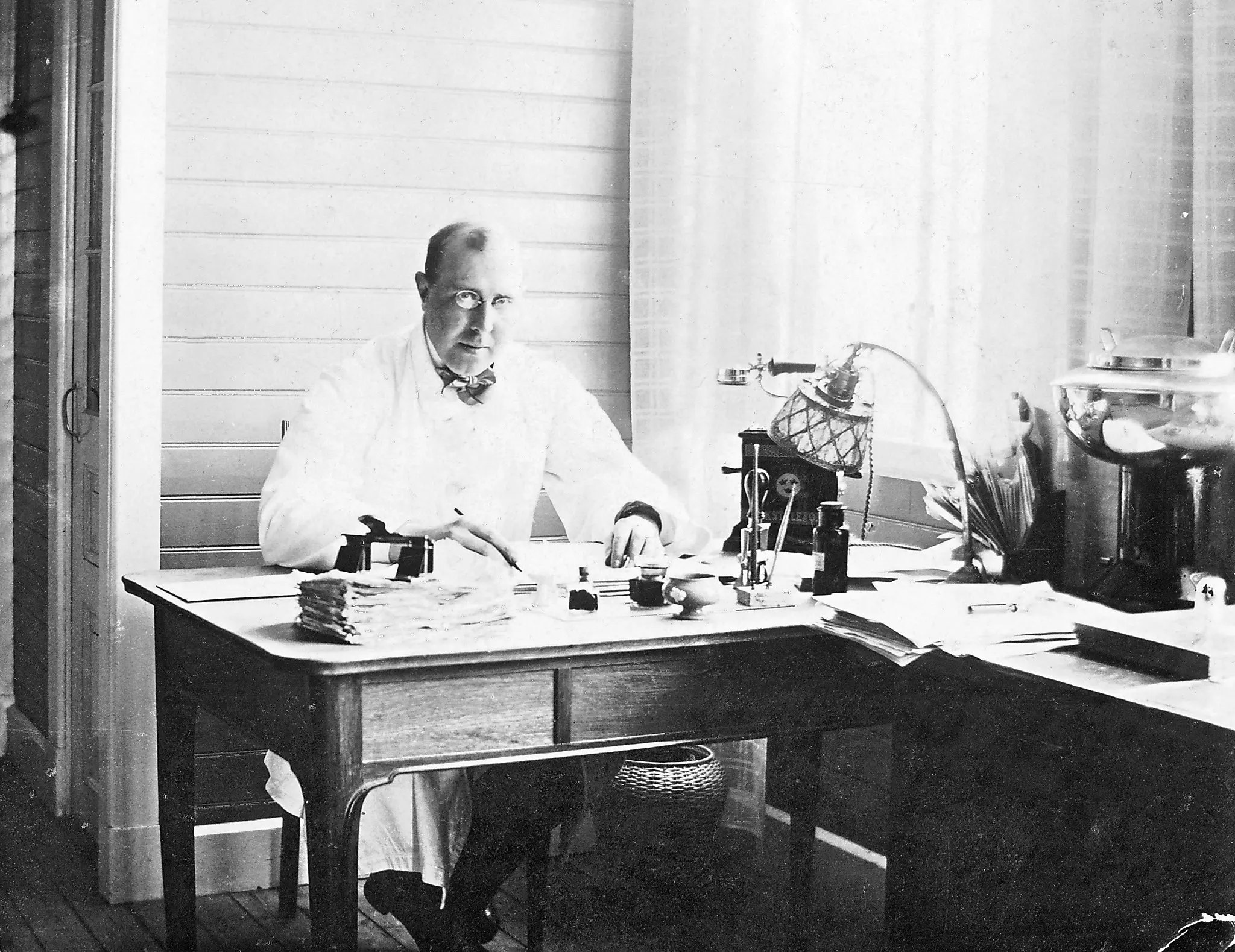
When the Nobel Prize in Physiology or Medicine was awarded in 1924, the chairman of the Nobel Committee at Karolinska Institutet described a proposal that the prizewinner Willem Einthoven had put forward as early as 1906.14 Einthoven wanted to record electrocardiograms with a string galvanometer in a physiology laboratory, from patients lying in a hospital several kilometres away. He called it the telecardiogram.14
In the same speech the detail was dismissed as history. Since a string galvanometer could now be found in practically every large hospital, the speaker said, the proposal was only of historical interest.14 The distance disappeared when the device became cheap enough to be everywhere.
The phone dominates
Of the remote contacts in 2024, 15,559,904 were phone contacts, 5,370,793 written contacts, 2,159,941 video contacts and 664,328 unspecified.2 As shares, that is 65.5, 22.6, 9.1 and 2.8%.2
The split is also uneven between types of care. 18,749,808 of the contacts, so 78.9%, took place in primary care, where the most common form is a phone call to a nurse.2, 3 The Swedish Association of Local Authorities and Regions (SKR) says that video contacts make up 8% in primary care and 4% of doctor contacts in specialist somatic care.3
The remote contacts have to be set against the physical visits to get the proportions right. The same statistics record 66,756,054 physical visits in outpatient care in 2024, of which 60,397,103 were clinic or home visits.2, 3 So roughly one in four contacts with outpatient care took place remotely, and most of those by phone.2
of the regions' 23,754,966 remote contacts in 2024 were phone calls. Video contacts were 9.1%.
SOURCE: SKR, ACTIVITY STATISTICS, OWN SUMTwo counts that must not be added together
Two figures appear in the debate, and they measure different things. The first is the regions' activity statistics for 2024, the 23.8 million remote contacts above, which cover all technologies, all types of care and both public and private providers.2
The second is digital out-of-region care, and there the invoice passes through several steps. Private digital care providers work under commercial agreements with ten health centres in Region Sörmland.4 The health centre pays the provider, invoices Region Sörmland and keeps a share as a middleman, after which the region invoices the patient's home region under the national agreement.4 That route carried 2.7 million digital care contacts in 2025, for one billion kronor, and about one million people used the services.4 The association says that this part is equal to about 14% of the regions' total number of digital care contacts, counted on 2024.4
The figures of 23.8 million and 2.7 million refer to different years and are collected in different ways. They should never be added together.2, 4
What is done remotely in practice
The forms that are growing, and what patients seek care for
Apart from the call, there are two forms that are growing without showing up in the contact statistics in the same way. One is self-monitoring, where patients measure values at home themselves and share them with their care team. The National Board of Health and Welfare's survey from 2023, which 18 of 21 regions answered, shows that self-monitoring is used in all regions and that it is most common for diabetes, asthma and heart failure.11 The other is digital treatment programmes, where four in five regions say they use apps for exercise, treatment and support for self-care.11
What patients seek care for has also changed. In digital out-of-region care, mental illness was the most common diagnosis chapter in 2025 with 20.8% of contacts, followed by endocrine and nutritional disorders with 14.7%, which the year before had been 5.0%.4 Skin diseases accounted for 11.3%.4 Musculoskeletal diseases, which were the largest chapter in 2021 with 29.8%, had fallen to 2.2% in 2025.4
Who you meet, and how fast it grew
Who you meet also differs between the two counts. Nationally, 35% of remote contacts are handled by doctors and 53% by nurses.4, 2 In digital out-of-region care the ratio is almost the reverse, with 61% doctors and 17% nurses.4
Digital out-of-region care grew fast and then levelled off. The number of digital out-of-region visits was 20,149 in 2016, 217,184 in 2017, 606,377 in 2018, 1,159,377 in 2019 and 2,308,089 in 2020.7 The regions' cost for them rose over the same period from 37 to 907 million kronor, which in 2020 was equal to 2% of the net costs of primary care, against 0.5% in 2018.7
Who uses it
Remote care is sold on access for people who live far from their health centre. The statistics point the other way. In digital out-of-region care, women accounted for 68% of care contacts in 2025, and most contacts were in the 20 to 34 age group.4 Among women aged 20 to 29, almost 30% had used the services at some point during the year.4
The geography is clearer still. The ten municipalities with the most patients per inhabitant in 2025 are all in Stockholm County.4 In Sundbyberg, 21.4% of inhabitants used digital out-of-region care during the year. In Övertorneå the figure was 2.3%.4
The Swedish Agency for Health and Care Services Analysis came to the same conclusion when it reviewed five regions for 2018.7 Digital visits were used mainly by people in big cities, people with higher education, high earners, women, children and younger adults, and by people without a chronic diagnosis.7 Physical doctor visits showed basically the reverse.7 The differences remained after adjusting for need-related factors.7
There is also a barrier in the other direction. According to the Swedish Internet Foundation's survey for 2025, 23% of internet users aged 18 and over have held back from booking a doctor's appointment because healthcare's online services were too hard to use.10 Among people with disabilities the figure was 31%, and among people born abroad 32%.17 Three per cent of the population aged 16 and over do not use the internet at all, and among people aged 76 and over that share is 19%.10
What it costs, and who sets the price
What the home region pays
When you seek digital care from a provider in another region, your home region pays a fixed amount.4, 5 The amount is a recommendation from the Swedish Association of Local Authorities and Regions, not a price set by law, and it has been lowered in three steps.5 According to the organisation's own recommendation, an appendix to the board decision of 30 January 2026, the amount for a digital doctor contact was 650 kronor in May 2017, 500 kronor in June 2019 and 435 kronor after that.5 For a psychologist, social worker or psychotherapist the corresponding amounts are 600, 425 and 405 kronor, and for other licensed healthcare staff 300, 275 and 235 kronor.5 The patient fee is included in the amounts.5
The invoiced cost of digital out-of-region care was 801 million kronor in 2021, 621 million in 2022, 873 million in 2023, 1,032 million in 2024 and 1,069 million in 2025, in current prices.4 Counted per inhabitant in 2025, Stockholm paid 161 kronor and Sörmland 51 kronor.4
What does not qualify for payment, and what is being reviewed
On 22 April 2026 the association's board also decided on an explicit list of what does not count as a digital care contact that qualifies for payment.6 A contact that only involves booking an appointment, a referral onwards, information about a test result, a message with no reply, self-care advice of the kind 1177 gives, or a prescription renewal without a new documented medical assessment is not care in the sense used for payment.6 The contact only counts when licensed staff make a medical assessment and decide on treatment or investigation.6
The system is being reviewed. On 23 October 2025 the inquiry Behovsstyrd vård (Needs-based care) was given the extra task of proposing national principles for payments and fees, whether care visits are physical or digital.13 The final report, SOU 2026:38, was submitted on 17 June 2026.13
Sweden in the OECD comparison
The OECD counts consultations per person per year.12 For 2023 Sweden had 2.4 in-person doctor consultations and 0.8 remote consultations, so 3.2 in total, which gives a remote share of 25.0%.18 The average for the 22 countries compared was 6.38 in-person and 0.91 remote, so 7.28 in total and a share of about 13%.18, 19
That puts Sweden among the five countries where remote consultations make up over a quarter of all doctor consultations, together with Denmark, Estonia, Israel and Portugal.19 Part of the ranking comes from the denominator being low.19 Sweden has among the lowest numbers of in-person doctor visits per person in the whole comparison.19 The OECD also writes in a note that Sweden includes text-based contacts and that data extraction varies between regions.19
What has already moved
Some remote care has become so taken for granted that nobody calls it that any more. In 2025 over 105 million prescription order lines were dispensed, all regions are connected to the National Medication List, and the Läkemedelskollen service (an online overview of your medicines) had just over 22 million logged-in visits.9 Renewing a prescription without a new medical assessment still does not count as a care contact in the sense used for payment.6 That is exactly where the line runs between digital infrastructure and digital care.
What should require a physical visit is still being tested. In 2019 the Health and Social Care Inspectorate reviewed thirteen care providers, seven private and six run by regions, and went through 446 patient records.8 Medicines had been prescribed in 122 of them.8 During 2026 the inspectorate is reviewing how all 21 regions assure the quality of care where staff work wholly or partly at a distance.8 The final report on the assignment is due on 30 November 2026.8
What the figures do not say
All figures on this subject are uncertain in a known way, and the association says so itself.3 Some registered remote contacts contain no qualified care but are information and advice, and so should not be reported as care contacts.3 Conversely, there are qualified contacts that are not registered correctly and so are missing from the statistics.3 The regions handle this differently, for example by requiring the contact to be planned or to carry a fee.3
The statistics for 2025 are not yet comparable. Three regions are missing from the data, which makes the national figures for that year look lower than they are.2 So the figures above refer to 2024 unless otherwise stated.
Whether an app service is healthcare depends on the activity and the measures taken.1, 20 The term bank draws the line at a care contact, meaning a contact between a patient and healthcare staff where care is given.1 The requirements for being paid for a digital care contact are a separate question.
All episodes in this area are on Season 2, Demographics & Social Change.
What to take away
The regions had 23,754,966 remote contacts in 2024, of which 65.5% were by phone and 9.1% by video, against 66,756,054 physical visits in outpatient care.2 Invoiced digital out-of-region care came to 1,069 million kronor in 2025.4 The technology is the oldest part: Einthoven proposed measuring at a distance as early as 1906, and the volumes are decided instead by definitions, payment levels and who uses the services.1, 5, 14 Follow the association's activity statistics on remote contacts by type of contact, and its reporting on digital out-of-region care with volume and invoiced cost.2, 4 Also follow the Health and Social Care Inspectorate's review of remote care, with its final report due on 30 November 2026.8
Education, not advice.
The fund
Behind the library stands a fund.
Own The Future is published by AIX. The library is the knowledge; AIX Dynamic is the tool, a systematic securities fund (UCITS) that follows the trend and steps aside when risk rises.
This is marketing. Fund units can both rise and fall in value. Read the key information document (KID) and the prospectus before you invest; you will find them on the fund's page at Avanza.
34 UNITHOLDERS · AS OF 15 SEP 2026The future in your inbox.
The most important things from each area, without the noise and without the hype.
Sources
- National Board of Health and Welfare (Socialstyrelsen), Termbanken (the term bank), the entries distanskontakt, vårdkontakt, öppen vård, enskilt öppenvårdsbesök and telemedicin (remote contact, care contact, outpatient care, single outpatient visit and telemedicine). The definitions and the three sub-terms.
- Swedish Association of Local Authorities and Regions (Sveriges Kommuner och Regioner, SKR), Verksamhetsstatistik 2016 till 2025 (Activity statistics 2016 to 2025), open data, the sheet Data kontakter. The number of remote contacts and physical visits in 2024 and the split by type of contact and type of care, summed by the editors.
- Swedish Association of Local Authorities and Regions, Regionen i siffror 2025 (The region in figures 2025). The shares by type of care, the share of video contacts and the organisation's own description of why remote contacts are hard to measure comparably.
- Swedish Association of Local Authorities and Regions, Digital utomlänsvård, digitala vårdkontakter fakturerade via Region Sörmland (Digital out-of-region care, digital care contacts invoiced via Region Sörmland). Volumes, costs, the split by sex, age and municipality, and the share of the regions' digital care contacts.
- Swedish Association of Local Authorities and Regions, Digital utomlänsvård, rekommendation (Digital out-of-region care, recommendation), appendix to the board decision of 30 Jan 2026, ref. SKR2025/00614. The history of payment levels from May 2017 and June 2019, the current amounts and the criteria for what is a digital care contact that qualifies for payment.
- Swedish Association of Local Authorities and Regions, Utomlänsersättningar för digitala vårdtjänster (Out-of-region payments for digital care services), circular 7/2026 after the board decision of 22 Apr 2026. The current amounts and the list of what does not qualify for payment.
- Swedish Agency for Health and Care Services Analysis (Myndigheten för vård- och omsorgsanalys), Besök via nätet, rapport 2022:1 (Visits online, report 2022:1). Which groups used digital visits in 2018 and how that compared with physical doctor visits, and the volume series 2016 to 2020.
- Health and Social Care Inspectorate (Inspektionen för vård och omsorg), Iakttagelser i korthet nr 3/2019 om digitala vårdtjänster (Observations in brief no. 3/2019 on digital care services), and the ongoing review Patientsäker vård på distans (Patient-safe remote care), with its final report due on 30 Nov 2026.
- Swedish eHealth Agency (E-hälsomyndigheten), the account of the annual report for 2025. The number of prescription order lines, connection to the National Medication List (Nationella läkemedelslistan) and the visits to Läkemedelskollen.
- Swedish Internet Foundation (Internetstiftelsen), Svenskarna och internet 2025 (Swedes and the internet 2025), the chapter on use of the internet and online services. The share who have held back from booking a doctor's appointment because of hard-to-use online services, and the share who do not use the internet.
- National Board of Health and Welfare, Tillämpning av digital vård i regionerna (Use of digital care in the regions), article number 2023-9-8711, published September 2023. The survey that 18 of 21 regions answered, self-monitoring and the digital treatment programmes.
- OECD, Health at a Glance 2025, figure 5.17 and the section on remote consultations with its note on the Swedish data extraction.
- Government of Sweden (Regeringen), additional terms of reference dir. 2025:94 for the inquiry Behovsstyrd vård (Needs-based care), decided on 23 Oct 2025, and the final report SOU 2026:38 of 17 Jun 2026.
- The Nobel Foundation, the award ceremony speech for the Nobel Prize in Physiology or Medicine 1924. Einthoven's proposal for the telecardiogram from 1906 and the committee's comment on the string galvanometer.
- World Health Organization, Consolidated telemedicine implementation guide (2022). The definition of telemedicine.
- World Health Organization, Consolidated telemedicine implementation guide, 9 Nov 2022, the guide's PDF via the organisation's open repository. Supports the definition of telemedicine with the wording that distance is a critical factor (page 1, the section Definitions and key terms).
- Swedish Internet Foundation, Svenskarna och internet 2025 (Swedes and the internet 2025), the full report, September 2025 (PDF, 264 pages). Supports that 31% among people with disabilities or functional variations and 32% among people born outside Sweden have held back from booking a doctor's appointment.
- OECD, Figure 5.17, Doctor consultations, in-person vs. remote, 2023, underlying data for Health at a Glance 2025, version 1 of 13 Nov 2025. Supports Sweden's 2.4 in-person and 0.8 remote, 3.2 in total, and the average for the 22 OECD countries of 6.377 in-person, 0.914 remote and 7.282 in total.
- OECD, Health at a Glance 2025, the full report, 13 Nov 2025 (PDF, 244 pages). Supports the share of 13%, the five countries with over 25%, that Sweden is one of the countries with fewer than three in-person doctor consultations per person, and the note that Sweden includes text-based contacts with variation in the regions' data extraction.
- The Swedish Parliament (Sveriges riksdag), Hälso- och sjukvårdslag (2017:30) (Health and Medical Services Act), Chapter 2 Section 1. Supports what counts as healthcare in the sense of the Act.
Links retrieved 9 Sep 2026.
Extended on 13 Sep 2026 with the guide's PDF behind the World Health Organization's definition, the full report behind the Swedish Internet Foundation's subgroups, the OECD's figure data and report, and the Health and Medical Services Act. The Swedish Association of Local Authorities and Regions gives primary care's share of remote contacts as 80%; the article follows its own sum of the same open data, 78.9%. The OECD gives 13% as the average of the countries' own shares, while the ratio between the reported averages gives 12.5%. In 2017 the Swedish Association of Local Authorities and Regions used the wordings psychologist or social worker and other healthcare staff; the article uses the recommendation's current category names for all three levels.