OWN THE FUTURE · SEASON 2 · DEMOGRAPHICS & SOCIAL CHANGE
What does Swedish healthcare cost, and who pays for it?
Healthcare is one of the largest activities in society, counted in both money and staff. We explain how it is organised, what it costs and which parts are changing fastest.
Published 10 Sep 2026 · About 11 minutes to read
On 1 January 1970 a visit to a doctor in public outpatient care cost seven kronor.13 A home visit cost fifteen.13 At the same time the body running the care received 31 kronor per visit directly from the health insurance system, and the fee also covered the X-ray and laboratory tests the patient was referred to.13
Before that day the patient paid the doctor according to a scale of fees, paid the money up front and claimed it back afterwards.13 In the government bill behind the reform, quoted in the parliamentary committee's report, the minister wrote that the patient could not see the cost in advance, because it depended on how much needed to be done in each individual case.13 The same reform laid down that anyone employed in healthcare may no longer accept payment on their own account from the patient being examined or treated.13
That is the day Swedish healthcare becomes what it is today: a publicly funded service with salaried staff and a fee that is the same for everyone. This article counts how large that service has become, who pays for it, who works in it and which parts are moving fastest.
Who pays
Healthcare in Sweden has three public bodies in charge.15 The regions are responsible for hospitals, primary care and specialist care.15 The municipalities are responsible for healthcare in special housing for older people and, except in Stockholm County apart from Norrtälje, for home healthcare in ordinary housing.6, 15 The state is responsible for legislation, supervision and a smaller part of the costs.15, 16
Counted in money, the split for 2024 looks like this. Regions and region-owned companies paid 413,542 million kronor, the municipalities 193,571 million and the state 11,595 million.1, 16 Households paid 92,230 million out of their own pockets.16 Voluntary health insurance, companies and non-profit organisations serving households together accounted for 8,000 million.16
That makes the publicly funded part 618,708 million kronor of 718,938, so 86.1%.1, 16 Households' own share of 12.8% is made up of patient fees, dental care and the part of the cost of medicines that falls below the high-cost protection ceiling.16
What it costs
Total current healthcare spending was 718,938 million kronor in 2024, so just under 719 billion.1, 17 That was equal to 11.2% of gross domestic product, which the same year was 6,391,596 million kronor.17 Divided by the population on 31 December 2024, 10,587,710 people, it comes to about 67,900 kronor per inhabitant.3, 17 That division is the editors' own; Statistics Sweden does not publish it.
kronor was what healthcare in Sweden cost in 2024, which is 11.2% of GDP and about 67,900 kronor per inhabitant.
SOURCE: STATISTICS SWEDEN, HEALTH ACCOUNTS 2024The money goes to four main purposes. Curative and rehabilitative care took 364,094 million kronor, so 50.6%, of which inpatient care 142,211 million and outpatient care 201,411 million.16 Healthcare within care for older people and people with disabilities took 198,651 million, 27.6%.16 Medical goods for outpatients took 87,129 million, 12.1%, of which prescribed medicines 45,361 million.16 Preventive care took 21,348 million, 3.0%, and administration 8,662 million.16
Spending has risen from 462,559 million kronor in 2015 to 718,938 million in 2024.1, 17 That series is in current prices, as Statistics Sweden itself points out, so the rise is not a real rise.1 The only real figure in this article comes from the Swedish Agency for Health and Care Services Analysis: the regions' combined net costs for healthcare rose by 13.8% between 2014 and 2024 in 2024 fixed prices, equal to 1.3% per inhabitant per year.11 The two series measure different things and should not be set side by side as if they were the same.
Who works there
Counted by industry
In 2024, 861,388 people were employed in the industries of healthcare, residential care and social work without accommodation.2, 18 Of the country's 5,260,642 employed people, that is 16.4%, so just under one in six.18
Healthcare alone, industry 86, employed 359,569 people, 6.8% of everyone in work.18 For comparison, education had 551,053 employed people the same year, construction 371,773, public administration and defence 350,792 and retail 299,015.18 Of those employed in industry 86, 78.8% were women, so 283,395 women against 76,175 men, and the group grew by 6.6% between 2020 and 2024.18
Counted by jobs and occupations
Counted as employees of the public bodies in charge, the regions had 293,320 monthly paid employees in November 2025, equal to 254,869 actual full-time equivalents.9 The healthcare staff group was 183,952 employees.9 Among them were 71,094 nurses, 52,842 assistant nurses and attendants, 22,291 specialist doctors and 15,882 doctors without a specialist qualification, 5,865 psychologists and 5,494 midwives.9 At the same time the municipalities had 787,102 monthly paid employees, of whom 159,888 were in health and social care: 101,233 assistant nurses and attendants, 39,534 care assistants and 17,501 nurses.9
The number of licensed professionals in work has grown steadily.4 There were 40,910 doctors in 2019 and 45,507 in November 2023.4 There were 113,148 nurses in 2019 and 116,790 in 2023.4 Per 100,000 inhabitants, the country had 431 doctors, 1,107 nurses, 134 physiotherapists, 99 psychologists, 80 dentists, 78 midwives and 35 pharmacists on 1 November 2023.4, 19
Assistant nurse has been a protected professional title since 1 July 2023.19, 20 By the end of 2024, 105,121 people had received a certificate, while the National Board of Health and Welfare found 175,305 people with the occupation code assistant nurse in Statistics Sweden's occupational register for 2022.19 Anyone who had a permanent job when the rules came into force may use the title without a certificate until 30 June 2033.19, 20
What healthcare produces
The same care is counted in several ways, so the figures differ without any of them being wrong. The National Board of Health and Welfare's patient register recorded 1,169,485 episodes of somatic inpatient care in 2024, with 4,557,514 days of care in total, an average length of stay of 3.81 days and 3.94 diagnoses per episode.5 That selection excludes psychiatric and geriatric care and care in special housing and nursing homes.5 The Swedish Association of Local Authorities and Regions' own count, which includes round-the-clock psychiatric care and inpatient primary care, gives 1,382,704 episodes of care the same year, against 1,562,739 in 2015.10
In outpatient care the difference is even clearer. The patient register records just over 14 million doctor visits in specialist outpatient care in 2024, while the association records about 16.5 million visits, partly because it counts more professions than doctors and lacks one region in its data.5, 10 For primary care, the National Board of Health and Welfare cannot present any national DRG statistics, because the collection of primary care data is not regulated by law for the agency.5
What people seek care for can be read in the same register. In specialist somatic outpatient care, diseases of the muscles, skeleton and connective tissue were the largest group, with 14.5% of care contacts.5 In inpatient care, circulatory diseases were the largest organ-specific chapter, with about 14% of episodes of care.5 The most common single reasons for admission were childbirth, pneumonia, heart problems and kidney and urinary tract infections.5
What is moving fastest
Hospital beds. The number of available beds was 23,209 in 2016 and 19,726 in 2024, a fall of 15.0%.10 The figures are daily averages and therefore decimals in the source.10 In 2024 the split was 8,024 beds in medicine, 5,143 in surgery, 2,559 in general psychiatry, 1,690 in geriatric care, 1,366 in forensic psychiatry, 658 in other somatic care, 149 in inpatient primary care and 137 in child and adolescent psychiatry.10
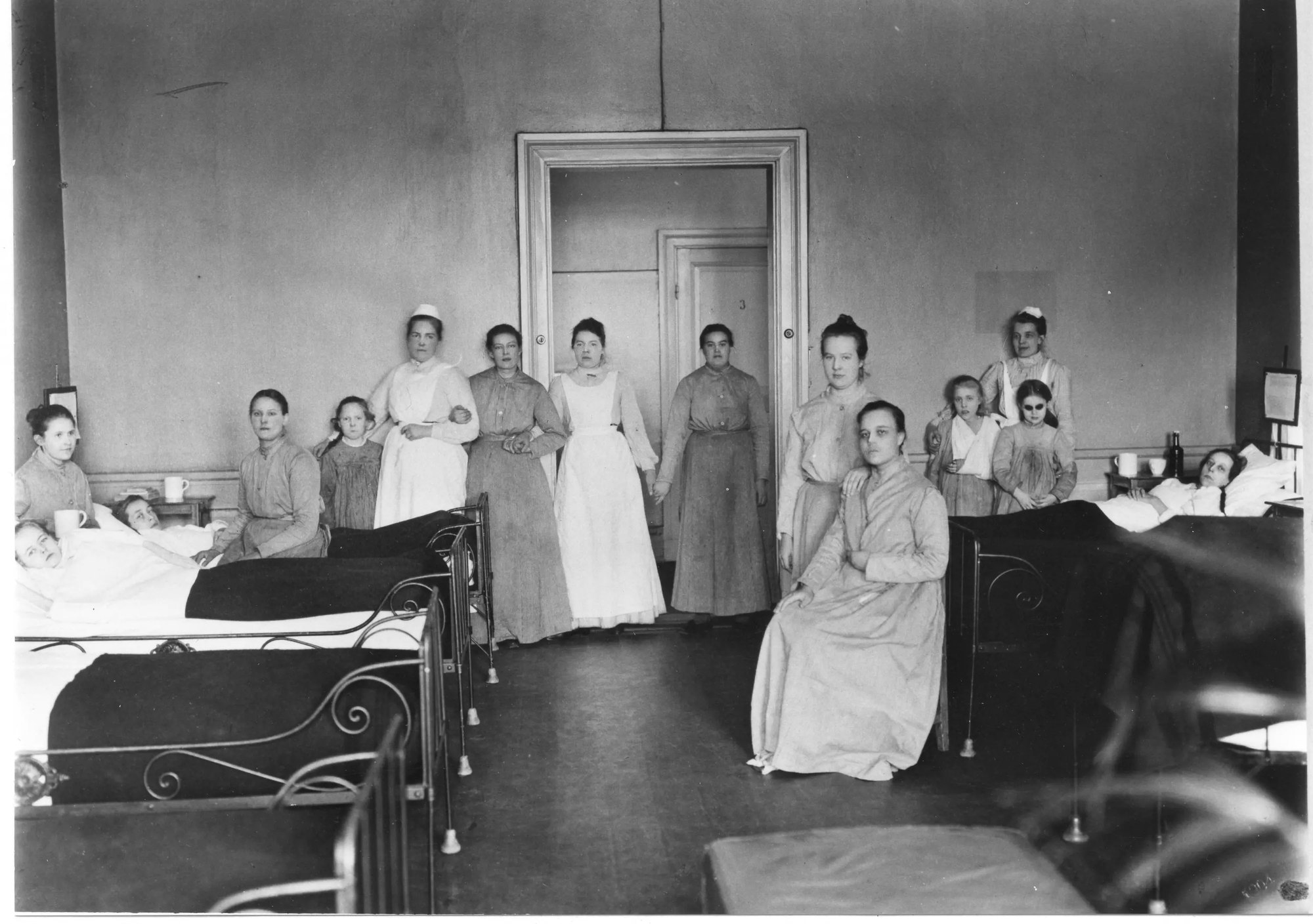
That trend cannot be understood without the Ädel reform. Through government bill 1990/91:14, dated 4 October 1990, the municipalities were given overall responsibility for long-term services and care for older people and people with disabilities, and the nursing homes were transferred to the municipalities on 1 January 1992.14 Care that used to sit on a hospital bed in the region's accounts has since then sat in the municipality's.14 For the same reason, the regions' 401,729 monthly paid jobs in 1990 cannot be read against 293,915 in 2025 as a simple fall.9 The association itself writes that the figures in that table are not fully comparable over time.9
Health centres are also changing. In 2016 there were 1,144 health centres, of which 486 were privately run, so 42.5%.10 In 2024 there were 1,245, of which 583 were private, so 46.8%.10 Among the professions, healthcare social workers grew fastest between 2019 and 2023 relative to the population, from 614 to 2,816 in work.4 Dental hygienists fell the most, from 4,431 to 4,032.4
Sweden compared with other countries
Sweden spends about as much on healthcare as comparable countries.11, 12 As a share of GDP in 2024, the US was at 17.2%, Germany at 12.2, France at 11.3, Sweden at 11.2, the UK at 11.1, Finland at 10.7, Denmark at 9.6 and Norway at 9.2.12 Per inhabitant in purchasing power adjusted dollars, Sweden was at 7,906, behind the US at 14,823, Germany at 9,584, Norway at 9,243 and the Netherlands at 8,696, but ahead of France at 7,433, Denmark at 7,401 and the UK at 7,008.12
Staffing levels are also in the middle.11 The Agency for Health and Care Services Analysis notes that Sweden's density of doctors and nurses is about average among similar countries, but that the number of general practitioners per 1,000 inhabitants is the lowest among them, 0.6 against an average of 0.8.11
Hospital beds are the figure where Sweden stands out, and it needs the full caveat. With 1.87 beds per 1,000 inhabitants in 2024, Sweden has the lowest number in the EU.11, 12 The Netherlands had 2.21, Denmark 2.26, the UK 2.44, Finland 2.48, Norway 3.20, France 5.34 and Germany 7.59.12 The measure does not, however, count places in housing for older people and people with disabilities, and on 31 October 2025, 85,000 people aged 65 and over had a current decision granting them special housing.7, 12 The agency describes the low figure both as the result of a long-term shift of care to outpatient care and municipal healthcare, and partly as a shortage of capacity.11
Do people get care in time?
The healthcare guarantee sets four time limits, and the National Board of Health and Welfare reports how well they are met every month.8, 15 In July 2026, 92% got contact with primary care the same day and 93% a medical assessment within three days.8 76% got a first visit in specialist care within 90 days, and 66% got an operation or treatment within 90 days.8 None of the limits is fully met.8 The figures are updated on the second Tuesday of each month, and the agency itself warns that nine regions are changing their medical records systems, which may affect reporting and data quality.8
Municipal healthcare is a separate part of the picture. In 2025 almost 404,000 people received services there, and about 352,000 got at least one care measure.6 Of those receiving it, 83% were 65 or older.6 The number has been broadly unchanged since 2016, when it was just over 405,000.6
What the figures do not say
The latest year in the association's activity statistics is not comparable.10 For 2025 two regions are missing from the data, which makes both hospital beds and health centres look as if they are falling more than they are.10 So the figures above refer to 2024.
Employees and jobs are different figures, and full-time equivalents are a third.9 The regions had 293,320 employees and 254,869 actual full-time equivalents in November 2025, and the difference is working hours and absence, not missing people.9
And the two counts of episodes of care measure different scopes. The difference between 1,169,485 and 1,382,704 is not a change over time but a difference in what is counted.5, 10 The same applies to the 14 and 16.5 million outpatient visits.5, 10
What to take away
Healthcare in Sweden cost 718,938 million kronor in 2024, so 11.2% of GDP, and 86.1% of it was publicly funded.1, 16, 17 The same year 861,388 people were employed in health and social care, just under one in six of everyone in work in the country.18 The direction is set by who is in charge over decades: when the nursing homes were moved to the municipalities in 1992, care that used to sit on a hospital bed in the region's accounts moved too, and the number of available hospital beds went from 23,209 in 2016 to 19,726 in 2024.10, 14 Follow Statistics Sweden's health accounts, the National Board of Health and Welfare's figures on meeting the healthcare guarantee, updated on the second Tuesday of each month, and the association's activity statistics on hospital beds and health centres.1, 8, 10
The next episode is S2:E4 Ageing, on how many people are old at the same time and how the dependency burden is counted.
Education, not advice.
The fund
Behind the library stands a fund.
Own The Future is published by AIX. The library is the knowledge; AIX Dynamic is the tool, a systematic securities fund (UCITS) that follows the trend and steps aside when risk rises.
This is marketing. Fund units can both rise and fall in value. Read the key information document (KID) and the prospectus before you invest; you will find them on the fund's page at Avanza.
34 UNITHOLDERS · AS OF 15 SEP 2026The future in your inbox.
The most important things from each area, without the noise and without the hype.
Sources
- Statistics Sweden (Statistiska centralbyrån, SCB), Hälsoräkenskaper (Health accounts), published 31 Mar 2026, the tables for spending relative to GDP and for spending by function and funder. The total of 718,938 million kronor, the share of GDP, the split by funder and function, and the series from 2015. Spending is in current prices and the latest year is preliminary.
- Statistics Sweden, Befolkningens arbetsmarknadsstatus (BAS) (Labour market status of the population), employed people by industry, SNI 2007. The figures of 861,388 and 359,569 employed, the split by sex and the comparison industries.
- Statistics Sweden, Statistikdatabasen, Folkmängden efter ålder och kön (Statistical Database, population by age and sex). The denominator of 10,587,710 inhabitants on 31 Dec 2024.
- National Board of Health and Welfare (Socialstyrelsen), Statistik om hälso- och sjukvårdspersonal (Statistics on healthcare staff), with an Excel appendix. Licensed professionals in work by licence group 2019 to 2024, the density per 100,000 inhabitants and the protected professional title assistant nurse.
- National Board of Health and Welfare, DRG-statistik 2024 (DRG statistics 2024). Episodes of care, days of care, average length of stay, diagnoses per episode, outpatient visits and diagnosis groups, and the note that national statistics for primary care are missing.
- National Board of Health and Welfare, Statistik om kommunala hälso- och sjukvårdsinsatser 2025 (Statistics on municipal healthcare services 2025), published 1 Jun. The number of people receiving services and the age split, and the fact box on which municipalities have taken over home healthcare.
- National Board of Health and Welfare, Statistik om socialtjänstinsatser till äldre 2025 (Statistics on social services for older people 2025). The number of people with a current decision granting special housing on 31 Oct 2025.
- National Board of Health and Welfare, Lägesbild och statistik, tillgänglighet, väntetider och vårdgaranti i hälso- och sjukvård (Current situation and statistics on access, waiting times and the healthcare guarantee), the situation in July 2026. The four key figures for the healthcare guarantee, and the agency's warning about changes of medical records systems in nine regions.
- Swedish Association of Local Authorities and Regions (Sveriges Kommuner och Regioner, SKR), Regionanställd personal 2025 (Region staff 2025), table B and table 1, and Kommunal personal 2025 (Municipal staff 2025), table B. Employees, full-time equivalents and occupational groups in November 2025, and the jobs in 1990 with the association's own note on comparability.
- Swedish Association of Local Authorities and Regions, Verksamhetsstatistik 2016 till 2025 (Activity statistics 2016 to 2025), the tabs for hospital beds, episodes of care and health centres. The series 2016 to 2024. The year 2025 lacks two regions and is not used.
- Swedish Agency for Health and Care Services Analysis (Myndigheten för vård- och omsorgsanalys), Nationell uppföljning av hälso- och sjukvården 2026 (National follow-up of healthcare 2026), PM 2026:3. The real cost trend 2014 to 2024, the density of general practitioners and the analysis of the hospital bed figure.
- OECD, Data Explorer, the dataflows Health expenditure and financing and Health care resources, for spending as a share of GDP, spending per inhabitant in purchasing power adjusted dollars and hospital beds per 1,000 inhabitants, for 2024.
- The Swedish Parliament (Sveriges riksdag), andra lagutskottets utlåtande nr 80 år 1969 (report no. 80 of 1969 from the Second Law Committee). The seven-kronor reform: the fees of 7 kronor and 15 kronor, the payment of 31 kronor to the body running the care, and the ban on accepting payment on one's own account.
- The Swedish Parliament, proposition 1990/91:14 om ansvaret för service och vård till äldre och handikappade (government bill on responsibility for services and care for older and disabled people), dated 4 Oct 1990. The Ädel reform and the transfer of the nursing homes on 1 Jan 1992.
- The Swedish Parliament, Hälso- och sjukvårdslag (2017:30) (Health and Medical Services Act), Chapter 8 Section 1, Chapter 9, Chapter 12 Sections 1 and 2, and Chapter 14 Section 1. Supports that regions and municipalities are the bodies in charge, the region's duty to offer care to those living in the region, the municipality's duty in special housing and day activities, the transfer of home healthcare in ordinary housing from region to municipality, and the four time limits of the healthcare guarantee.
- Statistics Sweden, Statistical Database, Totala hälso- och sjukvårdsutgifter efter hälso- och sjukvårdsändamål (HC) och finansiär (HF), år 2001 till 2024 (Total healthcare spending by healthcare function (HC) and funder (HF), 2001 to 2024), 31 Mar 2026. Supports the funders' 413,542, 193,571, 11,595 and 92,230 million kronor, the three other funders' 5,126 plus 381 plus 2,493, which together make 8,000, and the functions 364,094, 142,211, 201,411, 198,651, 87,129, 45,361, 21,348 and 8,662.
- Statistics Sweden, Statistical Database, Hälso- och sjukvårdsutgifter i relation till BNP, år 2001 till 2024 (Healthcare spending relative to GDP, 2001 to 2024), 31 Mar 2026. Supports the total of 718,938 million kronor, GDP at market prices of 6,391,596 million kronor and the ratio of 11.2% for 2024, and 462,559 million kronor for 2015.
- Statistics Sweden, Statistical Database, Sysselsatta 15 till 74 år efter näringsgren (SNI 2007), yrkesställning, kön, ålder och födelseregion, årligt register, år 2020 till 2024 (Employed people aged 15 to 74 by industry (SNI 2007), employment status, sex, age and region of birth, annual register, 2020 to 2024), 28 Nov 2025. Supports industry 86 with 359,569, industry 87 with 235,591 and industry 88 with 266,228, the sum of 861,388, the total of 5,260,642, the comparison industries of 551,053, 371,773, 350,792 and 299,015, the split by sex of 283,395 against 76,175, and the starting value of 337,231 for 2020.
- National Board of Health and Welfare, Statistik om hälso- och sjukvårdspersonal med legitimation eller yrkesbevis (2024) samt arbetsmarknadsstatus (2023) (Statistics on healthcare staff with a licence or certificate (2024) and labour market status (2023)), article number 2025-9-9756, 11 Sep 2025, corrected 30 Sep 2025. Supports table 1 with the density per 100,000 inhabitants on 1 Nov 2023, the 105,121 certificates by the end of 2024, the 175,305 people with the occupation code assistant nurse in the occupational register in 2022, and the exemption rule until 30 Jun 2033.
- The Swedish Parliament, Patientsäkerhetslag (2010:659) (Patient Safety Act), Chapter 4 Section 5 a and the transitional provisions of act 2021:739. Supports that only those with a certificate may use the professional title assistant nurse, the entry into force on 1 Jul 2023, and the ten-year rule up to and including 30 Jun 2033.
Links retrieved 9 Sep 2026.
Extended on 13 Sep 2026 with Statistics Sweden's tables in the Statistical Database behind the health accounts and the labour market status, the National Board of Health and Welfare's statistical report on healthcare staff, and the Health and Medical Services Act and the Patient Safety Act. The National Board of Health and Welfare's summary gives diseases of the muscles, skeleton and connective tissue as 14.5% of care contacts in specialist somatic outpatient care, while table 5 of the report gives 14.6% of all 11,896,196 care contacts; the article follows the summary. The hospital bed figure of 19,726 is a daily average that appears in the sources as 19,725.94.