OWN THE FUTURE · SEASON 4 · CLIMATE & RESOURCE SCARCITY
What is a battery, and why is storage hard?
A battery stores energy so that it can be used later, when it is needed. We explain how a battery works, what it is made of and why storage is hard.
Published 10 Sep 2026 · About 10 minutes to read
In 1938 there was a whole room under the Enskede telephone exchange in Stockholm that held nothing but batteries.9 Large glass jars on a wooden shelf, each one numbered with an enamel plate and connected to the next, with the lead plates visible through the glass.9 The job of the room was to keep the exchange running when the power grid failed.
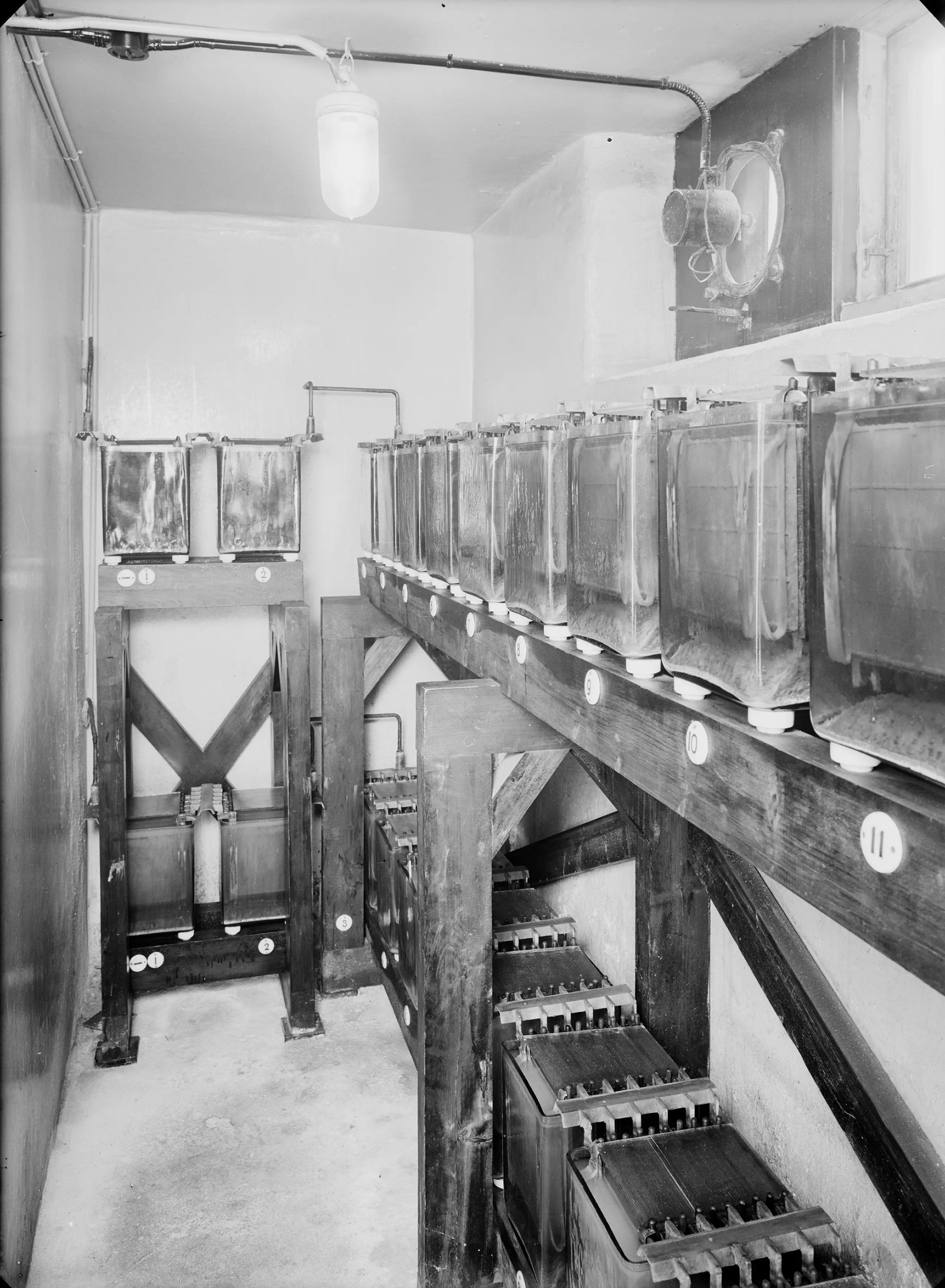
The picture shows exactly what the EU Batteries Regulation today lists in its definition of a battery cell: electrodes, electrolyte, container, terminals and, where relevant, separators, with active materials whose reaction generates electrical energy.6 So a battery converts chemical energy into electrical energy inside a container. In a rechargeable battery the reaction can be driven back when the battery is charged.
Rechargeable batteries are not new. According to the Swedish National Museum of Science and Technology, the Swede Waldemar Jungner patented a rechargeable battery in 1899, and in 1900 a car with his battery was test-driven on the streets of Stockholm for almost 150 kilometres in one go without recharging.11, 12 That it still took more than a hundred years before electric vehicles became common is exactly what the factor described below predicts: petrol carried more energy per kilo, and that settled it.4, 11
This article explains the parts, works out how much energy fits in them, and shows why Sweden's largest energy store is not a battery at all. Where the electricity comes from is counted in S4:E1 Clean Energy.
The parts
A cell has two electrodes, anode and cathode, with an electrolyte between them and usually a separator that stops them from touching each other.6, 13 During discharge, ions travel through the electrolyte from one electrode to the other, while the electrons are forced to take the outer route through the device being powered.13 During charging, the same reaction is driven backwards.13
The chemistry decides the properties. The type without nickel and cobalt is safer against fire and lasts for more charging cycles, but carries about 20% less energy per kilogram than the type that contains them.7, 13 That is a real trade-off, not a flaw waiting to be fixed.
The annex to the Regulation also lists the ways a battery can fail, among them dendrite formation inside the cell and thermal runaway that spreads from cell to cell.6 That is why battery rooms have their own ventilation and their own fire rules, both in 1938 and today.6
A lithium-ion cell has four main parts. The cathode and the anode store the lithium ions, the separator stops them from short-circuiting against each other, and the electrolyte carries the ions between them.6, 13 They are the same four functions that were in the glass jars in 1938, with other materials.
What the Swedish battery fleet looks like
The statistics divide the batteries into four size classes, and one of them is empty.1, 14 Plants under 1 megawatt hour together had 87 megawatts and 99 megawatt hours.14 The class from 1 to 10 megawatt hours had 185 megawatts and 182 megawatt hours.14 The class above 10 and up to 100 megawatt hours had 280 megawatts and 286 megawatt hours.14 The class above 100 megawatt hours was empty: no single grid-connected battery in Sweden was larger than that in 2024.14
The duration is also the same in every class, between 0.98 and 1.14 hours.14 It is the same figure everywhere, whatever the size, which says something about what the plants are built for.
Why the fuel tank wins on weight
Two figures from two databases explain most of it. One kilogram of petrol carries 12.13 kilowatt hours, according to the Swedish Energy Agency's (Energimyndigheten) own calorific values.4 One kilogram of lithium-ion cell carries between 0.09 and 0.30 kilowatt hours.7, 13 That is a factor of between 40 and 135.4, 7
That comparison is not the whole truth, though, and the honest other half belongs here too. Only 12 to 30% of the energy in petrol reaches the road in a combustion engine, according to the US Department of Energy and the Environmental Protection Agency.8 Counted on what actually becomes motion, and against the most energy-dense lithium-ion cell, the factor shrinks to between about 5 and 12.4, 7, 8
Even the smaller factor explains a lot. It is the reason an electric car is heavier than a petrol car, that flying is harder than driving, and that a grid battery is built for an hour and not for a week.
Diesel is close to petrol at 12.02 kilowatt hours per kilogram.4 At the other end, the lead-acid battery that stood in the cellar in 1938 manages 35 to 40 watt hours per kilogram, about 300 times less than petrol.4, 15 Lithium-ion technology has moved the limit a long way, but nowhere near the level of fuel.
Sweden's two stores
Sweden has about 900 hydropower plants in the electricity statistics, with reservoirs that together hold 33.7 terawatt hours.3, 16 All the country's grid-connected batteries together hold 567 megawatt hours and have a combined capacity of 551 megawatts.1, 14
is what the energy capacity of all grid-connected batteries amounts to, measured against Sweden's average electricity production in 2024. Full reservoirs amount to 71.6 days on the same comparison. The figures give the amount of energy; the power of the stores limits how fast it can be delivered.
SOURCE: SCB, SCB AND SWEDENERGY, OWN CALCULATIONThe difference in power is just under thirty times.14, 16 The difference in stored energy is almost sixty thousand times.3, 14 That does not describe a weakness of batteries. It describes what a battery is: a source of power rather than a store of energy. And that makes the Swedish situation unusual. Sweden already has enormous storage. It was built a hundred years ago and it is made of water.
The reservoirs are also rarely full. In week 35 of 2026 they held 24,559 gigawatt hours, a filling level of 73.2%.3 The average for the period 1960 to 2025 is 80.6%.3 So the figure of 33.7 terawatt hours is a ceiling and not a normal state.3
The number of plants says something else about the system. Hydropower has about 900 plants in the electricity statistics, nuclear power three, and solar power 293,019.16 The same electricity system therefore holds both a few very large plants and hundreds of thousands of very small ones.
The relationship between the two ratios is the whole point. The energy ratio is about 2,000 times larger than the power ratio.3, 14, 16 So a battery can be comparable with hydropower in one respect and not comparable at all in the other, and which respect applies depends on the question.
Put another way: at the full installed capacity of hydropower, full reservoirs would last 2,071 hours, that is 86 days.3, 16 At its full power, the battery fleet would last just over an hour.14
What the batteries actually do
The duration of the battery fleet can be worked out directly: 567 megawatt hours divided by 551 megawatts gives 1.03 hours.14 So Sweden's entire fleet of grid batteries can deliver its full power for just over an hour. The same applies within each size class, at 1.14, 0.98 and 1.02 hours.14
The reserves the grid asks for
That is no coincidence. Svenska kraftnät, the national grid operator, buys reserves that keep the frequency in the grid steady, and none of those markets asks for more than one hour.5, 17 The fastest is called FFR, and it requires the power to be in place 0.7 seconds after the frequency has fallen to 49.5 hertz, and to hold for 30 seconds.5, 17
In that market hydropower has zero megawatts of prequalified supply.18 Energy storage has 960 of 1,100 megawatts, that is 87.3%.18 In the slowest reserve the relationship is the reverse: energy storage has 8.2% and hydropower 70.7.18
So the battery fleet is built to fit the markets that exist. Sweden's basic need for the fastest reserve is up to 113 megawatts for 2026, and the prequalified supply from energy storage alone is 8.5 times as large.18, 19
Why each technology fits its own end
There are six reserves, and they differ in how quickly the power must be in place and how long it must hold.5, 17 The fastest requires 0.7 seconds and 30 seconds of endurance.17 The slowest allows several minutes but requires the power to be held much longer.17 Between them are four products with requirements in between.5, 17
A battery fits the fast end of the scale because it responds at once and does not need to start anything. A hydropower turbine fits the slow end because it can run for hours. The way the split between resource types looks is down to what the markets ask for, not to the technology itself.
The rules
The EU Batteries Regulation from 2023 is unusually concrete for a legal act. It has 96 articles, 15 annexes and 68 numbered definitions in Article 3 alone, and it has applied since 18 Feb 2024.6 One of the weightier provisions, the requirement that portable batteries must be removable and replaceable by the user, only starts to apply on 18 Feb 2027.6
The Regulation also sets limits on what a battery may contain: at most 0.0005% mercury by weight in all batteries, at most 0.002% cadmium by weight in portable batteries, and at most 0.01% lead by weight in portable batteries since 18 Aug 2024.6
The other half of why storage is hard
The first half is that the energy density is low. The second is that what you do manage to pack in is flammable.
In Article 12, the EU Batteries Regulation requires stationary battery energy storage systems to be safe during normal operation and use, and the technical documentation to show that they have been tested against the safety parameters in Annex V.6 The annex contains eleven parameters, among them thermal shock and temperature cycling, protection against external short circuit, overcharge, over-discharge, overheating and thermal propagation, and testing for mechanical damage, internal short circuit, thermal abuse, fire and gas emissions.6
The legal text describes the mechanics plainly. On internal short circuits, it says that their occurrence is one of the biggest concerns of battery manufacturers, that it can lead to venting, thermal runaway and sparks that ignite electrolyte vapours, that it can be triggered by manufacturing defects, impurities in the cells or dendritic growth of lithium, and that it causes most safety incidents.6 On thermal propagation, it says that thermal runaway in one cell can cause a cascade reaction through the whole battery.6
The handling of waste batteries is also regulated in detail. Under Annex XII, waste lithium-based batteries must be protected from heat, water and crushing, stored in their normal installation direction in a well-ventilated place and be covered with high-voltage rubber insulation.6
What is sold and what comes back
The Swedish Environmental Protection Agency (Naturvårdsverket) is the agency responsible for statistics on batteries sold and collected, and the figures for 2024 tell two separate stories.10
Portable batteries are a mature system. In 2024, 8,383.5 tonnes were sold and 3,915.4 tonnes were collected.10 The EU collection target under the Batteries Regulation is 63% by the end of 2027 and 73% by the end of 2030.6
Lithium industrial batteries look completely different. In 2024, 40,118.5 tonnes were sold and 498.0 tonnes were collected, that is 1.24% of the amount sold.10 The reason is that most of them are still in use. The series for the amount sold is remarkable in itself: 28.4 tonnes in 2010, 1,571.6 tonnes in 2015, 17,678.7 tonnes in 2020, 52,247.2 tonnes in 2023 and 40,118.5 tonnes in 2024.10 So the figure rose by a factor of about 1,400 in fourteen years, and then fell by 23.2% between 2023 and 2024.10
What the figures do not say
The figure of 551 megawatts should be read as a floor, not as an exact level.14 The Statistics Sweden (SCB) figure refers to 2024, while Svenska kraftnät had 960 megawatts of energy storage prequalified for the fastest reserve alone in July 2026.18 The plants are being built faster than the statistics can count them.
The reservoir volume of 33.7 terawatt hours comes from the industry body and not from a government agency.3 The editors have not found any agency document that gives the total Swedish reservoir volume in terawatt hours, and the figure should be read with that caveat.3
And power and energy are two different things measured in two different units. Megawatts are how much can be delivered at a given moment, megawatt hours are how much is stored. Mixing them up is the most common mistake in the whole subject, and it is the reason a battery and a water reservoir can look comparable in one unit and not comparable at all in the other.
What to take away
Sweden's grid-connected batteries hold 567 megawatt hours and have 551 megawatts of power, which gives a duration of 1.03 hours, while the hydropower reservoirs hold 33.7 terawatt hours.1, 3, 14 The difference is structural and not temporary: one kilogram of petrol carries 12.13 kilowatt hours against 0.09 to 0.30 for a lithium-ion cell, and none of Svenska kraftnät's six reserves asks for a duration longer than one hour.4, 7, 13, 17 A battery is therefore a source of power, built for the fast end. Follow Statistics Sweden's table of grid-connected batteries, Svenska kraftnät's prequalified volumes by resource type, where energy storage had 960 of 1,100 megawatts in the fastest reserve, and the Swedish Environmental Protection Agency's statistics on the amount of batteries sold and collected.10, 14, 18
The next episode is S4:E3 Water, about where the water comes from, what it costs and where it runs out.
Education, not advice.
The fund
Behind the library stands a fund.
Own The Future is published by AIX. The library is the knowledge; AIX Dynamic is the tool, a systematic securities fund (UCITS) that follows the trend and steps aside when risk rises.
This is marketing. Fund units can both rise and fall in value. Read the key information document (KID) and the prospectus before you invest; you will find them on the fund's page at Avanza.
34 UNITHOLDERS · AS OF 15 SEP 2026The future in your inbox.
The most important things from each area, without the noise and without the hype.
Sources
- Statistics Sweden (SCB), Statistikdatabasen, årlig energistatistik för el (Statistical Database, annual energy statistics for electricity), the tables of grid-connected batteries and of installed capacity and gross production by type of power, 2024. The batteries' 551 megawatts and 567 megawatt hours, hydropower's 16,269 megawatts, and the country's total production of 172,352 gigawatt hours.
- Statistics Sweden, Statistikdatabasen, Folkmängden efter ålder och kön (Statistical Database, population by age and sex). The denominator in the figures per inhabitant. The monthly table is protected with the cell key method, which makes individual counts of people approximate.
- Swedenergy (Energiföretagen), Kraftläget (The power situation). The total reservoir volume of hydropower in terawatt hours. Swedenergy is an industry body, not a government agency.
- Swedish Energy Agency (Energimyndigheten), statistical database, the tables Värmevärden för olika energivaror (Calorific values for different energy products) and Densitet i kg för olika energivaror vid 15 grader Celsius (Density in kg for different energy products at 15 degrees Celsius), retrieved 9 Sep 2026. Petrol: the calorific value for motor petrol, unblended, 9.10 megawatt hours per cubic metre, divided by the density of 750 kilograms per cubic metre for the same product, gives 12.13 kilowatt hours per kilogram. Diesel: the calorific value for diesel fuel, 9.80 megawatt hours per cubic metre, divided by the density of 815 kilograms per cubic metre for diesel fuel MK 1, gives 12.02 kilowatt hours per kilogram. The conversion from volume to weight is the editors' own.
- Svenska kraftnät (the Swedish national grid operator), Om olika reserver (About the different reserves) and the product pages for the individual reserves. Activation times and endurance requirements, the prequalified supply by resource type and the volume requirements for 2026.
- European Union, förordning (EU) 2023/1542 om batterier och förbrukade batterier (Regulation (EU) 2023/1542 concerning batteries and waste batteries, Swedish language version), Articles 3, 11, 12, 59 and 96 and Annexes I, V and XII. The definition of battery cell and active material, the list of failure modes, the limits on substances, the dates of application, the collection targets and the requirements for storing waste lithium-based batteries.
- International Energy Agency, Batteries and Secure Energy Transitions. The energy density of lithium-ion cells per kilogram and the difference between the common chemistries.
- US Department of Energy and Environmental Protection Agency, Where the Energy Goes. The share of the energy in petrol that reaches the road in a combustion engine.
- Swedish National Museum of Science and Technology (Tekniska museet), samlingsposten TEKA0140230 (collection record TEKA0140230) on DigitaltMuseum. The photograph of the battery cellar at the Enskede telephone exchange in 1938, licence Public Domain Mark.
- Swedish Environmental Protection Agency (Naturvårdsverket) and Statistics Sweden, Såld och insamlad mängd batterier efter batterityp (MI0309T03) (Amount of batteries sold and collected by battery type). Amount of portable batteries and lithium industrial batteries sold and collected in 2024, and the series for the amount sold from 2010. The selection industrial batteries, lithium/lithium-ion/lithium polymer (2.6), amount collected, 2024 gives 498.0 tonnes.
- Swedish National Museum of Science and Technology (Tekniska museet), Waldemar Jungner, laddningsbart batteri (Waldemar Jungner, rechargeable battery), published 21 Nov 2016. Supports the patent in 1899 and the test drive in Stockholm in 1900 of almost 150 kilometres in one go without recharging.
- Swedish National Archives (Riksarkivet), Svenskt biografiskt lexikon (Swedish dictionary of national biography), E Waldemar Jungner, volume 20. Supports the main patent of 11 Mar 1899 (no. 10177) and that a car was test-driven in Stockholm in the autumn of 1900 with a capacity of about 15 Swedish miles in 12 hours.
- European Commission Joint Research Centre, Clean Energy Technology Observatory, Battery Technology in the European Union, 2025 Status Report on Technology Development, Trends, Value Chains and Markets, JRC145289, EUR 40663, published 2026. Supports the structure of the cell and the charging and discharging process, and Table 2 with energy density and lifetime by chemistry: the nickel- and cobalt-free type 120 to 240 watt hours per kilogram and 2,000 to 8,000 cycles, the type containing nickel and cobalt 150 to 300 watt hours per kilogram and 1,000 to 1,500 cycles, with the note on mild thermal runaway.
- Statistics Sweden, Statistikdatabasen, Nätanslutna batterier efter lagringskapacitet, år 2024 (Grid-connected batteries by storage capacity, 2024), updated 8 Oct 2025. Supports the total of 551 megawatts and 567 megawatt hours, the four size classes 87 and 99, 185 and 182, 280 and 286, and zero and zero, and so the durations of 1.03, 1.14, 0.98 and 1.02 hours.
- Sandia National Laboratories, Battery Based Stationary Energy Storage, material for the Colorado Public Utilities Commission, 2024. Supports the practical energy density of the lead-acid battery of 35 to 40 watt hours per kilogram.
- Statistics Sweden, Statistikdatabasen, Bruttoproduktion, installerad effekt samt antal anläggningar fördelat på elområde, år 2015 till 2024 (Gross production, installed capacity and number of plants by electricity area, 2015 to 2024), updated 8 Oct 2025. Supports, for the whole country in 2024, hydropower's 900 plants and 16,269 megawatts, nuclear power's 3 plants, solar power's 293,019 plants, and the gross production of the five types of power, which adds up to 172,352 gigawatt hours.
- Svenska kraftnät, Översiktlig kravbild för reserver, uppdaterad juni 2026 (Overview of requirements for reserves, updated June 2026) (PDF). Supports that there are six products, FFR's activation time of 0.7 seconds at 49.5 hertz and endurance of 30 seconds, the slowest product's activation time of 100% within 5 minutes and endurance of 1 hour, and that no product requires an endurance longer than 1 hour.
- Svenska kraftnät, Utbud på marknaderna för reserver (Supply in the markets for reserves), prequalified volumes as of 1 Jul 2026. Supports that hydropower has zero megawatts prequalified for FFR, that energy storage has 960 of a total of 1,100 megawatts, that is 87.3%, and that the relationship in the slowest reserve is the reverse, with 1,550 of 18,810 megawatts for energy storage, that is 8.2%, against hydropower's 13,310, that is 70.8%.
- Svenska kraftnät, Behov av reserver idag och i framtiden (Need for reserves today and in the future), volume requirements for 2026. Supports that Sweden's basic need for FFR for 2026 is up to 113 megawatts.
- Statistics Sweden, Statistikdatabasen, Folkmängden efter ålder och kön, år 2025 (Population by age and sex, 2025), updated 24 Feb 2026. Supports the population of 10,605,529 on 31 Dec 2025, which is the denominator in the figures per inhabitant.
Links retrieved 9 Sep 2026.
Extended on 13 Sep 2026 with the individual Statistics Sweden tables behind the electricity statistics and the population, Svenska kraftnät's requirements, volume requirements and prequalified volumes, the European Commission research centre's status report on battery technology, a national laboratory's measured value for the energy density of the lead-acid battery, and the Swedish National Museum of Science and Technology's and the Swedish National Archives' details of the Swedish patent of 1899. Svenska kraftnät's product page for the fastest reserve gives the volume requirement as up to about 100 megawatts, while the agency's page on volume requirements gives up to 113 megawatts for 2026; the article follows the page on volume requirements. The number of hydropower plants is 900 in Statistics Sweden's electricity statistics and 1,790 hydropower stations in Svenska kraftnät's background report on the benefits of hydropower of 14 Apr 2026, where 1,391 of the stations are smaller than 1.5 megawatts; the article follows the electricity statistics. The reservoir volume of 33.7 terawatt hours and the filling levels still come from an industry body, because no government source giving the total reservoir volume in terawatt hours has been found.