OWN THE FUTURE · SEASON 5 · EMERGING GLOBAL WEALTH
How does a payment work, and why did cash disappear from the shops?
When you tap your card, a lot happens in less than a second. We explain how a payment works and why cash disappeared from Swedish shops.
Published 10 Sep 2026 · About 9 minutes to read
You hold your card against the terminal. It beeps. The cashier says thank you, and you leave. The approval can come within a second, and that is exactly why almost nobody knows what happened during it. Clearing and final settlement happen in later steps.5
This article explains it, without technical words. It then goes through how Swedes pay according to the Riksbank's own survey, and shows why the same survey can say, at the same time, that almost everyone uses Swish, the Swedish mobile payment app, and that almost nobody pays with Swish in a shop. Finally it looks at the rest of the world, where the story has happened in a different order.
A payment is a message. The money follows.
The money in your account is a number at your bank.1 A payment is an instruction to reduce that number and increase someone else's.1 If you both have the same bank, that is all it takes: the bank changes two numbers in the same book.1
If you have different banks, there are two steps.5 First a message is sent: your bank promises to pay the shop's bank. That is what happens in the second when the card beeps. The shop gets a yes, and you can leave. Then, later, the banks settle up with each other for real, and only then has the money moved. That step is called settlement, and it is invisible to you.1, 5
The difference between the two steps is clearest in an ordinary bank transfer. The Riksbank writes that a transfer made through online banking on a Friday afternoon reaches the recipient on Monday morning at the earliest.2 The message is sent on the Friday; the money moves when the banks settle up, and that happens on weekdays.2, 5 The Riksbank also points out that Swedish companies in practice cannot make instant payments to each other, because almost no bank offers such a service apart from Swish, which does not work between companies.2
That is the background for understanding the term instant payment. An instant payment is one where both steps happen at once: the recipient has the money in their account within seconds, whatever the day of the week.1 In Sweden, Swish is by far the largest service for such payments, according to the Riksbank.1 Since 2024 there has been a Nordic service for payments within Sweden and between Sweden, Denmark, Norway and Finland, but not every Swedish bank offers it.1
The second when the card beeps
Take the card purchase in the shop once more, this time with the roles spelled out. Four parties are involved: you, the shop, the shop's bank and your bank.6, 7 When you hold your card against the terminal, the terminal sends a question to your bank, through the shop's bank and the network the card belongs to: is there enough money to cover the amount, and is the card in order?5, 7, 8 The answer comes back the same way. The beep is the answer yes.
At that moment your bank has reserved the amount in your account, and the shop has a promise.8 The money has not yet left your bank. It does so later, when the day's payments are added up and settled between the banks in bulk rather than purchase by purchase.1, 5 That is the settlement from the previous section, the one that is invisible to you. It is why a card purchase can show as "reserved" in your account for a while before it becomes an ordinary line on your statement.8
Cash works the other way round. The note in your hand is both the message and the money at once.1 No question is sent to any bank, and nothing is settled afterwards. That difference is part of the background to the Riksbank's advice on preparedness further down in this article.
How Swedes pay, counted in two ways
The Riksbank regularly asks a sample of the population about their payment habits. It is a survey: the figures are what the respondents say, not a count of actual transactions.1 The latest round was collected in September 2025 and answered by 2,008 randomly selected people aged 18 to 84, weighted by sex, age and region.1 The survey asks two kinds of question, and the difference between them is the whole point of this section.
Two kinds of question about the same thing
The first kind is "have you used this in the past month?" Here 91% say they have used Swish, up from 82% in 2023.1, 10 85% have paid with a physical debit card.1, 10 The share who have used a card in their phone, a service where the card is stored in the phone, has risen from 3% in 2018 to 34%.1, 10
The second kind is "how did you pay at your last purchase in a physical shop?" Here the picture looks completely different. 61% answer physical debit card.1, 10 18% answer card in the phone, up from 9% in 2023.1, 10 Adding up all forms of card, debit card, credit card and card in the phone, it comes to about 92% of the payment methods at the last purchase in a physical shop.1, 10 Only 2% paid with Swish at their last purchase in a shop.1, 10 And 5% paid in cash.1, 10
Why the same survey gives two answers
Same survey, same people: 91% use Swish, 2% paid with Swish at the till.1, 10 Neither figure is wrong. The first measures whether people used the service at all during a month, for example to split a restaurant bill. The second measures what happened on a single occasion, in a shop. Swish is everyday between people and rare at the till. The card is the opposite.
The rule to take away is simple: when someone says that "everyone uses" something, ask what was measured. "Has used in the past month" and "used on the last occasion" are two different questions, and they give different answers about the same thing.
Cash: from 40% to 5
At the last purchase in a shop, 5% paid in cash in 2025. In 2023 it was 10%. Fifteen years earlier it was 40%.1, 10
of Swedes paid in cash at their last purchase in a physical shop in 2025. Two years earlier it was 10%, and fifteen years earlier 40%.
Source: Sveriges Riksbank, Payments report 2026, the Swedish public's payment habitsThe Riksbank points to several explanations. Fewer and fewer businesses accept cash, many people find it easier to pay digitally, and about one in three who wanted to pay cash in a shop have been turned away.1 What the survey also shows is the order of events. The card took over the till first. Then the card moved into the phone: from 9% of purchases in 2023 to 18% in 2025.1, 10 Swish took the payments between people, but not the till. Cash fell in almost every survey, with one exception between 2022 and 2023, when the share rose from 8% to 10%.1, 10 What took its place was the card, not some new way of paying.
Sweden is not alone, but it is far ahead. At the last purchase in a shop, 5% paid cash in Sweden in 2025 and 2% in Norway the same year. The Danish figure, 8%, comes from a survey from December 2023.1, 11, 12, 13 In the euro area, cash is still the most common way to pay in shops, according to the Riksbank, but the share is falling there too.1, 14 That figure is measured in a different way: 52% of all purchases in shops during 2024, not 52% of the respondents' last purchase.
That cash is used less does not mean that few people miss it. Almost half of the respondents in the Riksbank's survey think it is fairly or very negative that cash use is falling in Sweden, a share that was 36% in 2022.1 The view is more common among those who live outside the big cities and among people over 65.1
The Riksbank still wants to keep cash
While the Riksbank counts how cash is disappearing from the shops, it gives advice in the other direction. The Riksbank recommends that households keep about 1,000 kronor in cash per adult at home, to be prepared.1, 2 One of the reasons is linked to the first section: a digital payment is a message that has to get through, and that requires electricity, networks and banks to work.1 A note in your hand requires none of that. The Riksbank also points to those who have no payment account or for other reasons cannot use digital payment services.1, 2
The Riksbank also proposes a limit of 10,000 kronor for cash purchases in shops, and takes part in a European project for instant payments between Swedish kronor, euros and Danish kroner.1, 2 These are the Riksbank's proposal and the Riksbank's participation; they are reported here as facts about what the authority does, nothing more.
The rest of the world: the account came before the card
In Sweden almost everyone has had a bank account for so long that the question is never asked. In large parts of the world the account itself is the big change, and it has happened in the past fifteen years.
The account, the phone and the regions
In 2024, 79% of the world's adults had a financial account, up from 51% in 2011, according to the World Bank's Global Findex survey.3, 15 At the same time, about 1.3 billion adults in 2024 had no account at a financial institution or a mobile money service, according to the same source.3, 15 Of them, about 900 million own a mobile phone, and 530 million a smartphone.3
of the world's adults have a financial account, up from 51% in 2011. About 1.3 billion adults in 2024 had no account at a financial institution or a mobile money service, and 900 million of them own a mobile phone.
Source: World Bank, Global Findex 2025, press release 16 Jul 2025The phone is the key to the difference from Sweden. Here the account came first, then the card, then the phone. In many countries the phone is the account: 86% of the world's adults own a mobile phone, and 42% of adults in developing economies made a digital payment to a merchant, in a shop or online, during 2024, up from 35% in 2021.3, 15
The differences between regions are large. In East Asia and the Pacific, 83% of adults have an account. In South Asia it is close to 80%, where India pushes the level up with 90% of both men and women. In Latin America it is about 70%, in sub-Saharan Africa 58%, up from 49% in 2021, and in the Middle East and North Africa 53%, up from 45%.3
Instant payments elsewhere
And instant payments, which Swedish companies lack between themselves, exist as national infrastructure elsewhere. The World Bank mentions UPI in India and PIX in Brazil as examples of systems for instant transfers.3 Anyone who thinks Sweden is first in everything to do with payments has a couple of examples to think about there.
Global Findex is based on surveys in 141 countries and economies.4, 15 Just like the Riksbank's survey, it measures what people say, and the two surveys ask different questions. So the figures from the two sources stand separately in this article and are never added together.
What to take away
At the last purchase in a physical shop in 2025, about 92% paid with some form of card and 5% in cash, against 40% fifteen years earlier.1, 10 91% had used Swish in the past month, but only 2% said they used Swish at the till.1, 10 The shift is structural: a payment is a message followed by settlement, and that requires infrastructure, acceptance and habits that change over decades, not quarters. Follow three recurring figures: the cash share at the last purchase and the share who pay with a card in their phone, both in the Riksbank's payments report and its data tables,1, 10 and the share of adults in the world with an account, in the World Bank's Global Findex.3, 15
The next episode is S5:E2 E-commerce, about what happens after the buy button, counted in Swedish parcels.
Education, not advice.
The fund
Behind the library stands a fund.
Own The Future is published by AIX. The library is the knowledge; AIX Dynamic is the tool, a systematic securities fund (UCITS) that follows the trend and steps aside when risk rises.
This is marketing. Fund units can both rise and fall in value. Read the key information document (KID) and the prospectus before you invest; you will find them on the fund's page at Avanza.
34 UNITHOLDERS · AS OF 15 SEP 2026The future in your inbox.
The most important things from each area, without the noise and without the hype.
Sources
- Sveriges Riksbank, Betalningsrapport 2026 (Payments report 2026), March 2026, the section Svenska folkets betalningsvanor (The Swedish public's payment habits). Shares who have used different payment methods in the past month and at the last purchase in a physical shop, cash over time, Nordic comparison, instant payments.
- Sveriges Riksbank, press release Betalningsrapporten 2026: Åtgärder krävs för minskad sårbarhet och ökad inkludering på betalningsmarknaden (Payments report 2026: action needed for less vulnerability and more inclusion in the payment market), 12 Mar 2026. Transfer times, instant payments between companies, the recommendation on cash at home, the proposed limit, the participation in TIPS Cross Currency.
- World Bank (Världsbanken), press release Mobile-Phone Technology Powers Saving Surge in Developing Economies, 16 Jul 2025, on Global Findex 2025. Share of adults with an account, number without, mobile phone ownership, digital payments to merchants, regional levels, UPI and PIX.
- World Bank, The Global Findex Database 2025: Connectivity and Financial Inclusion in the Digital Economy, 2025. Number of economies and number of respondents in the survey.
- Sveriges Riksbank, Fakta, Betalningsprocessen (Facts, the payment process), from Den svenska finansmarknaden 2024 (The Swedish financial market 2024), 19 Jun 2024. The three steps of a payment, authorisation, clearing and settlement, the balance check at the time of payment, the clearing house's batch and the settlement between the banks' accounts.
- Sveriges Riksbank, Bra med ökad konkurrens bland betalsätt i butik (More competition between payment methods in shops is good), from Betalningsrapport 2025 (Payments report 2025), 10 Mar 2025. The four-party model and its four main actors: the cardholder, the payee, the acquirer and the card issuer.
- Sveriges Riksbank, Offlinebetalningar (Offline payments), updated 6 Jul 2026. The four actors usually involved in a card payment, the checks at the time of payment, and that the money moves in a later step when the transactions are sent to the acquirer.
- The Swedish Parliament (Sveriges riksdag), Lag (2010:751) om betaltjänster (Payment Services Act), chapter 5, sections 23 and 27. The check against the payer's account that there is enough money for a card based transaction, and that the payer's payment service provider reserves funds in the account and releases them only once the exact amount or the payment order has arrived.
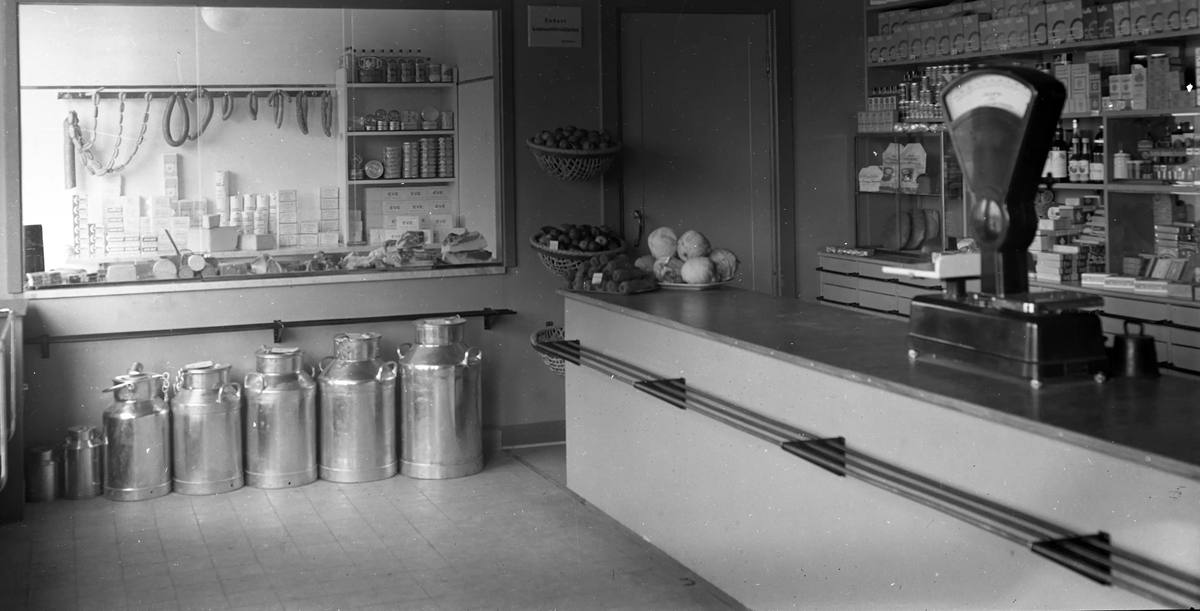
- Kulturparken Småland and Småland Museum (Smålands museum), Interiör från speceriaffär. Växjö (Interior of a grocer's shop. Växjö), collection record ANPE0877 on DigitaltMuseum. The subject, the photographer Anton Persson, the dating 1940 to 1949 and the Public domain mark licence.
- Sveriges Riksbank, Sifferunderlag till Betalningsrapporten 2026 (Data tables for the Payments report 2026), spreadsheet, 12 Mar 2026. The exact figures behind charts 1, 3 and 4 and the full cash series 2010 to 2025.
- Norges Bank, Retail payment services 2024, web report, 4 Jun 2025. That 2% of the respondents in the spring 2025 survey paid in cash at their last purchase at a physical point of sale, and that the question is about the last payment, the same measure as the Swedish one.
- Danish Competition and Consumer Authority (Konkurrence- og Forbrugerstyrelsen), Betalingsrapport 2024 (Payments report 2024), 20 Sep 2024. The Riksbank's stated source for the Danish figure: a survey in December 2023 of just over 2,000 consumers, where the question was about the last purchase in a physical shop.
- Danmarks Nationalbank, Danskernes brug af kontanter falder fortsat (Danes' use of cash keeps falling), analysis, 26 Jun 2026. That cash was used in 9% of payments in physical shops in Denmark in 2025, the payment diary among 3,013 respondents, and that the Danish and the European measures differ from the Norwegian and the Swedish ones.
- European Central Bank (Europeiska centralbanken), Study on the payment attitudes of consumers in the euro area (SPACE) 2024, 19 Dec 2024. The Riksbank's stated source for the euro area: cash as the most common payment method in physical shops at 52% of transactions in 2024, down from 59% in 2022, 72% in 2019 and 79% in 2016.
- World Bank (Klapper, Singer, Starita and Norris), The Global Findex Database 2025: Connectivity and Financial Inclusion in the Digital Economy, 2025. 79% in 2024 against 51% in 2011, the 1.3 billion adults without an account, 86% mobile phone ownership, 42% against 35% for digital payments to merchants, and about 145,000 adults in 141 economies.
Sources read on 4 and 7 Sep 2026. Extended on 14 Sep 2026 with the Riksbank's data tables for the payments report, the authority's description of the payment process and the four-party model, the Payment Services Act's rules on reserving funds, the Nordic and European surveys the Riksbank refers to, and the World Bank's original report and the museum record for the photograph. The Riksbank's main text gives the cash share fifteen years ago as 40%, while the authority's own data tables give 39 for 2010. The article follows the main text. The Danish figure of 8% comes from a Danish survey from December 2023 and is therefore two years older than the Swedish and the Norwegian figures.