OWN THE FUTURE · SEASON 5 · EMERGING GLOBAL WEALTH
What happens after you click buy? Counted in parcels
E-commerce is buying things on a screen instead of in a shop. We explain what it looks like in Sweden, counted in parcels, and what happens after you click buy.
Published 10 Sep 2026 · About 11 minutes to read
In 1899 two men started a mail order company in Insjön in the province of Dalarna.16, 20 The first product was a framed oleograph, a printed copy of an oil painting, of the royal family, which sold 100,000 copies.16, 20 A few months later came the first catalogue, with just over 270 products carefully pictured and described.16, 20 From 1904 it came out twice a year, and in 1906 the village post office closed and moved into the company's own premises.20
According to the Centre for Business History, the company had more than 250 employees in 1909, and the number of parcels sent that year passed a quarter of a million.16, 21 Those two figures have only that one source. Sweden then had 5,476,441 inhabitants.7 The business logic is the same as today: a catalogue instead of a shop, an order form instead of a conversation, a parcel instead of a carrier bag, and a payment at a distance instead of cash over the counter.
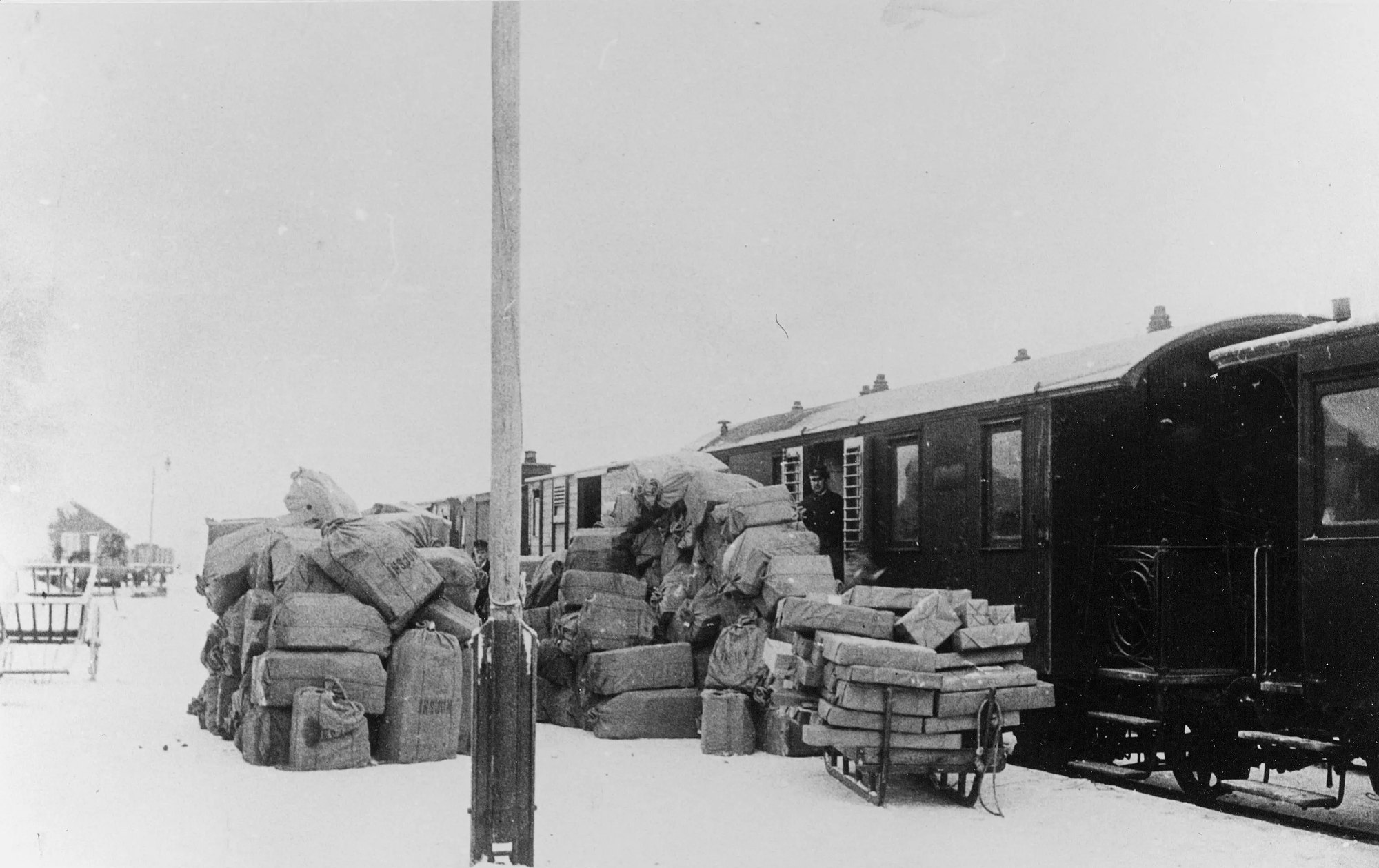
The museum's record for a photograph of the same department two years later describes the routine: an extra sheet, a sale catalogue, was packed with each shipment, or sent out separately to customers from a customer register.19 So targeted marketing based on customer data is no newer than 1911.
This article counts the same thing for the years 2024 to 2026, and then goes through what happens to the parcel after you click buy. The figures come from data collected by the Swedish Post and Telecom Authority (PTS), from Statistics Sweden (SCB), Swedish Customs, the National Board of Trade and the National Board for Consumer Disputes (ARN), from two laws and an EU regulation, and from two industry surveys of how parcels are delivered.
Three counts that must not be added together
E-commerce is measured in three ways in Sweden, and they answer different questions.
The first is the number of parcels. The Swedish Post and Telecom Authority collects it under the EU's parcel regulation, as a duty to report and not as a survey.8, 17 The second is turnover at the consumer level, what Swedes spend in kronor. The third is turnover at the company level, how much of companies' sales comes in through a website or an app. Statistics Sweden puts that share at 12% of turnover at companies with ten or more employees in 2024, and 17% in the retail and wholesale trade.6
The figures sit at different levels and must not be added together. This article is built on the parcels, because their number is affected neither by prices nor by who answers a survey.
313 million parcels
The whole market, and per inhabitant
During 2024, 368 million parcels were distributed across the whole Swedish parcel market. Of them, 313 million were delivered in Sweden. Domestic parcels were 256 million, imports 57 million and exports 55 million. Total turnover in the market was about 24 billion kronor.1, 17
parcels were delivered in Sweden during 2024. That is 29.6 per inhabitant per year, or about 855,200 a day, weekends included.
SOURCE: SWEDISH POST AND TELECOM AUTHORITY, THE SWEDISH PARCEL MARKET 2024, STATISTICS SWEDEN, POPULATIONDivided by the population at the end of 2024, 10,587,710 people, 313 million parcels make 29.6 per inhabitant per year.7, 17 Spread over the 366 days of the leap year, that is about 855,200 parcels a day. Counted that way, e-commerce is a logistics chain with a screen at one end.
Who sends, and the growth since 2018
Of the parcels delivered in Sweden, 74% go from business to consumer, 20% between businesses and 7% have a consumer as the sender.17 Of the three customer types, purchases grow the slowest. During 2024, sales to consumers grew by 6% in volume, while the flow with a consumer as sender grew by 46%.17 The authority reads this as a sign that the second-hand trend is holding up, and it also counts parcels between private individuals in the same flow.
The trend since 2018 is uneven between the parts of the market. Domestic volume grew 58% between 2018 and 2024, imports 64% and exports 35%.17 Measured by turnover, the same parts of the market grew by 60%, 104% and 46% respectively.17 Imports grow faster in kronor than in number. Turnover per imported parcel rose by about 24% between 2018 and 2024, roughly in step with the general price level, so in real terms the parcel is no more expensive to distribute today.24
What counts as a parcel
The definition is shared across the EU and is set out in the parcel regulation. A parcel is a postal item that is not a written message, that contains goods with or without commercial value, and that weighs no more than 31.5 kilograms.8 So it is the weight and the contents that decide, not who sent it or why.
Some e-commerce items are counted as letters instead. During 2025, 964 million letter items were sent in Sweden, of which 71 million were so-called parcel letters, small goods in letter format.2, 18 While traditional letters fell by 9% in volume, parcel letters rose by 7%.2, 18
After the click, in four steps
The first step is legal, and probably the most useful piece of information in the whole article. Under the Consumer Sales Act, the goods are delivered when you have them in your possession, and only then does the risk pass to you.10 If you hired the carrier yourself, the goods count as delivered as soon as they are handed over to it, but not if it was the seller who offered that delivery option.10 So a parcel that goes missing on the way is the seller's problem and not yours, as long as it was the seller who offered the delivery.
The second step is the way home, and it does not look the way it did ten years ago.
The third step is the cooling-off period. With a distance contract you have 14 days, and the period starts on the day you have the goods in your possession.9 It never starts before you have been told about your right to cancel, but it ends at the latest one year after it would have run out if the information had been given.9 The law lists fourteen exceptions.9 Since 19 June 2026, anyone selling through an online interface must also provide a function for using the right to cancel, easy to reach throughout the period and clearly labelled, and must send a receipt without delay.9
The fourth step is added if the parcel comes from a country outside the EU. On 1 July 2026 the customs exemption for items worth 150 euros or less was removed and replaced by a customs duty of 3 euros per item line.11 The 3 euro duty is temporary and will be replaced by a percentage duty on 1 July 2028.11 The fixed Swedish amount for 150 euros is 1,655.30 kronor.11 The duty is 3 euros per item line. Identical goods usually count as one line, but can be declared as separate lines.11
If something still goes wrong, there is the National Board for Consumer Disputes. During 2025 it received 24,603 cases, against 25,685 the year before.15 The consumer was found fully or partly right in 39% of the cases tried, and 76% of the recommendations were followed.15 The decisions are recommendations and not binding.
The map of where parcels are collected
The parcel lockers and the distances
This part of everyday life has been rebuilt in four years. The number of service points that are a parcel locker or parcel cabinet went from 1,446 in 2021 to 8,242 in 2025.3 Their share of all service points rose from 14% to 44%, while the total number of service points went from 10,608 to 18,778.3 At the start of 2026 there were 8,953 unique places for dropping off and collecting parcels, of which 5,164 were tied to a single operator.2, 18
The Swedish Post and Telecom Authority has calculated what this meant for distances in 2024. Having competing service networks shortened the average distance to the nearest service point by 250 metres, and the arrival of parcel lockers by 350 metres.1, 17 The two measures measure different things and cannot be added together, as the authority states.1, 17
The differences within the country are large. In 2024 the average distance to the nearest service point was 350 metres in Solna, the shortest of 290 municipalities, and 7,200 metres in Bräcke, the longest.1, 17 That is just over twenty times the distance to the nearest service point.
How the way of delivery has shifted
The shift can be followed over time in the industry's own annual report. Between the fourth quarter of 2019 and the fourth quarter of 2025, the share who had their latest purchase delivered to a pickup point fell from 64% to 41%, while the parcel locker rose from 2% to 19%.14, 23 Delivery to a letterbox or building mailbox stayed at around 17% to 19%, and the share who had the parcel left outside the door rose from 5% to 13%.14, 23
Two independent surveys point the same way. The annual report finds 41% for pickup points in the fourth quarter of 2025, and the monthly survey the figure is based on finds 42% in July 2026, despite different panels, different survey companies and seven months between the surveys.14, 22, 23
What looked like growth
Statistics Sweden's retail trade index for industry 47.91, mail order and internet retail, comes in two versions. In current prices, that is in kronor, the annual average was 100.0 in 2021, 98.8 in 2022, 98.4 in 2023, 104.3 in 2024 and 117.8 in 2025.5 The series looks almost flat for two years and then rises.
In constant prices, that is adjusted for price changes, the same period looks different. There the annual average was 99.8 in 2021, 92.5 in 2022, 84.7 in 2023, 88.2 in 2024 and 99.3 in 2025.5 So volume fell by 7.3% in 2022 and by a further 8.5% in 2023, and was back close to the 2021 level only in 2025.5 The annual averages are our own calculation from Statistics Sweden's monthly values.
The difference between the two series is the whole point. During two years of high inflation, sales volume in constant prices fell while turnover in current prices looked unchanged. E-commerce statistics are usually quoted in current prices. That gives a question that needs no background knowledge: is the figure in kronor or in things?
What comes from abroad
The National Board of Trade (Kommerskollegium) states that 5.8 billion low-value items were imported into the EU during 2025, about 16 million a day, against 4.6 billion in 2024 and 1.4 billion in 2022.12 Of the items in 2025, 93% came from China.12 They make up about 98% of all imported units of goods into the EU but only about 2% of the import value.12
What happens when the price of such an item changes can be measured without guessing. The Swedish Trade Federation's monthly survey for July 2026 shows that the share of consumers who bought from the two big low-price platforms fell from 18% in July 2025 to 8% in July 2026, after the customs duty was introduced on 1 July.13, 22 The Swedish Trade Federation itself says it is too early to call it a permanent fall.13
Who is left out
In 2025, 86% of the population aged 16 to 85 had bought or ordered goods or services online in the past year.4 At the same time, 517,500 people, or 6%, had never done so.4 Among those aged 75 to 85 the share is 24%, and among those aged 65 to 74 it is 13%.4
Income matters, but less than you might think, and geography even less. In the lowest income fifth, 73% had shopped online in the past year, against 93% in the highest.4 In big cities 86% had done so, against 83% in sparsely populated areas.4
And it does not always go well. Of the population aged 16 to 85, 19% said a delivery had taken longer than promised, 12% that it was hard to find information about guarantees, 7% that it was hard to complain or return a faulty item and 2% that they had been victims of fraud.4 The share who reported no problems at all was 41%.4 The share hit by a late delivery has fallen from 24% in 2021 to 19% in 2025.4
What is worth taking away is simple. Ask whether an e-commerce figure is counted in kronor or in things, and remember that the parcel is the seller's responsibility until it is in your hand, when it is the seller who offered the delivery.10
What to take away
During 2024, 313 million parcels were delivered in Sweden, or 29.6 per inhabitant, and 74% went from business to consumer.17 At the same time, retail volume in constant prices fell in 2022 and 2023 while the kronor looked unchanged.5 The force is structural rather than fast: the number of service points that are parcel lockers rose from 1,446 in 2021 to 8,242 in 2025, and a network of pickup points, laws and customs rules is rebuilt over many years.3 Follow the parcel volumes in the Swedish Post and Telecom Authority's annual report on the parcel market,17 Statistics Sweden's retail trade index for industry 47.91 in constant prices5 and the number of cases at the National Board for Consumer Disputes.15
The next episode is S5:E3 Financial Inclusion, about what an account is and who still does not have one.
Education, not advice.
The fund
Behind the library stands a fund.
Own The Future is published by AIX. The library is the knowledge; AIX Dynamic is the tool, a systematic securities fund (UCITS) that follows the trend and steps aside when risk rises.
This is marketing. Fund units can both rise and fall in value. Read the key information document (KID) and the prospectus before you invest; you will find them on the fund's page at Avanza.
34 UNITHOLDERS · AS OF 15 SEP 2026The future in your inbox.
The most important things from each area, without the noise and without the hype.
Sources
- Swedish Post and Telecom Authority (Post- och telestyrelsen), Den svenska paketmarknaden 2024 (The Swedish parcel market 2024), report PTS-ER-2025:12, published 17 Sep 2025. The number of parcels, the split by part of the market and customer type, turnover, distances to service points and the authority's own note that the two distance measures cannot be added together.
- Swedish Post and Telecom Authority, Svensk postmarknad 2026 (The Swedish postal market 2026). Letter volumes and parcel letters in 2025, and the number of unique service points at the start of 2026.
- Swedish Post and Telecom Authority, Svensk postmarknad 2025 (The Swedish postal market 2025). The series of service points and parcel lockers 2021 to 2025.
- Statistics Sweden (SCB), Statistikdatabasen (the Statistical Database), Befolkningens it-användning (The population's use of IT), subject area E-handel (E-commerce). The table Köpt eller beställt varor och tjänster via internet efter tidsperiod, kön och redovisningsgrupp (LE0108T22N2) (Bought or ordered goods and services online by time period, sex and group) with the selection time period in the past year and never bought or ordered, both sexes, groups by age, income and type of region, table content share of people in per cent, year 2025. The table Problem som uppstått när man köpt eller beställt varor och tjänster via internet (LE0108T55N) (Problems when buying or ordering goods and services online) with the same content and year 2025. The table paths in the open data are LE/LE0108/LE0108G/LE0108T22N2 and LE/LE0108/LE0108G/LE0108T55N.
- Statistics Sweden, Statistikdatabasen, the table Detaljhandelns omsättning efter näringsgren SNI 2007, index 2021 lika med 100 (DetOms07N) (Retail trade turnover by industry, SNI 2007, index 2021 equals 100). Selection: industry 47.91, the table contents current prices and calendar adjusted constant prices, the months 2019M01 to 2025M12. The annual averages in the text are our own calculation from the monthly values. The table path in the open data is HA/HA0101/HA0101B/DetOms07N.
- Statistics Sweden, Statistikdatabasen, Företagens användning av it (Companies' use of IT), subject area E-handel (E-commerce), the table Omsättning från e-handel efter typ av beställning och redovisningsgrupp (ForetagOmsEHandelN) (Turnover from e-commerce by type of order and group). Selection: orders through a website or app, all companies, share of companies' turnover, year 2024. The table path in the open data is NV/NV0116/NV0116E/ForetagOmsEHandelN.
- Statistics Sweden, Statistikdatabasen, the table Folkmängden efter ålder och kön (BefolkningR1860N) (Population by age and sex). Selection: all ages, both sexes, the years 1909 and 2024. The total for 2024 is 10,587,710 inhabitants on 31 December and is used as the denominator. The table path in the open data is BE/BE0101/BE0101A/BefolkningR1860N.
- European Parliament and Council (Europaparlamentet och rådet), förordning (EU) 2018/644 om gränsöverskridande paketleveranstjänster (Regulation (EU) 2018/644 on cross-border parcel delivery services, Swedish language version), Article 2, point 1. The definition of a parcel, a postal item containing goods that weighs no more than 31.5 kilograms.
- The Swedish Parliament (Sveriges riksdag), lagen om distansavtal och avtal utanför affärslokaler (Distance and Off-Premises Contracts Act), chapter 2. The 14 day cooling-off period, when it starts, the exceptions, and the requirement for a cancellation function in online interfaces from 19 Jun 2026.
- The Swedish Parliament, konsumentköplagen (Consumer Sales Act), chapter 2, sections 3 and 6. What counts as delivery, and that the risk passes to the consumer when the goods are delivered.
- Swedish Customs (Tullverket), Förändringar för lågvärdeförsändelser (Changes for low-value consignments). The customs duty of 3 euros per item line from 1 Jul 2026, the period of validity to 2028 and the fixed amount for 150 euros.
- National Board of Trade Sweden (Kommerskollegium), Direktimport till konsumenter via onlineplattformar (Direct imports to consumers via online platforms), March 2026. The volumes into the EU 2022 to 2025, the split by origin and the share of import value.
- Swedish Trade Federation (Svensk Handel), E-handelsindikatorn juni och juli 2026 (The e-commerce indicator, June and July 2026). The delivery methods for the latest online purchase and the change in the share who buy from foreign low-price platforms, with the organisation's own caveat.
- PostNord, E-barometerns årsrapport 2025 (E-barometer annual report 2025). The method and the report's own definition of e-commerce are on page 2, the comparison of delivery methods on page 33. The six-year series runs from the fourth quarter of 2019 to the fourth quarter of 2025. The data come from 101 retail companies and twelve monthly surveys with just over 1,200 respondents each.
- National Board for Consumer Disputes (Allmänna reklamationsnämnden), statistik (statistics) for 2025. The number of cases received, the share where the consumer was found right and the share of recommendations followed.
- Postmuseum (the Swedish Postal Museum), samlingsposten POST.019077 (collection record POST.019077), and Företagskällan's account of postorderns början i Insjön (the beginning of mail order in Insjön), and the Centre for Business History (Centrum för Näringslivshistoria) via Stockholmskällan, which is the only source for the number of employees and the number of parcels sent in 1909. The catalogue, the number of employees and the number of parcels sent in 1909.
- Swedish Post and Telecom Authority, Den svenska paketmarknaden 2024 (The Swedish parcel market 2024), report PTS-ER-2025:12, ref. 25-9191, dated 17 Sep 2025, the full report as PDF. 368, 313, 256, 57 and 55 million parcels, turnover of about 24 billion kronor, the split 74%, 20% and 7%, growth of 6% for sales to consumers and 46% for the flow with a consumer as sender, the six-year series 58%, 64% and 35% in volume and 60%, 104% and 46% in turnover, the distance effects of 250 and 350 metres with the authority's own note that they cannot be added together, and 350 metres in Solna and 7,200 metres in Bräcke out of 290 municipalities.
- Swedish Post and Telecom Authority, Svensk postmarknad 2026 (The Swedish postal market 2026), report PTS-ER-2026:8, dated 17 Apr 2026, the full report as PDF. 964 million letter items in 2025, 71 million parcel letters, minus 9% for traditional letters and plus 7% for parcel letters, and 8,953 unique service points at the start of 2026, of which 5,164 were tied to one operator.
- Postmuseum, Avgående avdelningen hos Åhlén och Holm, Insjön (The dispatch department at Åhlén och Holm, Insjön), collection record POST.019078 on DigitaltMuseum, photographed 1911. The sentence about the extra sheet, the sale catalogue and the customer register.
- Centre for Business History, Det började med postorder (It started with mail order), handelnshistoria.se, published 28 Sep 2023. The start in 1899, the oleograph in 100,000 copies, the more than 270 products in the first catalogue, the catalogue twice a year from 1904 and, in the caption to image AHL000140, that the post office in Insjön closed and moved into the company's premises in 1906.
- Centre for Business History, Åhléns år för år (Åhléns year by year), handelnshistoria.se, published 28 Sep 2023. That the company had more than 250 employees in 1909 and that the number of parcels sent that year exceeded a quarter of a million.
- Swedish Trade Federation, E-handelsindikatorn juni och juli 2026 (The e-commerce indicator, June and July 2026), report published 25 Aug 2026, the full report as PDF. The six delivery figures 42%, 21%, 19%, 13%, 2% and 1% for July 2026, the survey method, that the survey company is Novus, that the panel is Novus Sverigepanel, that the target population is the general public aged 18 to 89 and that the number of interviews for July 2026 was 2,044.
- PostNord with HUI Research, E-barometern, Annual Report 2025, English edition, the full report as PDF. The delivery comparison on page 33, 64 against 41, 2 against 19, 19 against 17 and 5 against 13 per cent with the base an average for October to December, and the method on page 2 with 101 companies, twelve monthly surveys with just over 1,200 respondents each, Kantar's web panel and a nationally representative sample aged 18 to 79.
- Statistics Sweden, Statistikdatabasen, Konsumentprisindex (KPI), totalt, 2020 lika med 100, månad 1980M01 till 2026M07 (Consumer price index, total, 2020 equals 100, months 1980M01 to 2026M07), the table KPI2020M. That the general price level rose 26.4% between the annual average for 2018 (97.76) and the annual average for 2024 (123.59).
Links retrieved 9 Sep 2026.
Extended on 14 Sep 2026 with the reports behind the authorities' landing pages, the report behind the delivery figure, the English edition of the industry report, the museum record for the 1911 photograph, the publisher's own timeline and caption for the facts from 1909 and 1906, and the consumer price index. The basic figures on the parcel market are in the report and not on the page listed first. The definition of a parcel is in Article 2, point 1 of the parcel regulation. The annual average in constant prices fell 8.5% between 2022 and 2023 calculated from the monthly values, and 8.4% calculated from the rounded annual averages. The article follows the former.