OWN THE FUTURE · SEASON 3 · RAPID URBANIZATION
Whatever happened to smart cities?
A smart city uses sensors and data to manage traffic, lighting and rubbish. We look at what was promised ten years ago and which of the promises have been kept.
Published 10 Sep 2026 · About 10 minutes to read
Before there were traffic lights, Swedish city junctions were controlled by a person standing in the middle of them. A photograph in the collection of the National Museum of Science and Technology shows a traffic policeman at a signal post at the junction of Regeringsgatan and Hamngatan in Stockholm.11 The signal is a box with two windows and the word STOPP (stop), and it is turned by hand.
So the question has never been whether traffic should be controlled, but by what. First a policeman, then a timed signal, then a detector in the tarmac, then a connected sensor. The smart city is the next link in a long chain, not a break from it.
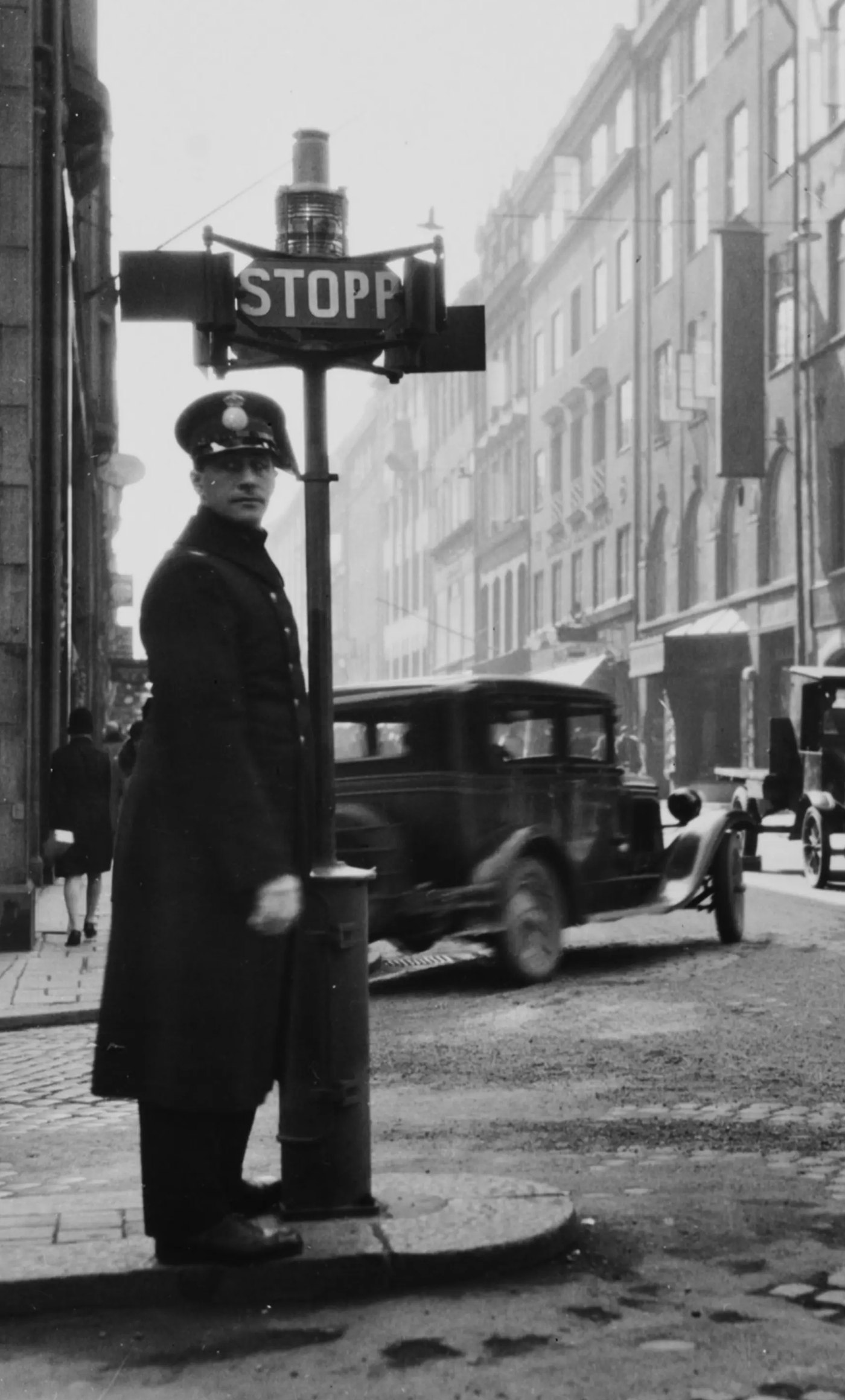
This article tests what was promised in Sweden between 2014 and 2018, and what was reported later. The review follows four documented promises from 2014 to 2018.1, 2, 4, 6 Two of the four had no measurable targets.
What a smart city is, according to Swedish policy documents
The term has no definition in Swedish law. The closest description is in the government's communications to parliament, where a smart city is a city that uses digitalisation and connectivity to improve its own services, and where everything from water, sewage, energy and transport to lighting and traffic lights is connected.7
That the definition exists only in policy documents and not in law has a practical consequence. No agency is tasked with measuring how smart a city is, and there are no official statistics on how many connected street lights or sensors Sweden has. The figures that exist come from individual municipalities' own accounts and from evaluations of individual programmes.
Four promises, two of which could be measured
The period 2014 to 2018 produced four dated Swedish lines of promises. One of them contained both a figure and a year. One contained figures but no target year, one had a year but no figures, and one had neither.
The first was an EU-funded demonstration project with the City of Stockholm as coordinator, decided on 19 Dec 2014. The project's targets were up to 1,500 new jobs at demonstration level and 60% lower energy demand.6, 12 The project also included Cologne and Barcelona.6, 12 The second was the government's interim target of 12 Apr 2018.2, 13 The third was Stockholm's own strategy from spring 2017, which set the goal of becoming the world's smartest city by 2040 but left the measures to be worked out later.4, 14 The fourth was the government's collaboration programme for smart cities, which ran from 2016 to 2018 without concrete targets.1, 16
Of the two measurable promises, one was only half reported. The demonstration project reported 123,000 square metres of renovated floor space, which is a concrete outcome, but the public final reporting contains energy results for individual measures, and we have not been able to verify an overall follow-up of the promise of 1,500 jobs and 60% lower energy demand.6 The second, the interim target, was reported in full and failed.
The target that could be tested
The interim target of 12 Apr 2018 is the only one with both a figure and a year: the share of passenger transport by public transport, cycling and walking was to be at least 25% in 2025, measured in passenger kilometres.2, 13 The starting point was given in the same document as about 20% for the period 2000 to 2016.2, 13
The Swedish Environmental Protection Agency's follow-up of the environmental objectives, updated on 31 Mar 2026, gives the verdict in one line: the interim target has been assessed as not achieved by the target year.3, 15
There is a detail in the 2018 communication that makes the story more interesting. Already then the government wrote that a recurring view among the consultation bodies was that following up the target could be difficult and that more policy instruments were needed to reach it, and that there were requests to specify what the target included and how it would be measured.2, 13 So the objection came eight years before the outcome, and it was about the same thing.
The programme that could never be tested
The government's collaboration programme for smart cities was one of five such programmes in the 2016 to 2018 term of office.1, 7, 16 The Swedish National Audit Office reviewed them and reported the result on 17 Mar 2020.1, 16
Two sentences from that review carry the whole subject. The first: the Swedish National Audit Office has not identified any systematic follow-up work for the collaboration programmes.1, 16 The second: the government nevertheless assesses the programmes as successful in its reporting to parliament.1, 16
It is the state's own auditor saying that the state does not know, and that it reported success anyway. In its latest follow-up of targets, Transport Analysis describes the same kind of problem in the cycling field. There, according to Transport Analysis, the Swedish National Audit Office points in particular to inadequate follow-up of the effects of the measures.8, 17
Stockholm's own review
On 13 May 2026 the City Executive Office in Sweden's largest municipality published a look back at eight years of work on the smart city.4, 18 It is unusually direct, and it is the city's own words about its own work.
The platform few came to use
The ambition in 2017 was a shared platform for connected sensors that would meet the needs of the whole city.4 Three suppliers were chosen from 33 companies in a competitive dialogue, but the procurement was abandoned.4 The city writes that the ambition to procure both technology and expertise that way did not succeed.4 The platform was bought as a licence instead, and the expertise part never happened.4
Today, according to the look back, only a few departments and companies use the platform.4 The city also notes that what the world imagined as the next big technical breakthrough for a data-driven city has not become reality, and that data collected has in practice often stayed with the part of the organisation that produced it.4
The city gives several explanations, and one of them is not about technology. When departments and companies have bought solutions, their own needs and their own budgets have been in charge, which has meant that sharing data and services has often been given low priority.4
initiatives identified for connected sensors in Sweden's largest municipality had become established solutions in operation by 2025.
SOURCE: CITY OF STOCKHOLM, LOOK BACK 13 MAY 2026The initiatives that grew in number anyway
The same document contains the counterweight. Twelve initiatives in 2022 had become 35 by 2025, and eleven of them are established solutions in operation.4 So the central platform idea from 2017 became thirty-five separate initiatives, of which eleven have made it all the way to operation.
The progress also shows in how far the initiatives have come. At the 2022 survey, most of the twelve initiatives were on the first two steps of the development ladder, tests and pilots, and only three had reached higher levels.4 At the 2025 follow-up the weight had shifted from tests towards pilots, but most were still on the first two steps.4
What the money bought
The open project database of Vinnova, Sweden's innovation agency, shows what the agency funded. Between 2016 and 2024, 87,105,126 kronor went to 16 innovation platform projects in two phases.5 Eleven of them went to seven municipalities: Borås, Gothenburg, Kiruna, Lund, Malmö, Stockholm and Umeå.5 Five went to a research institute and two other organisations outside the municipalities.5
The database has a field where the projects themselves write what they achieved. All sixteen have filled it in, but one of them only writes that the project ended early and that results therefore cannot be described.5 The others list methods, networks, coordinator roles, knowledge alliances and models for working across boundaries. In one case, an internal innovation index that rose from 70 to 72 in the staff survey.5 The projects' own descriptions of results are mainly about organisation and ways of working.
The wording in the results field speaks for itself. One municipality reports that an internal innovation index in the staff survey rose from 70 in 2017 to 72 in 2018.5 Another that 134 parties were involved, 51 property owners and developers took part and 13 innovations were tested together.5 A third that new roles were set up at office level, such as innovation coordinators and development coordinators.5 A fourth that it built up interest and willingness to develop the innovation capacity of the municipal group.5
It is entirely possible that such work is worth the money. But what is reported is not sensors, kilometres or units in operation, and it is the funder's own database that shows it.
What is actually in operation
The current state can be counted, and it is smaller and more everyday than the promises. In 2025, 48 of 290 municipalities, or 16.6%, took part in the national climate contract, against nine cities in 2020.10, 19 Among the municipalities that answered an ongoing survey by the Agency for Digital Government, 30% said they had automated business processes widely or in some departments, and 45% within individual functions.9
On the ground, 41 kilometres of new state footpaths and cycle paths were built in 2025, and 111 kilometres of new municipal cycle paths in 2024 by the 49 municipalities that measure it.8 These are kilometres, municipalities and solutions in operation, measured afterwards.
The climate contract grew step by step: nine cities signed in 2020, 23 had done so by 2022, and in 2025 48 municipalities took part, of which 33 pioneer cities and 15 twin cities, together with six government agencies.10
The survey is not yet published, and the response rate among municipalities was 35% at the turn of 2025 and 2026.9 The figures should be read with that caveat. Besides business processes, 32% say they have automated repetitive tasks widely or in some departments, and 28% that they have automated decisions.9
On the traffic side, Transport Analysis also reports that 74 crossings for pedestrians, cyclists and mopeds were newly built or improved in 2025, and that the 49 municipalities that measure together invested just under a billion kronor in new cycling infrastructure in 2024.8
The state has changed its tone
Two government communications, seven years apart, on the same subject. The 2018 communication says that the development of smart cities and regions with digitally driven innovations such as smart grids and transport solutions should be promoted.7
In the 2025 communication a heading instead reads that digitalisation needs to happen with a greater focus on security, and the text notes that it is unavoidable that the smart city therefore brings new vulnerabilities.7
So the state itself has moved the idea from the opportunities column to the risks column, and the move is dated.
What the figures do not say
None of the figures here measures how smart a city is, because nobody measures that. They measure how much was promised, how much was followed up and how much is in operation in the few places where someone counts.
There are also no national statistics for two of the three things the episode description mentions. Traffic can be followed through the accounts of the Swedish Transport Administration and the municipalities, but for connected street lighting and for sensors in waste handling there is no combined Swedish count at all.
And the most important lesson is about method rather than technology. Clear criteria and a date for follow-up make promises easier to test. Two of the four promises in this article could never be tested, and that was not because of the technology.
What to take away
The review follows four documented promises from 2014 to 2018, two of which had no measurable targets.1, 2, 4, 6 The interim target of at least 25% walking, cycling and public transport in 2025 was assessed as not achieved, eleven of 35 initiatives in Sweden's largest municipality were established solutions in operation in 2025, and 87,105,126 kronor went to 16 innovation platform projects.3, 4, 5 What decides the outcome over decades is not the technology but whether a promise has criteria and a date, since no agency measures how smart a city is.1, 4 Follow the Swedish Environmental Protection Agency's follow-up of interim targets, the number of municipalities in the climate contract, and Transport Analysis's measure of newly built footpaths and cycle paths.3, 8, 10
The next episode is S3:E4 Automation, about what happened to work when the machines came.
Education, not advice.
The fund
Behind the library stands a fund.
Own The Future is published by AIX. The library is the knowledge; AIX Dynamic is the tool, a systematic securities fund (UCITS) that follows the trend and steps aside when risk rises.
This is marketing. Fund units can both rise and fall in value. Read the key information document (KID) and the prospectus before you invest; you will find them on the fund's page at Avanza.
34 UNITHOLDERS · AS OF 15 SEP 2026The future in your inbox.
The most important things from each area, without the noise and without the hype.
Sources
- Swedish National Audit Office (Riksrevisionen), Innovation genom samverkan, statens satsningar på strategiska samverkans- och innovationsprogram (Innovation through collaboration, the state's investment in strategic collaboration and innovation programmes) (RiR 2020:6), published 17 Mar 2020. That no systematic follow-up work was identified, and that the government still assessed the programmes as successful in its reporting to parliament.
- The Government (Regeringen), communication 2017/18:238, En klimatstrategi för Sverige (A climate strategy for Sweden), decided 12 Apr 2018. The target of at least 25% of passenger transport by public transport, cycling and walking in 2025, the starting point of about 20%, and the consultation bodies' objections about following up the target.
- Swedish Environmental Protection Agency (Naturvårdsverket), uppföljningen av etappmålen (the follow-up of the interim targets), updated 31 Mar 2026. The assessment that the interim target was not achieved by the target year.
- City of Stockholm (Stockholms stad), Stockholm mot en smart och innovativ stad (Stockholm towards a smart and innovative city), the City Executive Office's look back at eight years of work, 30 pages, dated 13 May 2026, pages 8, 10, 11, 12, 14, 15, 21 and 25. The abandoned procurement, the use of the platform, the city's own explanation, and the growth from twelve initiatives in 2022 to 35 in 2025 with eleven established solutions.
- Vinnova (Sweden's innovation agency), 16 innovation platform projects within the calls 2015-04203 and 2019-03465, of which eleven to seven municipalities and five to the research institute RISE and other organisations. The calls are called Innovationsplattformar för hållbara attraktiva städer (Innovation platforms for sustainable attractive cities), phase 2 and phase 3. The selection is the projects whose funding call is one of these in Vinnova's open project data, retrieved through the interface data.vinnova.se on 9 Sep 2026 (the interface did not respond when checked on 17 Sep 2026). Phase 2 gives eight projects and 44,340,292 kronor, phase 3 eight projects and 42,764,834 kronor, together 87,105,126 kronor. Each project can be looked up by its reference number in Vinnova's project database; the database's own project pages have addresses built on project names, not reference numbers, and so are not linked here. The years 2016 to 2024 in the text refer to the projects' own start and end dates, not decision dates, which the database does not report. The compilation:
- 2015-06039, Go:innovation, Göteborgs Kommun, 2016-01-01 to 2019-08-31, 5,815,352 kronor (phase 2).
- 2015-06042, Future by Lund 2.0, Lunds kommun, 2016-01-01 to 2019-08-31, 6,850,000 kronor (phase 2).
- 2015-06044, Malmö Innovationsarena, MALMÖ STAD, 2016-01-01 to 2019-11-30, 6,672,895 kronor (phase 2).
- 2015-06045, Innovationsplattform hållbara Stockholm, STOCKHOLMS KOMMUN, 2016-01-01 to 2019-08-31, 6,704,868 kronor (phase 2).
- 2015-06046, Innovationsplattform Borås, BORÅS STAD, 2016-02-15 to 2019-08-31, 6,850,000 kronor (phase 2).
- 2016-03253, Innovationsplattform Kiruna -samhällsplaneringsprocessen som innovationsplattform, KIRUNA KOMMUN, 2016-07-01 to 2019-08-30, 7,822,377 kronor (phase 2).
- 2016-04946, Nationell samverkan mellan innovationsplattformar för hållbara attraktiva städer, RISE Research Institutes of Sweden AB, 2016-11-25 to 2019-08-31, 3,334,800 kronor (phase 2).
- 2017-05167, Finansieringsmodeller för förebyggande arbete, RISE Research Institutes of Sweden AB, 2017-12-11 to 2018-11-30, 290,000 kronor (phase 2).
- 2019-02703, Future by Lund 3.0, FBL Innovation ek för, 2019-09-02 to 2023-12-31, 6,650,000 kronor (phase 3).
- 2019-02711, Innovationsplattform hållbara Stockholm, IPHS, Stockholms kommun, 2019-09-02 to 2023-12-31, 6,650,000 kronor (phase 3).
- 2019-02713, Go:Innovation fas 3, Göteborgs kommun, 2019-09-02 to 2023-12-31, 6,547,175 kronor (phase 3).
- 2019-02714, Innovationsplattform Borås (Fas 3), Borås kommun, 2019-09-30 to 2024-06-30, 6,650,000 kronor (phase 3).
- 2019-02715, Innovationsplattformar för hållbara attraktiva städer - fas 3, Kiruna kommun, 2019-09-02 to 2022-12-31, 6,030,000 kronor (phase 3).
- 2019-05199, Innovationsledning i hållbara stadsutvecklingsprojekt, IQ SAMHÄLLSBYGGNAD AB, 2019-11-25 to 2020-12-01, 408,205 kronor (phase 3).
- 2019-05942, SPIS (Social Progress Innovation Sweden), Umeå kommun, 2020-03-01 to 2023-12-31, 7,919,362 kronor (phase 3).
- 2020-00186, Nationell samverkan mellan innovationsplattformar för hållbara attraktiva städer - Fas 3, RISE Research Institutes of Sweden AB, 2020-04-08 to 2022-01-01, 1,910,092 kronor (phase 3).
- European Commission, CORDIS, the final reporting for the demonstration project GrowSmarter, with the Commission's signature date of 19 Dec 2014 and project start on 1 Jan 2015. The targets of 1,500 jobs and 60% lower energy demand, and the later account of renovated floor space.
- The Government (Regeringen), skrivelse 2017/18:230, Strategi för Levande städer (communication 2017/18:230, Strategy for living cities), the section on digitalisation: that the development of smart cities and regions with digitally driven innovations should be promoted. And the Government (Regeringen), skrivelse 2024/25:96, Ny strategi för levande och trygga städer (communication 2024/25:96, New strategy for living and safe cities), section 5.4 on page 17, the heading saying digitalisation needs to happen with a greater focus on security, and the sentence saying the smart city brings new vulnerabilities.
- Transport Analysis (Trafikanalys), Måluppföljningens indikatorer och mått 2026, PM 2026:4 (Indicators and measures for target follow-up 2026, memo 2026:4), the section on walking and cycling. The Swedish National Audit Office's assessment of inadequate follow-up of the effects of the measures, 41 kilometres of new state footpaths and cycle paths and 74 improved crossings in 2025, and 111 kilometres of new municipal cycle paths in the 49 municipalities in Kommunvelometern (the municipal cycling survey) 2024. Background memo to Transport Analysis report 2026:4.
- Agency for Digital Government (Digg), bilaga till uppföljningen av digitaliseringsstrategin (appendix to the follow-up of the digitalisation strategy), February 2026, table 23 on page 20. Data from the agency's ongoing survey; the municipalities' response rate was 35% at the turn of 2025 and 2026.
- Swedish Energy Agency (Energimyndigheten), Klimatkontrakt 2030 (Climate contract 2030), participating cities in 2020 and 2025: nine cities signed the first contracts in 2020, and in 2025 48 municipalities took part, of which 33 pioneer cities and 15 twin cities.
- National Museum of Science and Technology (Tekniska museet), samlingsposten TEKA0016127 (collection record TEKA0016127) on DigitaltMuseum. The photograph of the traffic signal at Regeringsgatan and Hamngatan, licence Public Domain Mark.
- European Commission, CORDIS, the project page for the demonstration project GrowSmarter, grant agreement 646456, 2014 to 2019. The promise of up to 1,500 new jobs at demonstration level, the promise of 60% lower energy demand, the Commission's signature date of 19 Dec 2014, start date 1 Jan 2015 and end date 31 Dec 2019, and that the renovation target covered 100,000 square metres with 70 to 90% lower energy demand.
- The Government (Regeringen), En klimatstrategi för Sverige (A climate strategy for Sweden), communication 2017/18:238, 12 Apr 2018, PDF, 146 pages, section 5.1.6 on pages 71 to 72. The wording of the interim target, the starting point of about 20% for the years 2000 to 2016, and the consultation bodies' recurring view about following up the target.
- City of Stockholm (Stockholms stad), City Executive Office, Strategi för Stockholm som smart och uppkopplad stad (Strategy for Stockholm as a smart and connected city), 2017, PDF, 39 pages, section 2.3 and section 6. That the goal of the world's smartest city is taken from the city's vision for 2040, and that the follow-up measures were to be worked out later, within a coming digitalisation programme.
- Swedish Environmental Protection Agency (Naturvårdsverket), Andelen gång-, cykel- och kollektivtrafik (The share of walking, cycling and public transport), the interim target's own page, last updated 31 Mar 2026. The wording of the target, the target year 2025 and the assessment that the interim target was not achieved by the target year.
- Swedish National Audit Office (Riksrevisionen), Innovation genom samverkan, statens satsningar på strategiska samverkans- och innovationsprogram (Innovation through collaboration, the state's investment in strategic collaboration and innovation programmes), RiR 2020:6, 17 Mar 2020, PDF, 67 pages. The five collaboration programmes, the period 2016 to 2018, the sentence saying no systematic follow-up work was identified, the sentence saying the government still assesses the programmes as successful, and that the programme form is not evaluated.
- Swedish National Audit Office (Riksrevisionen), Statens arbete med att förbättra förutsättningarna för cykeltrafiken (The state's work to improve conditions for cycling), RiR 2025:11, decided 25 Apr 2025, PDF, 103 pages. The review that Transport Analysis describes, the assessment that the state's work on cycling falls short and the recommendation of better follow-up.
- Statistics Sweden's statistical database (SCB Statistikdatabasen), Folkmängden efter region, ålder (utökade åldersgrupper) och kön, år 2025 (Population by region, age, extended age groups, and sex, year 2025). That Stockholm, with 999,239 inhabitants, is the country's largest municipality, ahead of Gothenburg with 613,278 and Malmö with 367,924.
- Statistics Sweden (SCB), Län och kommuner, regionala indelningar (Counties and municipalities, regional divisions). That Sweden has 290 municipalities, the denominator in the 16.6%.
Links retrieved 9 Sep 2026. Extended on 13 Sep 2026 with the project page behind the demonstration project's promises, the PDF of the decided communication, Stockholm's own strategy from 2017, the interim target's own follow-up page, the Swedish National Audit Office's two review reports in full text, and Statistics Sweden's data on the number of municipalities and their populations. The project database gives 19 Dec 2014 as the Commission's signature date and 1 Jan 2015 as the project's start. The Swedish National Audit Office's landing page in k1 is now reached via the address with /granskningar/ instead of /rapporter/, and the collection record in k11 answers 403 to an ordinary request and was therefore read through another route. Vinnova's open project data answers 405 to a HEAD request but 200 to an ordinary request, and the extract on 13 Sep covered 16,494 projects and gave the same 87,105,126 kronor as the source entry states.