OWN THE FUTURE · SEASON 3 · RAPID URBANIZATION
How is a city built, and who decides what?
A house starts as a drawing and a detailed development plan long before anyone pours a foundation. We go through how a city is built, step by step, and who decides what.
Published 10 Sep 2026 · About 10 minutes to read
Sweden's planning law begins with fires. The main purpose of the Building Ordinance of 1874 was to stop fire from spreading, and the means were wider streets and firebreaks.3, 13 Through the Town Planning Act of 1907 the plans gained legal backing, and municipalities got both the right and the duty to buy up land for streets.3, 13 The National Board of Housing, Building and Planning itself describes this as the origin of what is today called the municipal planning monopoly.3, 13
With the Building Act of 1947 the step was taken in full. Municipalities could now decide where and when plans should be drawn up and what they should contain, and denser building could in principle only go ahead under a plan adopted in advance.3, 13 The Building Ordinance of 1960 brought the requirement for a building committee in every municipality, and the responsibility for drawing up plans moved from the landowner to the municipality.3, 13
That order still applies, now through the Planning and Building Act of 2010.1 This article follows the chain step by step, with the decision maker and the deadline set out, and then counts what happens when someone says no. The structures the city rests on are counted in S3:E1 Infrastructure. This one is about the decisions.
The municipality decides, and that is the whole point
The phrase municipal planning monopoly does not appear in the law, but its meaning does. The municipality normally decides on detailed plans. The exception is in Chapter 11, Sections 15 and 16 of the Planning and Building Act: the government may order a municipality to adopt, change or revoke a plan, and if the municipality does not comply, the government may have the county administrative board draw up the proposal at the municipality's expense and then adopt, change or revoke the plan itself.1 Each of the country's 290 municipalities has a building committee that rules on permits.1, 14 Plans are adopted by the municipal council, which under Chapter 5, Section 27 may delegate to the municipal executive board or the building committee the adoption of a plan that is not a matter of principle or otherwise of major importance.1
The comprehensive plan covers the whole municipality and shows how land and water are meant to be used. It is not binding, but in practice it steers what becomes possible later. The municipal council must adopt a planning strategy no later than 24 months after each ordinary election, and if it does not, the comprehensive plan counts as out of date.1 At the end of 2025, in addition, all comprehensive plans adopted before 1 Jan 2004 ceased to apply.1, 4 Four municipality-wide comprehensive plans in the country had gained legal force in the period 1990 to 2003.4
The detailed plan is the opposite. It covers a block or a few properties, it is legally binding, and it decides what may be built and how high. The way to it goes through consultation and review, and in 2025 close to one in four detailed plans was drawn up using the more extensive procedure instead of the standard procedure.4
Seven steps, seven decisions
The order is firmer than it looks. The municipal council decides on the comprehensive plan and the detailed plan. The building committee decides on the building permit, the start notice and the final notice.1 Lantmäteriet, the land survey authority, divides up the land. When a detailed plan is appealed, the court can only uphold or revoke the decision, never adopt a plan in the municipality's place. For appealed permits the usual rules apply, and the higher body can change the municipality's decision.1
One step in the chain carries a deadline with a penalty, and that is the building permit. The building committee has ten weeks to decide, counted from when the application is complete, and the deadline may be extended once by at most ten more weeks.1 If it is exceeded, the law says the fee must be reduced by one fifth for each week or part of a week.1
of the building permit fee falls away for each week or part of a week by which the building committee exceeds the ten-week deadline. After five weeks of delay, the part of the fee covered by the reduction rule can have fallen away completely. Other parts of the fee may remain, and the reduction does not apply if the deadline is exceeded because of a decision under Chapter 9, Section 102.
SOURCE: CHAPTER 12, SECTION 8 A, PLANNING AND BUILDING ACTIt is one of the few places in Swedish administrative law where the individual gets money back when the authority is late. The rule also shows why the process can still take years: the ten-week deadline applies to one of seven steps.1 Before it come the comprehensive plan, the four months for the planning notice, the consultation and review of the detailed plan, and the wait for legal force. After it come the start notice and the final notice.
The rules changed recently. On 1 Dec 2025 a new ninth chapter of the Planning and Building Act came into force.1, 16 Attefall houses and friggebod sheds were replaced by a pool of square metres, the special duty to notify for works exempt from permits was removed, and the ten-week deadline moved from Chapter 9, Section 27 to Chapter 9, Section 99.1, 4, 16
The permit is not permission to start
A granted building permit does not mean the spade can go into the ground. Under the law, work may not begin before the building committee has given a start notice, and before that there is usually a technical consultation where the inspection plan and waste handling are gone through.1 In the start notice the committee sets the inspection plan and decides which documents must be handed in before the end.1
During construction the committee must visit the site at least once if the start notice was preceded by a technical consultation, and always if the project is large or complicated.1 When everything is finished, the building may not be used until the committee has given a final notice, which is issued when the developer has shown that the requirements in the permit, the inspection plan and the start notice are met.1
The permit also has a shelf life. A building permit ceases to apply if the work has not begun within two years and been completed within five years of the decision gaining legal force.1
The step nobody counts on
Property formation can sit between the detailed plan and the building permit. If the project needs a new property or changed property boundaries, a cadastral procedure is required, and that step has neither a statutory deadline nor public attention. The municipality decides separately on the street address.
Lantmäteriet itself gives an average queuing time of around one month, and on top of that an investigation time of around six months for the simplest case, a private person who is going to build a house.6 For creating or changing a public facility it gives eleven months, and for public infrastructure seventeen.6 The authority has handled around 12,000 applications in the past year.6
Six months is longer than the building permit's ten weeks, and for that step there is no fee reduction.1, 6
When someone says no
Why plans are revoked
In 2025 the country's municipalities made 1,036 decisions on detailed plans.4 The same year, 269 planning cases were appealed to the Land and Environment Courts.4 The appeals cover detailed plans and area regulations and should not be read as a share of that year's municipal decisions in particular.4 During the year, plan decisions were revoked in 47 cases.4
The National Board of Housing, Building and Planning's review of the 47 shows that the most common reason was not the content of the plan.4 In 16 cases the reason was that the municipality had handled the planning process badly, and in 13 cases there were shortcomings in investigations and planning documents.4
What the court may examine
This is linked to a rule few people know about. Under Chapter 13, Section 17 of the Planning and Building Act, the court only examines whether the decision breaks a rule of law.1 The main rule is that the decision is upheld or revoked as a whole, but if the municipality agrees, the decision may be revoked in part or changed in some other way, and changes of minor importance may be made without the municipality's consent.1 The reasons are rarely about what the houses look like: among the 47 revoked plans, process errors were given in 16 cases and the design of the planning documents in 13.4 Process error is a wider category than a mistake in the consultation.
The right to appeal is used a lot and rarely changes the outcome. In 2025 the Land and Environment Courts received 2,236 cases under the Planning and Building Act and had 880 outstanding at the turn of the year.5 The Land and Environment Court of Appeal decided 1,146 such cases and changed the lower court's ruling in 111 of them, or 9.7%.5 The same year, 32.5% of criminal cases were changed in the courts of appeal.5
Two limits are worth knowing about. As a main rule, only someone who has put forward comments in writing no later than during the review period, and not had them met, may appeal a detailed plan. The law makes exceptions, among others when the proposal has been changed after the review period.1 And the order of appeal is different for the two decisions: a detailed plan is appealed directly to the Land and Environment Court, while a building permit first goes to the county administrative board.1 A building permit can therefore pass through four levels, a detailed plan three.1
The same law, six times as long a wait
All 21 county administrative boards apply the same law to the same kind of case.4, 14 The average processing time for an appealed permit or advance notice was 107 days nationally in 2025.4 Between the counties the range went from 48 days to 303 days, a factor of 6.3.4
The government has set four target goals for processing times.4 Six of 21 county administrative boards met all four.4 The country as a whole met one of four.4 So your neighbour's appeal costs you roughly a month and a half in one county and ten months in another, with identical legal text.4
What the process lets through
In 2025, 9,748 building permits for new construction were granted, of which 4,729 were for residential buildings. The residential permits covered 35,663 homes.7, 17, 18 The same year, building started on 29,353 homes in new buildings and 31,359 were completed.7, 19 More were completed than started because a building project stretches over several years, so the figures come from different years of started projects.
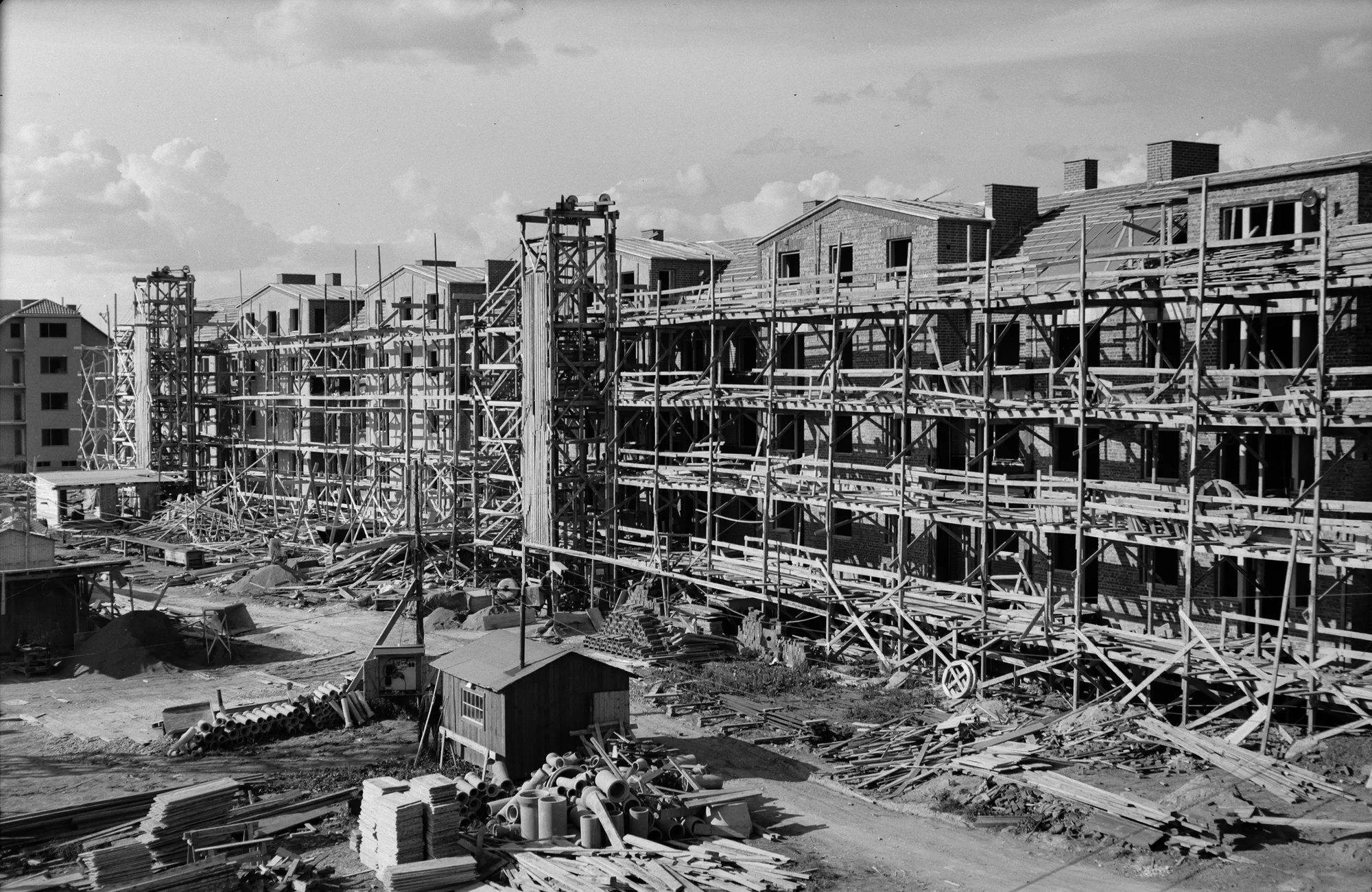
Statistics Sweden's series starts in 1938 and makes the scale understandable.7, 20 The record year is 1970 with 109,843 completed homes, and the low point is 1998 with 11,459.20 In the ten-year period 1965 to 1974, 1,005,578 homes were completed.20 In the last ten years, 2016 to 2025, the figure was 498,218, just under half as many, in a country that has grown by just over 2.5 million inhabitants in the meantime.9, 20, 21 Counted per person, 13.6 homes per 1,000 inhabitants were completed in 1970 and 3.0 per 1,000 in 2025.9, 20, 21
The movement is strong in the short term too. Homes started fell from 67,873 in 2021 to 27,183 in 2024, a fall of 60.0%, and stood at 29,353 in 2025.7, 19
What it costs to build
Costs can be followed in an index of their own. Statistics Sweden's construction cost index for blocks of flats, with 2015 as the base and excluding wage drift and VAT, rose from 99.5 in January 2015 to 155.3 in July 2026, or 56.1% in eleven and a half years.10, 22 The rise is spread unevenly: the materials part rose 74.7% and the wages part 33.6%.10, 22
Nor is the movement even over time. Between January 2022 and January 2023 the total index rose 16.5%. In the seven years before that, from January 2015 to January 2022, it rose 24.3%.22
How applicants experience the process is measured too. Building permits are one of four compulsory areas of authority in the service survey that the Swedish Association of Local Authorities and Regions, SKR, carries out among the municipalities.11 In the survey for 2025, 217 municipalities and 15 joint administrations took part, and the combined result was unchanged at 74 out of 100.11 The share of participating municipalities with a low result fell from 24% in 2012 to 0.5% in 2025.11
What the figures do not say
Granted, started and completed homes measure three different things at three different points in the same project. They should never be added together and rarely be set against each other as a change.
The housing stock is a fourth measure. It was 5,291,493 homes in 2025 against 5,260,876 the year before, a net addition of 30,617.8, 23 That figure is smaller than the 31,359 completed, because the stock also shrinks when homes are demolished or merged.7, 8, 19, 23
And the figure of 3.0 homes per 1,000 inhabitants mixes points in time: the numerator refers to 2025 and the denominator to the population on 31 Dec 2024.9, 21 It is an order of magnitude, not an exact measure.
The direction may also be about to change. In the National Board of Housing, Building and Planning's survey, the municipalities say the change in the law on 1 Dec 2025 is generally expected to bring a shift from checking works in advance to checking them afterwards through supervision.4 That is the municipalities' own assessment, not an outcome.
What to take away
In 2025 the municipalities made 1,036 decisions on detailed plans, 269 planning cases were appealed and plan decisions were revoked in 47 cases.4 The same year, 9,748 building permits for new construction were granted, building started on 29,353 homes and 31,359 were completed.7, 17, 19 What makes this a slow force is the order: seven decisions by different bodies, where only the building permit has a deadline with a penalty, and where property formation has no deadline at all.1, 6 The lead times are in the law, not in the economic cycle. Follow three recurring publications: Statistics Sweden's quarterly figures on homes started and completed, the National Board of Housing, Building and Planning's annual account of planning and building law with detailed plan decisions and the county administrative boards' processing times, and Statistics Sweden's construction cost index every month.4, 7, 10
The next episode is S3:E3 Smart Cities, about what became of the promises and which of them could be measured.
Education, not advice.
The fund
Behind the library stands a fund.
Own The Future is published by AIX. The library is the knowledge; AIX Dynamic is the tool, a systematic securities fund (UCITS) that follows the trend and steps aside when risk rises.
This is marketing. Fund units can both rise and fall in value. Read the key information document (KID) and the prospectus before you invest; you will find them on the fund's page at Avanza.
34 UNITHOLDERS · AS OF 15 SEP 2026The future in your inbox.
The most important things from each area, without the noise and without the hype.
Sources
- The Swedish Parliament (Sveriges riksdag), plan- och bygglagen (2010:900) (the Planning and Building Act). The planning monopoly, the planning strategy in Chapter 3, Section 23, the planning notice in Chapter 5, Section 4, the review period in Chapter 5, Section 18, the building permit deadline in Chapter 9, Section 99, the fee reduction in Chapter 12, Section 8 a and the court's examination in Chapter 13, Section 17.
- The Swedish Parliament (Sveriges riksdag), plan- och byggförordningen (2011:338) (the Planning and Building Ordinance). Supplementary provisions on permits and notification.
- National Board of Housing, Building and Planning (Boverket), PBL kunskapsbanken (the planning and building law knowledge bank), the sections on how the legislation developed, on the detailed plan process and on processing deadlines. The Building Ordinance of 1874, the Town Planning Act of 1907, the Building Act of 1947 and the Building Ordinance of 1960.
- National Board of Housing, Building and Planning (Boverket), Redovisning av tillämpningen av plan- och bygglagstiftningen år 2025 (Account of how planning and building law was applied in 2025). Report 2026:15. The number of detailed plan decisions and appealed planning cases in 2025; these are separate annual volumes. The sample of appeals covers detailed plans and area regulations. The review of revoked plans and the reasons they were revoked. The county administrative boards' processing times for appealed permits and advance notices. The national average of 107 days, the range between the counties and how well the government's four target goals were met.
- Swedish National Courts Administration (Domstolsverket), Domstolsstatistik 2025 (Court statistics 2025). The number of incoming and outstanding cases under the Planning and Building Act in the Land and Environment Courts, and the cases decided by the Land and Environment Court of Appeal and its rate of change compared with the courts of appeal's criminal cases.
- Lantmäteriet (the Swedish mapping, cadastral and land registration authority), genomsnittliga handläggningstider för lantmäteriförrättningar (average processing times for cadastral procedures). The queuing time, the investigation times per type of case and the number of applications per year.
- Statistics Sweden (SCB), Statistikdatabasen, nybyggnad av bostäder (statistical database, new construction of homes). Homes started and completed by quarter and by year, the series from 1938, and building permits granted for new construction.
- Statistics Sweden (SCB), Statistikdatabasen, bostadsbeståndet (statistical database, the housing stock). The number of homes in the stock in 2024 and 2025.
- Statistics Sweden (SCB), Statistikdatabasen, Folkmängden efter ålder och kön (statistical database, population by age and sex). The denominators of 8,081,229 inhabitants in 1970 and 10,587,710 on 31 Dec 2024.
- Statistics Sweden (SCB), Statistikdatabasen, byggkostnadsindex (statistical database, construction cost index). The index for blocks of flats with 2015 as the base, split into materials and wages, January 2015 to July 2026.
- Swedish Association of Local Authorities and Regions (Sveriges Kommuner och Regioner), servicemätningen Insikt (the Insikt service survey) for 2025, published 22 Apr 2026. Participation, the combined result and the trend since 2012. SKR is a membership organisation, not a government agency.
- Upplandsmuseet (Uppland Museum), samlingsposten PS13322 (collection record PS13322) on DigitaltMuseum. The photograph from Tuna backar in 1948, licence Public Domain Mark.
- National Board of Housing, Building and Planning (Boverket), Plan- och bygglagstiftningens utveckling (How planning and building law developed), PBL kunskapsbanken. Supports the Building Ordinance of 1874 and its fire purpose, the Town Planning Act of 1907 with the right to buy up land and the origin of the municipal planning monopoly, the Building Act of 1947 with the municipalities' right to decide where and when plans should be drawn up and the requirement for a plan adopted in advance, and the Building Ordinance of 1960 with a building committee in every municipality.
- Statistics Sweden (SCB), Län och kommuner, regionala indelningar (Counties and municipalities, regional divisions). Supports that Sweden has 21 counties and 290 municipalities.
- The Swedish Parliament (Sveriges riksdag), förvaltningslagen (2017:900) (the Administrative Procedure Act), Section 44. Supports the three-week appeal period that the chart gives for the legal force step.
- The Swedish Parliament (Sveriges riksdag), proposition 2024/25:169, Ett nytt regelverk för bygglov (government bill 2024/25:169, new rules for building permits), 27 May 2025. Supports the shared pool of 45 square metres that replaces the friggebod shed of 15 and the Attefall house of 30, the removal of the special duty to notify, and that the ten-week deadline was previously in Chapter 9, Section 27 and moves to Chapter 9, Section 99.
- Statistics Sweden's statistical database (SCB Statistikdatabasen), Bygglov för nybyggnad, antal och bruttoarea efter region och hustyp, kvartal 1996K1 till 2026K2 (Building permits for new construction, number and gross area by region and type of building, quarters 1996Q1 to 2026Q2). Supports the 9,748 building permits granted in 2025 and how they split into residential buildings, holiday homes and commercial buildings.
- Statistics Sweden's statistical database (SCB Statistikdatabasen), Bygglov för nybyggnad, antal lägenheter i bostadshus och fritidshus efter region och hustyp, kvartal 1996K1 till 2026K2 (Building permits for new construction, number of homes in residential buildings and holiday homes by region and type of building, quarters 1996Q1 to 2026Q2). Supports the 35,663 homes in residential buildings in 2025 and the 1,961 in holiday homes.
- Statistics Sweden's statistical database (SCB Statistikdatabasen), Lägenheter i nybyggda hus efter region och hustyp, kvartal 1975K1 till 2026K2 (Homes in new buildings by region and type of building, quarters 1975Q1 to 2026Q2). Supports homes started, 67,873 in 2021, 27,183 in 2024 and 29,353 in 2025, and the 31,359 completed in 2025.
- Statistics Sweden's statistical database (SCB Statistikdatabasen), Färdigställda lägenheter och rumsenheter i nybyggda hus efter region och hustyp, år 1938 till 2025 (Completed homes and room units in new buildings by region and type of building, years 1938 to 2025). Supports the start of the series in 1938, the peak of 109,843 in 1970, the low of 11,459 in 1998, 1,005,578 in 1965 to 1974 and 498,218 in 2016 to 2025.
- Statistics Sweden's statistical database (SCB Statistikdatabasen), Folkmängden efter ålder och kön, år 1860 till 2024 (Population by age and sex, years 1860 to 2024). Supports the denominators of 8,081,229 inhabitants in 1970 and 10,587,710 on 31 Dec 2024, and the population in 1965 to 1974.
- Statistics Sweden's statistical database (SCB Statistikdatabasen), Byggkostnadsindex för bostäder exkl. löneglidning och moms, 2015=100, efter hustyp och kostnadsslag, månad 2015M01 till 2026M07 (Construction cost index for housing excluding wage drift and VAT, 2015=100, by type of building and type of cost, months 2015M01 to 2026M07). Supports the total index of 99.5 in January 2015 and 155.3 in July 2026, the materials part, the wages part and the rise between January 2022 and January 2023.
- Statistics Sweden's statistical database (SCB Statistikdatabasen), Antal lägenheter efter region och hustyp (inklusive specialbostäder), år 2013 till 2025 (Number of homes by region and type of building, including special housing, years 2013 to 2025). Supports the housing stock of 5,291,493 homes in 2025 and 5,260,876 in 2024.
Links retrieved 9 Sep 2026. Extended on 13 Sep 2026 with the National Board of Housing, Building and Planning's working address for the PBL knowledge bank, the government bill behind the change in the law on 1 Dec 2025, the appeal period in the Administrative Procedure Act, Statistics Sweden's regional divisions and the individual Statistics Sweden tables that carry the figures on building permits, homes started and completed, population, the construction cost index and the housing stock. The figures for homes started and completed in 2025 come from the quarterly series and are provisional; the annual table gives the same 31,359 completed. The National Board of Housing, Building and Planning's website answers 403 to an ordinary request, so report 2026:15 was read through another route.